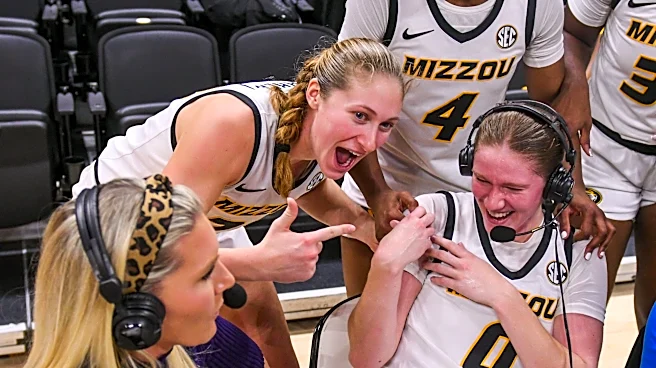







There is a different feeling around Grace Slaughter entering this season.
For the first time since she arrived in Columbia, the possibility of her final game in a Mizzou uniform is no longer some far-off thought. Slaughter is entering her senior season, carrying four years of experience with the Tigers and a goal that has been sitting in the background for much of her college career: finding a way to play professionally.
The WNBA has been part of Slaughter’s aspirations since before Kellie Harper’s
staff took over at Mizzou, and now that possibility is getting closer. The Tigers’ coaching staff has spent the past year helping Slaughter understand what it takes to make that jump, while Slaughter has taken much of that development into her own hands.
“She knows what it takes,” assistant coach Kenzie Kostas said. “She gets in the gym a lot. She’s asking coaches to watch film, to be in the gym with her all the time.”
That work has become one of the defining characteristics of Slaughter’s development. Kostas said the possibility of playing professionally has been a consistent topic between Slaughter and the coaching staff, but it is not something the senior simply talks about. She has made the individual work part of her routine, looking for ways to turn the areas of her game that need improvement into strengths before she gets to the next level.
For Mizzou, that development extends beyond simply making Slaughter a better scorer. She already has the shooting ability that has made her one of the Tigers’ most dangerous offensive players, but the staff wants her to become more complete. Ball handling, finishing with either hand, rebounding and defense have all become important pieces of the process as Slaughter prepares for another season.
“She’s a great shooter, but going off the bounce and using her right hand or her left hand, and different things like that, she’s really embraced,” Kostas said.
That versatility could be one of Slaughter’s biggest assets as she pursues a professional career. Last season, Mizzou used her in different spots across the floor, including at the four and center, forcing opponents to figure out how they wanted to defend her. Bigger defenders could give her a different look, while smaller players created opportunities for her to use her size and shooting ability.

Kostas believes that ability to create matchup problems is an important part of Slaughter’s professional potential. Opponents spent much of last season trying to find answers for her, and Mizzou wants Slaughter to become even better at recognizing those defensive choices and making the right play. Head Coach Kellie Harper entering her second season with Mizzou echoed that statement.
“I think her versatility is huge,” Harper said. “All last year, people had to figure out ways to guard her.”
Harper has seen the evolution of her game and does not seem interested in limiting Slaughter to one position. If anything, the Mizzou coach believes Slaughter’s ability to move around the floor gives the Tigers another weapon while giving Slaughter another opportunity to show professional scouts that she can do more than one thing.
“I want Grace on the court,” Harper said.
That mentality has shaped much of Slaughter’s development under Harper. Instead of worrying about where Slaughter is supposed to play, Mizzou has focused on finding ways to keep her involved and make her difficult to defend. Harper said Slaughter embraced that role last season more than she initially expected, finding success at multiple positions and becoming a tougher matchup because of it.
The coaching staff is also trying to prepare Slaughter for the physical demands that come with professional basketball. Harper pointed to strength and conditioning alongside skill development as important parts of the senior’s progression, with the goal of developing Slaughter into a more complete athlete rather than simply asking her to reproduce the same numbers she has already put up.

“We want to be able to see the improvements this year, maybe be holistically, maybe broader,” Harper said. “How do we develop the entire athlete?”
That approach fits with the way Harper and Kostas describe Slaughter. They see someone who is serious about basketball, willing to put in the extra work and invested in squeezing as much as possible out of her potential final season. Kostas said Slaughter’s buy-in has been evident since the coaching staff arrived, and that commitment has now translated into a leadership role with a roster that features five freshmen and several new faces.
Slaughter is no longer simply one of the young players learning Mizzou’s system. She is one of the veterans expected to help establish it. Alongside Abbey Schreacke and Averi Kroenke, she is part of a small group of players who understand the program from multiple seasons and can help the newcomers navigate the expectations of playing for the Tigers.
That makes this season about more than preparing for the WNBA.
Mizzou wants to get back to the NCAA Tournament after falling short last season, and Harper has made it clear that postseason basketball remains the standard. Slaughter has one more opportunity to help make that happen while simultaneously building the résumé she hopes will carry her beyond Columbia.
Harper has coached tournament teams and understands the difference between being a productive college player and being prepared for the next level. That experience has made professional development an intentional part of Mizzou’s player-development philosophy, not something reserved for the end of a player’s career.
For Slaughter, that means the work happening this season has two purposes. Every new skill can help the Tigers win, while every improvement also gives her another piece to present to professional scouts.
The timeline makes this season different. There are no guarantees about what comes after it, but the opportunity is finally close enough to see clearly. Slaughter has spent four years building her game in Columbia, and now she has one season left to show how much further it can go.
Her final year at Mizzou will inevitably come with plenty of reflection, but Slaughter does not appear to be approaching it simply as a goodbye tour. She is entering it as another challenge, another season of development and another chance to compete for the postseason with a program she has invested so much of herself in.
And when the season eventually ends, the next question will be waiting: Can Grace Slaughter turn everything she has built at Mizzou into a professional career?