







For the second year in a row, the Diamond Heels of UNC will host a former PAC-12 member in a Chapel Hill Super Regional after the Southern California Trojans came out of Texas A&M’s College Station Regional as the #2 seed. UNC will be hoping that this time, they’re more successful than they were a year ago, as they try to make a return to Omaha. Beating the Trojans will be no easy task, though. Here’s a look at the team coming to Chapel Hill this weekend.
Don’t be fooled by the fact that USC weren’t
regional hosts; they had a very good season. They finished the season with a 42-14 record and rank 8th in RPI. The Big Ten is not a great baseball conference, but they ran through everybody in it except for regional hosts UCLA, Nebraska, and Oregon the way that a good team should have, finishing with a 20-10 conference record that included getting swept at UCLA and Nebraska and losing a series at Oregon that featured two extra-innings games — they might have had a notably different season had any of those series been at home. They probably ended up not hosting despite the lofty RPI because metrics like DSR had them lower and they entered the tournament with just one win against Quad 1 opponents, but was more down to lack of opportunity outside of those top 3 teams in their conference than ability — as shown by their two-game sweep of Texas A&M to take the Regional.
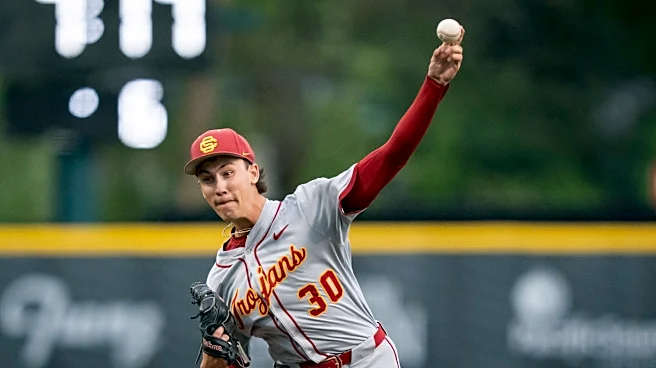
Things start on the mound for USC, where they start arguably the best pitcher in the country in lefty Mason Edwards, who could be a first-round pick in July. Edwards’ 164 strikeouts are first in the country by a margin of 27 — that’s also the difference between #2 and #11. He’s also second in the country with an ERA of 1.85, and first with a batting average against of .153. Again, level of competition has a little bit to do with that, but he’s shown his stuff on the big stages, too — 6 innings of shutout ball against Oregon, and 4 shutout innings on 66 pitches in the Big 10 Tournament against Michigan State. He did get touched up in the 5th inning against Lamar in their first elimination game on Saturday, however. Edwards throws a low-90s fastball with a lot of ride, but the real weapons are his curveball and changeup, which both have insane (60+%, when 40% is well above average) whiff rates and make him hard to square up in any count. If he has a weakness, it’s his zone command — he’s allowed 43 walks in his 92.2 innings, which is slightly elevated compared to everything else he’s done. It’s a bit of a meme around Diamond Heels fans that UNC’s otherwise good lineups get shut down by crafty, off-speed heavy lefties — Edwards is kind of the platonic ideal of such a pitcher and this lineup is going to have to work at-bats deep and limit their swings to try and chase him early in their matchup.
The other Trojan starters are no slouches, either. Saturday starter Grant Govel was also First Team All-Big Ten after recording a 2.93 ERA in 84.2 regular season innings pitched. He’s a less overpowering pitcher than Edwards, with 96 punchouts in 98.1 total innings, but he’s also only walked 15 batters all year and that contributes to his unreal 0.88 WHIP, the best remaining in the tournament. He’s got a little bit more velocity than Edwards, running the heater up to 95 in-game, but like his Friday counterpart, his real weapon is his changeup, and figuring out both his off-speed as a righty and Edwards’ as a lefty has given opposing lineups fits all season. USC has had some adventures finding a consistent third starter, but freshman Diego Velazquez has been pretty good in that role lately, with an ERA right around 4 and a batting average against of .207. When he gets hit, he gets hit hard, but he can eat innings if hitters swing too freely against him.
USC’s bullpen isn’t as star-studded as the starting rotation, but they’ve got a few good options. Relief ace Sax Matson holds opposing batters under .200 and has 54 strikeouts in 42 innings; closer Adam Troy has 12 saves, and the first-year duo of Gavin Lauridsen and sometimes starter Chase Herrell have combined for 100 innings with ERAs under 5. As a team, the Trojans rank 3rd in staff ERA — and while that’s a little inflated due to their competition, they’re also 19th in xFIP and SIERA, stats that attempt to adjust for, among other things, quality of opposition. This is, in short, a very good pitching staff that will rank among the best top-to-bottom that the Heels have faced outside of practice — the only real counterpoint might be Clemson.
On the offensive side, the Trojans were pretty underwhelming in the regular season, with a team slash line of .282/.384/.485, all of which ranked around ~100th in the country. They’ve hit 88 home runs on the year, which is pretty solid and ranks in the nation’s top 40, but that power hasn’t been quite enough to offset below-average contact rates and zone control — they record 1.61 strikeouts for every walk, which ranks worse than 100th, and all of that adds up to a wRC+ (a stat that attempts to condense and normalize offensive effectiveness into one, context-adjusted number) of 106, or 6% above D1 average for a ranking of 79th.
That would be the story here, but USC got white-hot in their regional, though, scoring 55 runs in their 4 wins while batting .390 and hitting 8 home runs. That version of this Trojans team could be really dangerous, especially because they did it with offensive leader Jack Basseer (.341/.441/.629, 27 XBH) playing below his standard. Catcher Isaac Cadena (.305/.436/.524, 16 2B) and DH Augie Lopez (.279/.367/.605, team-leading 19 HR and the Regional MOP) stand out as the big threats after Basseer, while CF Kevin Takeushi fits the classic leadoff profile to a T with a 43:42 K-BB ratio and 14 stolen bases on 15 attempts.
While they haven’t been fantastic with the bat, this is an outstanding defensive lineup. The available defensive metrics for college baseball aren’t the most reliable, but it’s certainly not nothing that USC ranks first in the country in opponent BABIP (batting average on balls in play) and 15th in fielding percentage. They have a strong up-the-middle combination as well as an outstanding defensive third baseman in Kevin Tekeuchi, who has a .976 fielding percentage. Surprisingly to me, they’ve only turned 36 double plays all season — this could be because a lot of their innings are eaten by pitchers who don’t allow a lot of balls in play, or because they’re more sound than they are dynamic, or it could be both; I haven’t watched enough of them to say for sure. But I do know that this is not a team that you cannot expect to give away extra outs to a lineup.
This appears to be a matchup of strength on strength — two teams that have made their hay this season on pitching, defense, and at least enough offense to get by. UNC’s had the more consistent offense all season, ranking in the nation’s top 25 or so in most relevant categories, but USC might just have the caliber of arm barn to limit them — then again, the Trojans haven’t seen a lot of staffs like UNC’s, either. It’s a fascinating head-to-head, and it’s shaping up to be a weekend of good baseball. The Heels are at home and the higher seed, so they’ll be favored to win, but as I said at the opening, this is a serious opponent.