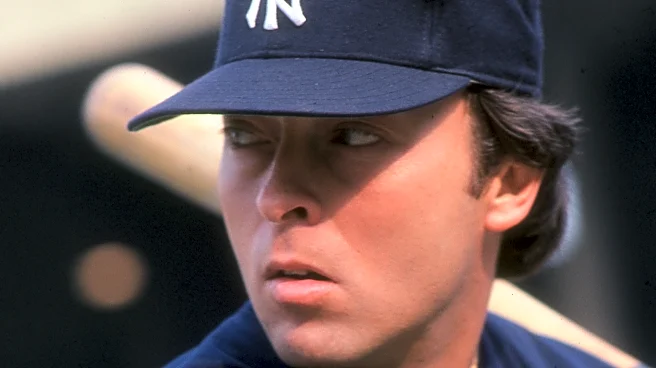

They say first impressions last the longest, but what about first impressions being the only impressions? And if you fail to hit the ground running, it’s on to the next one in line? The Yankees experienced
this with Dave Collins back in 1982. A strange strategic choice of their own volition, Collins had one disappointing season with diminished playing time at the behest of three different managers. It was not a winning environment, and he didn’t play particularly well. By season’s end, the oft-capricious ‘80s Yankees leadership showed their colors and seemingly couldn’t wait to be rid of Collins — quietly committing another error in the transition.
Dave Collins
Signing Date: December 23, 1981
Contract: 3 years, $2,475,000
The 1981 MLB season was a weird one due to a midseason strike that split the season into two “halves”: one from April to mid-June, and another that began when the campaign resumed in mid-August and lasted through early-October. In planning the postseason, the league decided to have the first-place teams in each division for each half meet in a new Division Series to determine the Championship Series clubs. That helped out the Yankees, who would’ve finished fourth in the AL East by full-season record, but it hurt the best regular-season team in the league that year, the Reds. Although no one had a better overall mark than their 66-42 (a 99-win pace over 162), Cincinnati finished second in both halves and missed the playoffs.
As such, there was more general interest around the league than normal for a non-postseason team. It was a mini-resurgence for the “Big Red Machine” that was about to get sent to the shop for good. The Yankees turned out to be aggressive in pilfering players from that team to supplement an offense that would ultimately move forward without Reggie Jackson, as George Steinbrenner opted to let Mr. October depart for the Angels a free agent. On top of Collins, who came over as a free agent, the Yankees had previously filled out their outfield in the 1982-82 offseason by making a trade for Ken Griffey Sr., known at the time as just Ken Griffey.
It was Griffey’s acquisition that, in part, ended up dictating where Collins would, or in this case wouldn’t, play as a Yankee. Before moving to the Bronx, Collins had almost exclusively played the outfield … but the Yankees had one of the best outfields in the bigs with Dave Winfield, Jerry Mumphrey, and the aforementioned Griffey joining the group. Despite being under six feet, first base was really the only plausible spot for Collins as a regular starter—where he had only appeared 10 times in 775 career games, mind you—and even that never came to pass. At the time, Collins touched on playing time assurances as a key factor in his signing with the Yankees, but surely he didn’t have a case to start over any of the Yankees’ top three outfielders.
So who was Dave Collins anyway? Going back to his minor-league days in the early-’70s, the South Dakota native’s strengths had always been speed and contact. Indeed, his last full season before making The Show, he hit .349/.420/.458 with 131 singles and 61 stolen bases across 121 games at High-A Salinas and Double-A El Paso. Similar success followed at Triple-A to start ‘75 and in short order, he was ready. Collins had a 106 OPS+ in his rookie year for the Angels and established his bona fides in a hurry, swiping 24 bags in 93 games to finish second among all rookies in steals despite not debuting until June (easily leading in swipes per game).
Collins’ bat could put him in funks though and he spent his next few years bouncing around from the Halos to the Mariners to those Reds, where after bottoming out with an ugly ‘78, he rebounded quite nicely with a .318/.364/.402, 109 OPS+ campaign in ‘79. The Reds won the NL West and though they were swept by the Pirates in the NLCS, Collins hit .357 with a pair of steals across the three games.

Collins’ bat stayed around that 1979 level (albeit while never topping his career-high five homers with Seattle in ‘77), and he brought his basestealing ability to new heights by swiping a whopping 105 bags across his final two seasons with the Reds, including 79 in ‘80. That 105 figure ranked fifth in the majors from 1980-81 and trailed only Pittsburgh’s Omar Moreno among National Leaguers.
That brings us to the Yankees. In 1981, they won their fourth pennant in six seasons and over that span from 1976-81, they’d easily won more games than anyone in baseball with 548 — a dozen ahead of the second-place Orioles and 21 more than the third-place Reds. But that wasn’t enough for the insatiable Steinbrenner. Since winning back-to-back titles in 1977-78, the Yankees had missed the playoffs in ‘79, got swept by the Royals in the ‘80 ALCS, and then upon returning to the Fall Classic in ‘81, they blew a 2-0 series lead and dropped four in a row, including the Game 6 clincher at Yankee Stadium.
All the other recent success notwithstanding, Steinbrenner decided that the Yankees were too reliant on power needed to change their approach on offense. Most notably, that meant swapping out a slugger like Reggie for a speed-focused player like Collins — never mind that this was especially ill-considered from the start since again, they never had a clear opening on the field for Collins. Thus, the dreaded “‘Bronx Burners” was born.

Despite the fact that he was then signed to a three-year deal and promised a significant role, the Yankees only started Collins in 85 games that year, as the left-handed hitter struggled heavily—Collins also wasn’t shy about voicing his displeasure in a diminished role. Had the former Red played at his best level as a hitter with a .299 average across his last three seasons in Cincinnati, the Yankees had room to give him regular at-bats at first, if for nothing else, due to a lack of options since John Mayberry and others were also quite poor in 1982. However, given Collins’ own woes, there was no incentive to make a big push for him as an everyday bat.
With a full outfield and a bat that didn’t even come close to justifying regular starts at first, Collins moved around and lost playing time as the year went on, especially after the Yankees acquired Lee Mazzilli in early August and he hit well enough to cover the cold corner. As for the Yanks as a team? They couldn’t live up to the promise of 1981 and finished the ‘82 campaign with a losing record, burning their way through multiple managerial changes. Bob Lemon had taken over in midseason ‘81 but his second tenure ended at just 14 games into ‘82 at 6-8 (he had, of course, been promised that he’d manage the full campaign). The man he had replaced the previous year, expert scout Gene Michael, stepped right back into the role and went 44-42 before the ever-implacable Steinbrenner canned him again. Longtime advisor Clyde King skippered the final 62 games, going 29-33; the Yanks finished in fifth.*
*It’s almost as though the actual manager wasn’t the problem!
Regrettably for Collins, the most memorable aspect of his Yankee tenure is not even the negative impact of his dismal ‘82 campaign, since that team had bigger problems. The first baseman/outfielder was signed to a three-year deal, which meant that moving on from him required a trade, and boy, was it a bad one.
In order to acquire reliever Dale Murray, who was coming off one of his best seasons with the Blue Jays, the Yankees had to build a package around Collins, which meant shipping out a couple of other players: Mike Morgan, a starter with pedestrian numbers in 1982, and a prospect by the name of Fred McGriff, a future Hall of Famer and a first baseman of a quality the Yankees farm hasn’t produced since Don Mattingly. Mattingly, of course, had only just debuted in ‘82 and had his full prime ahead of him, somewhat easing the blow of the McGriff loss — though the ascent of the “Crime Dog” did come as Mattingly began to battle serious injuries. Back to the Collins trade though, it’s worth noting that Tom Dodd also came over to the Bronx in that deal but never reached the majors in pinstripes. For Collins’ part, he got his career back on track for at least a little while in Toronto, so honestly, good for him.
While one could lament Morgan’s departure, as he also became a pretty notable pitcher, his true success didn’t come until years later with the Dodgers, multiple teams removed from his Blue Jays period. It’s the McGriff loss that truly stinks, all in large part because the Yankees decided they needed more speed and added a player they didn’t really have room for. The Collins contract was a mistake in the first place, and it was only compounded by the trade they felt they had to make to (in part) remedy the error. From start to finish, Collins was an unfortunate symbol of everything that Steinbrenner could do wrong when he fancied himself too much of a baseball expert.
See more of the “50 Most Notable Yankees Free Agent Signings in 50 Years” series here.