

The Portland Trail Blazers are stirring up controversy across the NBA on a seemingly weekly basis in the Summer of 2026. They let go of long-time (and nationally-famous) play-by-play man Kevin Calabro as part of wider broadcasting team cuts. They’re battling with government entities over funding for arena renovations. Multiple national reports—normally a Trail-Blazers-free-zone—have Portland as the talk of NBA Summer League for all the wrong reasons.
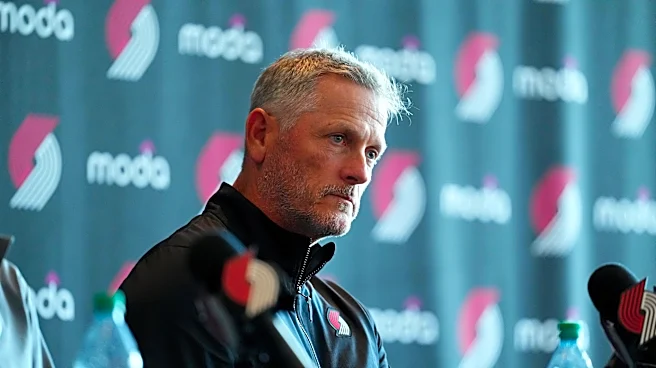
Amid the hubbub, new Trail Blazers owner Tom Dundon
is getting his name dragged through the mud, at least in several quarters. That includes this brief, but pointed, submission to the Blazer’s Edge Mailbag, part of a wider trend of sentiment that seems to be spreading. Take a look.
Dave,
WT[heck] is wrong with Dundon? Is he stupid or is he determined to make us the joke of the NBA? It’s been three months and I’m already sick of the guy. This isn’t the Blazers I know. Bottom line how can one guy mess up so much that fast?
Jerry
This isn’t stupidity at all. It’s just a clash of culture and priorities.
Pretty much everything the Blazers are doing right now fits the Private Equity model of taking over a company. You slash as much from the organization and production process as humanly possible. That’s how you save money, not by producing more or a better product, but by cutting costs in how the same product is made. Then you cover it in two ways:
- Get the people who still work for you to work harder and longer, doing more jobs for less pay.
- Cover it with a barrage of advertising, glitz, and emphasis on the “customer experience” disguising the fact that the wheels are wobbling on the actual production process.
We’re seeing Step 1 take place right now. We’ll see Step 2 start to roll out as the season approaches. And woe be to the ticket agent who doesn’t close enough sales.
This approach is effective, mercenary, and designed to produce plenty of short-term gains. It’s the smart thing for investment-oriented business leaders to do…the opposite of stupid, from their point of view.
That said, there are several potential problems when applied to a professional NBA team.
One obvious one is that the process doesn’t always—maybe doesn’t often—produce sustainable gains for the company. Private Equity takeover can easily become a prelude to bankruptcy. Execs bleed every cent they can out of the operating process, run up credit to the max to stay afloat, then file in court when they can’t borrow any more.
But what’s the NBA equivalent of bankruptcy? A franchise can’t just cease to exist. They can spend years as a bottom-feeder, I guess. Or they can move and start over, the more direct analogy. It’s all the same to the executives at the top. It kinda sucks for fans, though.
Second, this approach usually has negative implications for product quality. Cutting corners on staff gets accompanied by costs savings on equipment, infrastructure, ingredients. The burger that was once 1/3 pound becomes 1/4 pound or less. The artisanal buns get swapped out for the mass-produced, Sysco Truck variety, now with half the sesame seeds. If you think that burger just isn’t the same as it was when you were a kid, you’re probably right. It’s been flayed within an inch of its profit-marginal life and then infused with 46% soy byproduct.
The effect is even worse when Private Equity process meets luxury brand. That’s almost guaranteed to be a disaster, because high-end items sell on two things: quality of the product and the aura surrounding it. Reducing costs impacts the quality. The impression of penny-pinching, salary-cutting, and unhappy/stressed/overburdened staff works against the luxury name. Pretty soon you have Rolexes selling in Wal-Mart and the mystique is gone. Nobody wants them anymore. It’s literally the antithesis of everything they once stood for.
This is a big source of conflict (and controversy) between Dundon and the NBA culture. Above all things, this league is elite. Back when Summer League meant something, before it became just another product, it used to be The Place To Be for NBA glitterati. You only had to experience two seconds of Carmelo Anthony or Baron Davis walking in the building before you got the message. The stance. The stride. The transportation. The clothes and jewelry. The hushed overtones of bystanders and fans flocking around. The rub other NBA officials and employees got from a dap or a handshake. The NBA is THE League of Leagues, the pinnacle, the dream. Everything associated with it is meant to bolster that image. You cannot be anywhere near the action without absorbing that lesson and how much participants are invested in it.
So what happens when designer fashion meets Dollar Store business sensibilities? You better bury that approach deep, in the farthest recesses of the company, otherwise people are going to recoil. Dreams are not purchased with coupons.
You do not turn to Mr. Star Player and say, “Here’s your Honda Civic Uber to the airport. You’re flying Southwest today. It saved us money!” Nor can you do so to the people around that star player, lest the facade drop. Nor can you replace wood-paneled walls with Sherwin Williams, nor Gatorade with hand-mixed generic goo powder, nor the world-class weight room with Temu fitness equipment. This is not what participants signed up for.
If you do these things, two results will follow.
First, everyone who believes they’re entitled to more based on their production and reputation will stay away from you. You’ll be known as the cheap outlet, the last refuge for people who have no other choice, the clearance bin at the back of the store. It’s worth noting that the Trail Blazers spent decades trying to avoid this impression, struggling to stand out among relatively-obscure, small-market franchises, likely because their leaders knew that it’s all too easy to get painted with that brush and that, once you do, it’s hard to get the stain out. It’s also worth noting that when Paul Allen, the last dedicated and intentional owner the franchise had, passed away, one of the first things to go was the distinction. The Blazers became just another nondescript team in a glut of them. They haven’t recovered yet.
Second, when you start becoming known for penny-pinching all the other luxury brands will say, “JEEEZZZZZZZ…ugh!” and do their best to distance themselves from you (publicly, at least). The banner will read, “This is not the way the NBA works.” We’re hearing about this happening behind the scenes as we speak.
In the midst of this, Mr. Dundon appears to be drawing a bright, if fine, line between the players and everyone else in the organization. He’s trying to strike a tricky balance, maintaining the luxury aura with the guys on the court while cutting costs everywhere outside of that tight circle, saying that the guys in sneakers are all that matters.
The problem is, the league is interconnected. Players are the center of the sport, but the people around them are more that noticeable. The NBA is a small, relatively-insular fraternity/sorority. Getting in is HARD! But once you’re past the gate, everybody knows everybody, at least by association. When you offer a uniquely-insecure, low-paid head coaching contract, people notice that. When you lowball Kevin Calabro—a famous, talented, and well-respected national broadcaster—people see that too.
The Blazers didn’t even come from a position of strength in the Calabro negotiations. “We don’t like you anymore, Kevin. We’re going a different direction.” You could say that’s wacko given Calabro’s talent, but it’s a valid, integral stance, the organization taking a strong stand. Instead it was, “We don’t want to pay you much, Kevin. Here’s our bargain-basement offer.” That looks like you don’t have the money to be a first-class franchise or you just don’t care to. People inside NBA circles absolutely saw that and absolutely got that message.
Head Coaches and lead broadcasters aren’t players, but they’re literally the most visible non-player members of the franchise. How you treat them matters, at least optically. And optics are everything when you’re talking luxury. If you think NBA stars and world-class professionals in other positions are going to be happy about the idea of coming to an organization with the reputation of being cheap and second-class, that impression is likely to be corrected soon.
To be clear, I think you can do some of the things Mr. Dundon is doing. You just can’t do them as loudly, obviously, and with the lack of optical awareness that he’s evidencing right now without taking a big reputation hit that’s not just going to impact you, but the franchise you’re trying to improve the status of.
That’s where the rubber meets the road for me. I may not agree with all of Mr. Dundon’s tactics and aims, but that hardly matters. He’s the owner and I’m not. He gets to decide those things. But the way in which he’s doing them? It’s hard to see that as anything but counterproductive. Can you tell a slightly off-color joke at a party? Sure. I wouldn’t, myself, but hey. Can you burst in the door and yell that same joke at the top of your lungs with a voice so brassy and loud that nobody can hear anything but you in that moment? Dude, I don’t think you understand what parties exist for.
I suspect that, sooner or later, if this relationship is going to succeed, the processes of Tom Dundon and the brands of the NBA and Trail Blazers need to find a middle ground. Right now the clash is obvious, vocal, and turned up to 11. He might want to come across as a maverick or a business genius who doesn’t care about what people think of him. He’s actually coming across as a guy who stepped into a luxury watch store never having worn anything north of a Timex, yet somehow knowing everything about the industry. Innovate all you want, but the first thing you’re going to have to change is that impression if you want credit from anybody. You can’t plunk a payday loan outlet in the middle of Rodeo Drive and call it good. The business isn’t wrong, but the time, place, and instincts sure are. Whatever short-term gains you make will likely be offset by longer-term losses. More to the point, everybody—including the customers and the neighbors—is going to be miserable in the meantime.
Thanks for the question! You can always send yours to blazersub@gmail.com and we’ll try to answer as many as possible!