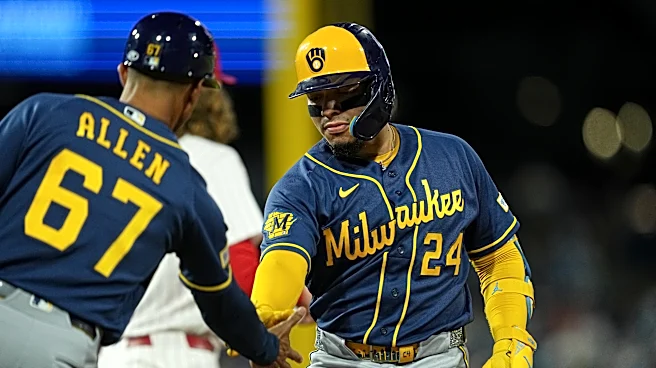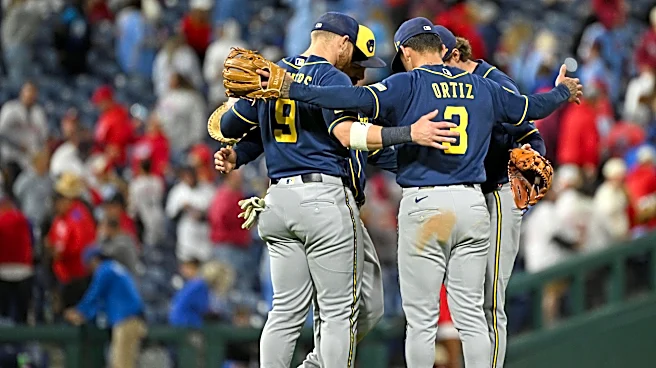


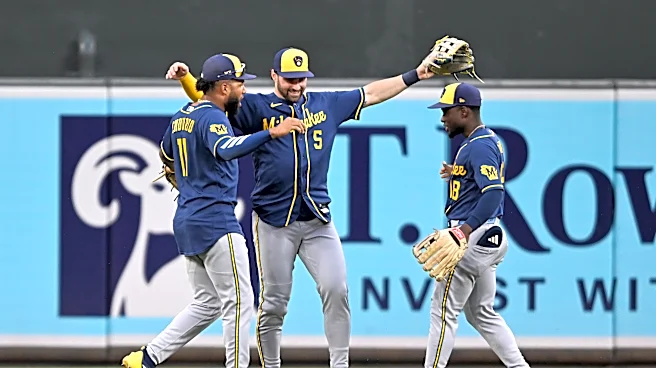
There are just four games left in the regular season, and the Brewers have a first-round bye locked up. While the pitching situation is more chaotic right now, the position player situation is much more straight-forward. Let’s take a look at how they compare to last year’s postseason players.
For this post, the assumption is that the 14 current position players will also be the 14 position players on the postseason roster. It’s strongly likely that 13 of the 14 players will be on the roster. Bo Naylor
is one player that the Brewers could pivot on. They have barely used him since the start of September, with just a couple rare starts and late game substitutions so far.
The Brewers could pivot and grab someone else from the minors, but the only three position players on the 40-man roster currently are Akil Baddoo, Tyler Black, and Brandon Lockridge. There is also an open 40-man spot, if they choose to use it. However, this is discussing the 14th position player on the roster, so whoever they choose to go with likely won’t have much of an impact.
(Statistics are from FanGraphs are are through Tuesday’s games.)
Catcher
- 2025: William Contreras (150 G, .260/.355/.399, 114 wRC+, 17 HR, 76 RBI, 3.7 fWAR, 3.8 bWAR)
- 2026: William Contreras (143 G, .272/.341/.422, 110 wRC+, 18 HR, 91 RBI, 3.1 fWAR, 3.0 bWAR)
Last season, Contreras spent most of the year dealing with a broken left middle finger. It affected his numbers at the plate, but despite that, he still put together a strong season. This season, even though he’s healthy, the overall numbers are not much different. He has seen a rise in his batting average and slugging percentage, though his on-base percentage is lower. His WAR is a little lower, but overall, the numbers are about the same. The one big addition to this season has been the ABS challenge system, which has been a point of difficulty for Contreras all year. We can’t say how he would have handled it last season, so that won’t be a factor here. Overall, Contreras is a very similar player to last year, so there’s no real advantage to either version here.
Advantage: Even
First Baseman
- 2025: Jake Bauers (86 G, .235/.353/.399, 115 wRC+, 7 HR, 28 RBI, 0.8 fWAR, 0.6 bWAR)
- 2026: Jake Bauers (139 G, .269/.396/.495, 147 wRC+, 26 HR, 90 RBI, 3.6 fWAR, 3.1 bWAR)
When looking at the overall numbers, this looks like an easy comparison. Bauers this season has been much better than he was last year. However, it’s important to remember that Bauers’ rise began late last season. He played so well in September (21 G, .360/.458/.560, 188 wRC+) that he took full control of the first base job, and basically forced Rhys Hoskins off the roster once he returned from injury. This year, he’s just continued that play and set himself up for a big contract this offseason. It’s still an advantage for Bauers this year, but it’s closer than the numbers would suggest.
Advantage: 2026 Jake Bauers
Second Baseman
- 2025: Brice Turang (156 G, .288/.359/.435, 124 wRC+, 18 HR, 81 RBI, 24 SB, 4.4 fWAR, 5.5 bWAR)
- 2026: Brice Turang (146 G, .264/.364/.437, 124 wRC+, 20 HR, 94 RBI, 19 SB, 5.3 fWAR, 7.2 bWAR)
The rise of Turang continues in 2026. While the offensive numbers are very similar, it’s his defense that is the big change. Last year, he was closer to neutral on defense. This year, he’s made a resurgence, and his defense has caught up to where it should be. He’s jumped from 7 DRS (Defensive Runs Saved) in 2025 to 22 DRS in 2026, and his Fielding Run Value is up from 0 FRV to 13 FRV. This postseason, they will still have the same strong player on offense in Turang but will also get the better defense from past seasons.
Advantage: 2026 Brice Turang
Third Baseman
- 2025: Caleb Durbin (136 G, .256/.334/.387, 105 wRC+, 11 HR, 53 RBI, 18 SB, 2.7 fWAR, 2.7 bWAR)
- 2026: Joey Ortiz (131 G, .267/.326/.403, 102 wRC+, 9 HR, 46 RBI, 9 SB, 2.7 fWAR, 2.5 bWAR)
Ortiz has helped stabilize the third base position, which was in disarray at the start of the season. Luis Rengifo barely provided any positive value before he was released. David Hamilton was OK at the position, but he was just holding it down. Meanwhile, Ortiz has really stepped it up in the last couple months. Since the All-Star break, he’s batting .327/.377/.544 with a 151 wRC+. That’s in addition to 7 DRS in just 372 innings at third base. The overall numbers would suggest that these two are near even over the course of the season. However, with Ortiz’s late-season resurgence and defensive prowess, I’d give a slight edge to him here.
Advantage: 2026 Joey Ortiz
Shortstop
- 2025: Joey Ortiz (149 G, .230/.276/.317, 67 wRC+, 7 HR, 45 RBI, 14 SB, 1.4 fWAR, 0.2 bWAR)
- 2026: Cooper Pratt (70 G, .276/.344/.364, 98 wRC+, 3 HR, 33 RBI, 17 SB, 1.4 fWAR, 1.6 bWAR)
While Ortiz has seen a boost at third base this year, it’s hard to think about his performance last season. He provided overall positive value, but his bat in the lineup was a regular problem. This year, Pratt has matched Ortiz’s production in less than half the games. It’s an impressive rookie season from Pratt, and he’s going to provide a boost at shortstop over what the Brewers had last season.
Advantage: 2026 Cooper Pratt
Left Fielder
- 2025: Jackson Chourio (131 G, .270/.308/.463, 112 wRC+, 21 HR, 78 RBI, 21 SB, 3.0 fWAR, 2.2 bWAR)
- 2026: Jackson Chourio (122 G, .283/.343/.478, 125 wRC+, 24 HR, 70 RBI, 22 SB, 4.1 fWAR, 4.4 bWAR)
Realistically, you couldn’t go wrong with either choice here. Chourio last year was a great player. This year, he’s turned into a star. He’s boosted his numbers on both offense and defense. If he hadn’t missed a month of the season due to injury, his stats would be even better. Not only that, but he is healthy heading into this postseason, compared to last season when he was dealing with a hamstring injury. I’m looking forward to seeing what this year’s Chourio can do in the postseason.
Advantage: 2026 Jackson Chourio
Center Fielder
- 2025: Blake Perkins (54 G, .226/.298/.348, 83 wRC+, 3 HR, 19 RBI, 7 SB, 0.4 fWAR, 0.3 bWAR)
- 2026: Garrett Mitchell (140 G, .266/.358/.426, 118 wRC+, 11 HR, 65 RBI, 14 SB, 3.2 fWAR, 3.6 bWAR)
Entering this season, I didn’t have much faith in Mitchell. It wasn’t the talent, it was the injury history. Losing so many games to injury had soured his outlook. However, he’s proven me wrong this season, along with many other people. Mitchell has remained healthy and has shown what he’s capable of. Not only are his numbers on offense significantly better, but he’s matched what Perkins was able to do last season. It’s a much more complete package overall, and it’s a huge step up from where they were last postseason.
Advantage: 2026 Garrett Mitchell
Right Fielder
- 2025: Sal Frelick (142 G, .288/.351/.405, 114 wRC+, 12 HR, 63 RBI, 19 SB, 3.6 fWAR, 2.9 bWAR)
- 2026: Luis Lara (58 G, .251/.317/.335, 83 wRC+, 1 HR, 25 RBI, 3 SB, 0.1 fWAR, 1.1 bWAR)
This one is a bit hard to pinpoint who is the primary starter right now, as both Lara and Frelick have been splitting time in right field. For now, I’ll go with Lara, who appears to be getting a bigger share of the starts there lately. Either way, the result is the same on this one. While Lara has shown a lot of promise so far, the overall numbers don’t back it up yet. Meanwhile, Frelick was an incredibly solid right fielder last season. Lara has the ability to eventually be better than Frelick, but for now, Frelick last season was the better right fielder.
Advantage: 2025 Sal Frelick
Designated Hitter
- 2025: Christian Yelich (150 G, .264/.343/.452, 122 wRC+, 29 HR, 103 RBI, 16 SB, 2.5 fWAR, 3.0 bWAR)
- 2026: Christian Yelich (114 G, .235/.313/.372, 90 wRC+, 11 HR, 57 RBI, 11 SB, 0.0 fWAR, 0.2 bWAR)
There’s not much to say for Yelich, other than it’s been a disappointing season for him. Across the board, his numbers have been down this season. He’s barely been above replacement level, and he’s been trending the wrong way. Since the All-Star break, he’s batting .225/.295/.369 with an 83 wRC+. According to FanGraphs, he’s been worth 0.0 fWAR, which is right at replacement level (though he did hit a home run on Wednesday night). It’s still not a question of if he’ll be on the postseason roster — he definitely will be on it. However, the Brewers may have to think carefully about how they want to use the DH spot this postseason.
Advantage: 2025 Christian Yelich
Backup Infielder
- 2025: Andruw Monasterio (102 G, .270/.319/.437, 111 wRC+, 4 HR, 16 RBI, 2 SB, 0.7 fWAR, 0.7 bWAR)
- 2026: David Hamilton (117 G, .241/.308/.329, 80 wRC+, 4 HR, 26 RBI, 30 SB, 0.2 fWAR, 1.7 bWAR)
Both players have been the infield utility player throughout the season. They bounced between second base, third base, and shortstop all year. Hamilton has been used more regularly this season. He was a regular starter earlier in the year, but is now behind Turang, Pratt, and Ortiz on the depth chart. He still can be a great bench player this postseason, particularly as a late game pinch-runner. He can also move runners up effectively and provides decent defense. He shouldn’t be the primary player at any position, but as a backup and overall utility guy, he has a lot of value. Monasterio had a better profile on offense, though Hamilton offers a lot of flexibility as a pinch-hitter, pinch-runner, or late inning defensive replacement. That’s good for the roster in the postseason.
Advantage: Even
Backup First Baseman
- 2025: Andrew Vaughn (64 G with Brewers, .308/.375/.493, 142 wRC+, 9 HR, 46 RBI, 1.9 fWAR, 1.3 bWAR)
- 2026: Andrew Vaughn (104 G, .306/.390/.444, 134 wRC+, 6 HR, 43 RBI, 1.6 fWAR, 1.6 bWAR)
It doesn’t feel fair to call Vaughn the backup first baseman here. He’s been getting a good amount of play time throughout the season. However, compared to Bauers, he is the clear backup. That’s still a good player to have as a backup, though. While the power numbers have been down this year, his on-base percentage is up. He’s been just as valuable this season, though part of that could be due to being more selective with his starts. He will be valuable on the postseason roster, and if he could get some extra starts while Bauers covers DH or right field, that will help the team. Overall, it’s about even with what he provided last postseason.
Advantage: Even
Backup Catcher
- 2025: Danny Jansen (25 G with Brewers, .254/.346/.433, 120 wRC+, 3 HR, 7 RBI, 0.4 fWAR, 0.7 bWAR)
- 2026: Gary Sánchez (84 G, .209/.352/.419, 117 wRC+, 11 HR, 36 RBI, 0.8 fWAR, 0.5 bWAR) & Bo Naylor
Last postseason, Jansen had next to no impact on the postseason roster. Contreras started every game and Jansen did not get a postseason at-bat. That will likely be a different story this postseason, especially if the Brewers carry three catchers as they are right now. Having two backup catchers gives the Brewers flexibility to use Contreras at DH or pinch-run for a catcher late. They could also choose to use Sánchez in either of those roles. Naylor will just be an emergency catcher and will see very little play time. It’s still a better situation than they had at catcher last postseason.
Advantage: 2026 Gary Sánchez & Bo Naylor
Backup Outfielder
- 2025: Isaac Collins & Brandon Lockridge
- Collins (130 G, .263/.368/.411, 123 wRC+, 9 HR, 54 RBI, 16 SB, 2.6 fWAR, 2.0 bWAR)
- Lockridge (20 G with Brewers, .261/.308/.370, 86 wRC+, 0 HR, 6 RBI, 2 SB, 0.2 fWAR, 0.4 bWAR)
- 2026: Sal Frelick (107 G, .234/.297/.322, 73 wRC+, 4 HR, 39 RBI, 7 SB, -0.4 fWAR, -0.6 bWAR)
While it looks like Collins has the big advantage here, he was not much of a factor in the postseason. His numbers in September dropped to .191/.345/.319 with a 97 wRC+. He only received 10 plate appearances over six games between the NLDS and NLCS, and was relegated to a bench role. Lockridge was in a similar role, only playing in four games and getting two plate appearances. That still is better than Frelick’s numbers to finish up this season. The backup outfielder should hopefully have a smaller role in the postseason, but last year’s duo has the advantage.
Advantage: 2025 Isaac Collins & Brandon Lockridge