
In the long lineage of beloved Yankees, the predominant image is of the stoic, poised figure who excelled under New York’s bright lights and handled the media like a professional. Joe DiMaggio. Derek Jeter.
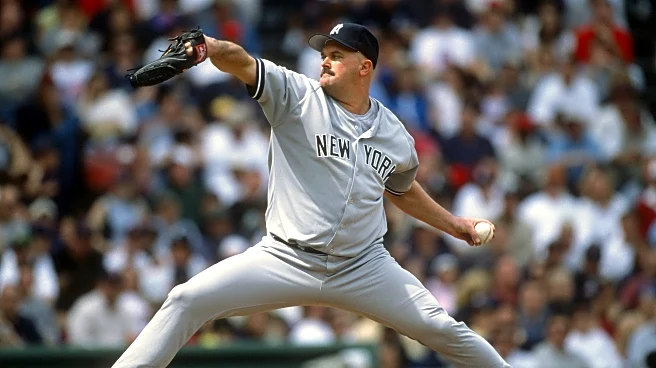
Aaron Judge. But there is also a storied history bubbling under the surface of fan favorites who won over the Bronx faithful despite (or, perhaps, because of) their rowdy and mercurial ways. Babe Ruth. Billy Martin. Joe Pepitone. During the Yankees’ dynasty run of the 1990s, no player embodied this visage of the Yankee anti-hero better than David “Boomer” Wells.
David Wells
Signing Date: December 24, 1996
Contract: Three years, $13.5 million
Wells grew up in San Diego, raised by his mother Eugenia “Attitude Annie” Wells and her boyfriend, “Crazy Charlie” Mendez, members of the local Hells Angels Motorcycle Club. The crew of bikers would come to young David’s Little League games, incentivizing his performance by paying him for each strikeout and win. “I could pull in $100 a game, and nobody dared screw around with me,” he would later say. “Try, and I’d say, ‘I’ll get my mom’s boyfriend on you.’”
Taken by the Blue Jays in the second round of the 1982 MLB Draft, Wells spent three years in the minors before a UCL injury ended his 1984 season. The southpaw became just the third pitcher to undergo Tommy John surgery after John himself and future pitching guru Brent Strom. He returned in 1986 and was in the bigs with Toronto by the next season. He would spend parts of six seasons as a Blue Jay to start his career, establishing himself first as a reliever and then as a swingman, a stretch that included 4.1 scoreless relief innings in the 1992 World Series as Wells earned his first ring. He also established a reputation for unpredictability and debauchery that would follow him throughout his career, leading Toronto to release the promising 29-year-old the offseason after their championship. “We did everything we could to control him,” Blue Jays GM Gord Ash stated sheepishly in a 2000 profile on Wells.
Boomer signed with Detroit the following season and, finally a full-time starter, came into his own. His run with the Tigers culminated in 1995, when he started the year 10-3 with a 3.04 ERA en route to his first All-Star selection. It was here that Wells had his first intersection with Yankees history. GM Gene Michael was reportedly bullish on the starter as his team pursued its first playoff berth since 1981, considering parting with a package that would have netted the Tigers Mariano Rivera for Wells’ services. Michael ultimately declined to move his future Hall of Famer, leading the Tigers to ship Wells instead to the Reds at the deadline. He spent the rest of the season there before ending up on the trading block once again during the offseason, this time ending up with the Orioles. After one year in Baltimore, he became a free agent at the age of 34.
That’s when the Yankees came calling. The defending champs were looking to add pitching with Jimmy Key and John Wetteland heading to free agency and Kenny Rogers and Dwight Gooden facing injury concerns. George Steinbrenner, now back in control of his club after a three-year ban, pursued several options, including Roger Clemens and Key. After Clemens and Key signed with division rivals Toronto and Baltimore respectively, Wells was the last impact arm left on the market. He reportedly made a strong impression on the Yankees owner by demonstrating his passion for the team — and, in particular, Babe Ruth — when the two met. Boomer signed a three-year, $13.5 million contract to join New York. “The opportunity to achieve a childhood dream is what this is about for me,” Wells told The New York Times’ Jack Curry after the signing. “I grew up as a Yankee fan in San Diego. They’re always the team I followed in the American League. This is something I’ve always wanted.”
Wells got off to a rocky start for his new team, breaking his hand punching a wall in January of 1997. That didn’t stop him from putting together a strong debut campaign in pinstripes, going 16-10 with a 4.21 ERA in 32 starts. One of those starts garnered more attention than the rest, when Wells wore a game-used Ruth cap he’d purchased for $35,000 during a June outing. Joe Torre made his starter remove the cap after the first inning, the first sign of what would be a rocky relationship between the two. “I made him take it off,” the Yankees manager said after the game. “I didn’t know he had it on until he was out in the middle of the diamond. It wasn’t the standard uniform.”

“I love what he did for the game,” Wells said of his adoration of Ruth. “He saved it. He gave everyone that’s playing the game today a chance. I love the way he lived, too. He was a wild man, so we have similar personalities. I wish I could come back reincarnated as Babe Ruth.”
When Wells struggled down the stretch he began to show more of the irascibility that had played a role in the nomadic start to his career. He got into a shouting match with Steinbrenner, during which the similarly hot-headed owner reportedly said, “I’d trade you but nobody wants your fat behind.” Before Game 3 of the ALDS, Bob Watson gave his take on the pros and cons of having Wells in his rotation. “He’s his own worst enemy,” the Yankees GM told the press. “On ability, he’s one of the best three or four left-handers in baseball. You know you’re going to get effort out of him — you just don’t know if that effort is going to last two innings or eight.”
Later that day, Wells gave an admirable effort through nine, tossing a complete-game victory in his sole start against Cleveland. He held a stacked lineup that included Manny Ramirez, Matt Williams, and David Justice to just one run while staking the Yankees to a 2-1 ALDS lead. Back-to-back losses would doom the Yanks that year, but Wells continued to build his playoff bona fides.
But it was the next season that would be the pinnacle of his career. Wells went 18-4 with a 3.49 ERA and MLB-best 163:29 strikeout-to-walk ratio, finishing third in Cy Young voting while helping his team to a then-record 114 regular-season wins. The season hinged on a month of May that would become the stuff of legend. After his offense staked him to a 9-0 lead early in an outing against the Rangers, Wells unraveled, allowing seven runs before Torre pulled him in the third. The starter threw up his hands and refused to acknowledge his manager during the pitching change. After the game, Torre torched his starter in the press. “I just didn’t like the way Wells was walking around on the mound. He was kicking at it and going slow and just really had bad body language,” he told the media. “I thought he had good stuff, I think he just ran out of gas. Maybe he’s not in shape, I don’t know.”
Whether due to this public chiding or not, the proud Wells turned the corner quickly. Two starts later, he showed up to Yankee Stadium operating on one hour of sleep on his day to pitch. He later described himself as “half-drunk, with bloodshot eyes, monster breath, and a raging, skull-rattling hangover” on that day. It didn’t stop him from delivering one of the greatest performances in Yankees history, the team’s second perfect game.
As Daily News writer Joe Trimble famously wrote about the man who twirled the first, Don Larsen (coincidentally a fellow Point Loma High School alum), the imperfect man had pitched a perfect game. Wells gave credit to the owner with whom he’d nearly come to fisticuffs the year prior. “If it wasn’t for him signing me, this wouldn’t have happened,” he said while icing down after the game. “I guess you got to give him credit everywhere. I thanked him for giving me the opportunity. He made my dream come true, being in pinstripes. I guess he didn’t know what he was in store for when he signed me.”
After his masterful season, Wells continued to pitch like an ace in the playoffs, shutting out the Rangers for eight innings in Game 1 of the ALDS and winning both of his ALCS starts along with series MVP honors.
While he was less effective in his sole World Series appearance, allowing five runs in seven innings, he earned his fourth victory of the postseason thanks to a big rally as the Yankees swept the series.
Wells’ future looked bright in the Bronx. But it ended in shocking fashion on the day he reported to Yankees camp in 1999, when the burly lefty was shipped to Toronto as part of a package to acquire Roger Clemens. Wells was caught off guard by the transaction. “I’m a little emotional right now,” he said to reporters on the day of the move while declining to answer questions. “Just give me a couple of days. It’s a little tough to take.”
The move reverberated throughout the organization that had grown fond of the iconoclastic hurler. “We had a very emotional meeting and that’s all I’m saying because I like David a lot,” Steinbrenner said after talking with Wells. “My door is always open to David.” “We lost a lot of character today,” David Cone said, Wells’ rotation-mate and drinking buddy. “There are probably a few establishments in Manhattan that will be down in the dumps today when they hear the news. There may be some bars going out of the business.”
Wells spent two seasons back with the team that drafted him, pitching exceptionally well before he was traded to the White Sox. He looked injured and diminished that season and, hitting free agency before what would be his age-39 season, availed himself of Steinbrenner’s offer to keep the door open for a return, meeting him for lunch in Tampa and negotiating directly. The Boss was effusive in his praise for Wells upon the signing, which saw the lefty go back on his handshake agreement to join the same Diamondbacks team that had just ended the Yankees’ dynasty. “David Wells is a winner and he belongs in pinstripes,” Steinbrenner said in a statement. “People say we’re going out on a limb, but we’ll see. We’re betting on The Boomer.”
Wells found himself in a bit of hot water early on in his second Yankees tenure when his autobiography, which discussed both his debauchery and the prevalence of steroids in baseball, netted him a six-figure fine from the Yankees. Nonetheless, it was to be a renaissance for the veteran, who won 34 games while posting a 3.95 ERA and 112 ERA+ during two seasons back in the Bronx — though it ended in a painful manner when Wells wrenched his back and left World Series Game 5 after just one inning in Miami, putting the Yanks in an awful spot.
Ever the nomad, Wells continued to bounce around in the league until the age of 44 after leaving the Yankees for good, including two stints with his hometown Padres, before hanging up his cleats.
Wells remains a beloved figure among the Yankee faithful, appearing regularly at Old-Timers’ Day events, where he draws healthy ovations from fans who appreciated his tenacity and boisterous attitude. His performance was enough to rank 68th on our Top 100 Yankees just a few years ago. As Cone said simply of his friend, “he made his mark in Yankee history, and not many people can say that.“
See more of the “50 Most Notable Yankees Free Agent Signings in 50 Years” series here.