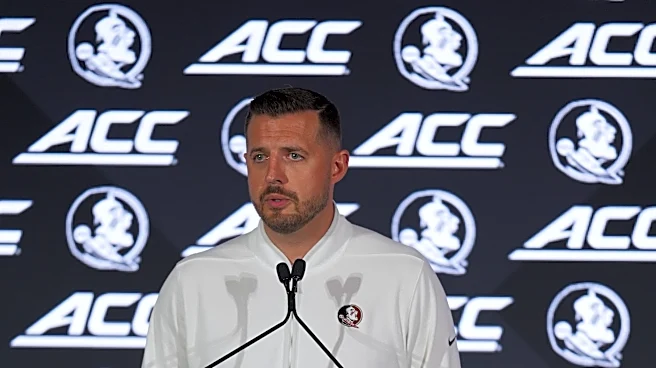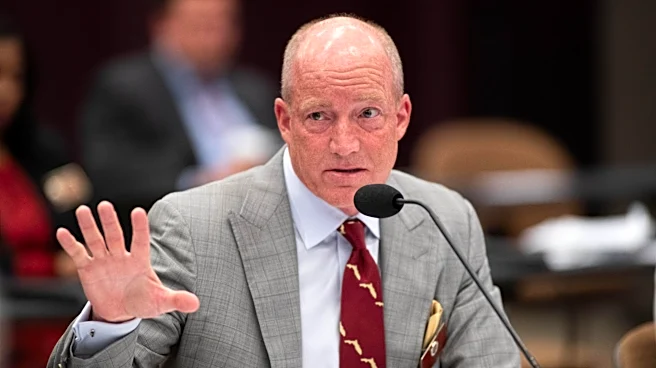



Florida State Board of Trustees chair Peter Collins personally pressed senators to change conference realignment restrictions in the Protect College Sports Act (PCSA), according to emails obtained by Tomahawk Nation through public records requests and an interview with Collins.
FSU president Richard McCullough sought Collins’s input before signing a joint ACC letter supporting the bill in June. In August, McCullough sent him the final Senate text. Four days later, Collins told McCullough and then-FSU
athletic director Michael Alford that he was “actively working” on a compromise.
That is an unusual role for a board chair. In records from five other ACC schools, Tomahawk Nation found no comparable example. The correspondence and interview show how that dynamic played out as FSU moved from supporting the bill to seeking changes, with its board chair using his political relationships to make the university’s case.
At the center of FSU’s concerns was Section 205, which caps conference membership and restricts schools moving between major conferences. For Florida State, the provision cut against what it had just spent a year and a half fighting for. FSU sued the ACC in December 2023 before reaching a settlement in March 2025 that set the terms under which Florida State could leave the league.
“I think that there’s a lot of good things in the bill. We’d like to see a lot of that pass,” Collins said in an exclusive interview with Tomahawk Nation of his messaging to senators, “but we feel like we’re in a position where we’d be advocating to pass a bill that effectively eliminates our options that we just fought for a year and a half with the ACC to have.”
President Seeks Chairman’s Input
Alford sent McCullough and Collins an overview of the proposed legislation on May 28.
Alford described the PCSA as a potential federal framework to stabilize college athletics. His list of “Key Highlights” covered transfers, NIL, revenue sharing, agents, scholarships, athlete welfare and governance.
Alford wrote that FSU would continue working with the ACC because parts of the bill could affect “governance, competitive balance, and revenue models across the industry,” particularly for “institutions like ours navigating conference and national landscape shifts.”
Four days later, McCullough told Collins that the ACC was asking its presidents and chancellors to sign a letter supporting the bill.
“Michael suggests that I sign it and I am inclined to,” McCullough wrote. He then asked Collins to let him know if he had any concerns.
Collins asked to see the letter. After reviewing it, he replied, “I don’t have an issue with this.”
On June 3, McCullough authorized his digital signature.
Collins told Tomahawk Nation the information FSU received from the ACC at the time didn’t give a full picture of the bill.
“I would say that what the ACC sent wasn’t a complete analysis of the bill. And based on what they sent, we were favorable,” Collins said.
He added that he would “give them all the benefit of the doubt and just say it wasn’t a complete assessment that they sent out.
“If all that bill did was everything that was in that memo from the ACC, we wouldn’t be talking today,” Collins said.
FSU’s Position Shifts
By July, FSU was taking a different position on parts of the bill.
On July 9, Clayton Stein, a senior policy adviser to Sen. Rick Scott, emailed FSU director of federal relations Josh Duncan asking for Florida State’s position on the PCSA.
Duncan responded on July 16, “We are hesitant to support the bill with the provisions on media rights and prohibition on leagues accepting new teams for membership. I think if those provisions were removed, we could get behind the bill.”
Stein replied that Scott’s office was “hearing similar things from other universities and conferences” and asked FSU to send any specific redlines it had for the bill. There was no responsive email in the records produced.
ACC Asks Schools for a Final Position
On July 30, ACC commissioner Jim Phillips sent McCullough and the conference’s other presidents and chancellors the “Pencils Are Down” email from Part 1 of Tomahawk Nation’s “Inside ACC’s campaign for the Protect College Sports Act” series.
Phillips scheduled a 4 p.m. call that afternoon to determine the ACC’s answers to two questions from Senate Commerce: whether the conference or school supported the final bill and whether it would “actively work” to secure passage.
The following night, Phillips publicly reaffirmed the ACC’s support.
“The ACC continues to support the Protect College Sports Act,” Phillips said.
Two weeks earlier, Duncan had told Scott’s office that FSU was hesitant to support the bill because of media rights and conference membership.
Collins told Tomahawk Nation that, from his knowledge of the meeting, “there was a lot of division amongst a lot of the presidents, and there wasn’t a vote.”
Asked what authority Phillips had to speak for the conference, Collins declined comment.
Collins Enters Negotiations
An NCAA summary sent to FSU leadership July 31 described the 19-team conference cap contained in Section 205 of the PCSA.
On Saturday, Aug. 1, McCullough sent Collins an email with the subject line “Final” and attached the PCSA final text.
The email again brought Collins into FSU’s review of the legislation. In June, McCullough had asked Collins for his view before signing the ACC support letter. Now McCullough was sending him the Senate text that would shape the next round of debate.
Collins said the SEC and Big Ten endorsement was what got schools looking closely at the bill, “When you look at (Section) 205 and … you’re Florida State, and you just fought for the ability to leave, to be able to go somewhere regardless if you have a spot or not, the last thing you’re going to do is just turn around and have the government tell you, no, you can’t move” Collins said.
Shortly after that, he began calling senators about the provision.
“I started calling some senators and asking them about this, and a lot of them didn’t know about that provision,” Collins said. “And then I had a conversation with Senator (Ted) Cruz.”
Collins said that conversation took place shortly after the SEC and Big Ten endorsed the bill. According to Collins, Cruz said “there can’t be any changes from this point.”
When Collins asked about the requirement that a school spend five years as an independent before switching conferences, he said Cruz told him, “Well, we don’t want a super conference.”
Collins said he replied, “Great. I don’t want a super conference either. I don’t know anybody that’s, you know, got their hand up going, ‘Hey, let’s have a super conference.’ But if you cap the teams at 19 or 20, there’s only six or eight spots available in those conferences to begin with, so you’re never going to have a super conference. So why do you need the five years of independence?”
According to Collins, Cruz responded, “Well, we’ve just got to have that. We’ll lose a lot of votes if we don’t get that.”
Collins said he also spoke with Scott, Sen. Ashley Moody, Sen. Eric Schmitt and Sen. Maria Cantwell, among several other senators.
Collins said Scott and Cruz also held a call early that week with several athletic directors from schools in the state, including Alford.
On Aug. 5, FSU general counsel Carolyn Egan forwarded Collins, McCullough and Alford the Senate Commerce Committee press release announcing the revised PCSA.
Collins responded, “Actively working compromise to go to 20 team cap and 2-year delayed implementation of the 5-year independent requirement to switch conferences.”
McCullough replied two minutes later: “Thank you, Mr. Chairman.”
Sen. Ashley Moody Sends FSU Her Amendments
On Aug. 7, Charles Sedore, legislative director for Sen. Ashley Moody, emailed Duncan with the subject line “Moody Submitted Amendments.”
One of the two attachments was titled “Amendment Protecting Schools Withdrawing During Grace Period.”
The amendment would have exempted a school from the conference-movement restrictions if it began the process of withdrawing from its conference within 180 days after the bill became law.
Collins confirmed to Tomahawk Nation that the amendments were due to conversations between Moody’s office and FSU: “Both Josh and myself were routinely in touch with Senator Moody and her office regarding our thoughts on this. It was due to those conversations.”
Collins said there were no significant developments between early August and the Sept. 29 letter other than “lots of conversations with lots of people.”
The conference cap remained part of the negotiations after Congress returned in September.
On Sept. 28, Moody offered an amendment raising the cap from 19 teams to 20. The Senate approved it by voice vote, and the 20-team cap became part of the Senate-passed bill.
That was the same cap Collins had told FSU leadership he was “actively working” toward on Aug. 5.
The Senate passed the PCSA 77-22 later that day and sent the bill to the House.
Scott’s office responded to Tomahawk Nation’s request for comment but said it could not answer questions before publication because staff members were focused on Hurricane Isaias recovery.
Moody’s office did not respond to Tomahawk Nation’s request for comment.
FSU Joins Clemson, Miami and UNC
One day after the Senate vote, McCullough joined Clemson president Benjamin Ayers, UNC chancellor Lee Roberts and Miami president Joe Echevarria in a letter to House Speaker Mike Johnson, Majority Leader Steve Scalise and Majority Whip Tom Emmer.
The Sept. 29 letter focused on Section 205 and conference movement.
The four schools argued that requiring a school to spend three years as an independent would add another cost to the financial terms schools already negotiate when leaving a league. They also argued that the 20-team cap could restrict future conference configurations and affect media-rights negotiations.
The schools asked the House to make two changes: raise the membership cap from 20 to 22 and remove the independence requirement for schools moving between covered conferences.
“As the legislation moves to the House, our coalition has worked together to identify a compromise that addresses our concerns while supporting the broader goal of advancing a durable framework for college athletics,” the letter said.
Collins told Tomahawk Nation that while he did not recall when the first calls between the schools took place, other ACC schools that did not sign the letter were on those calls as well.
“There were other schools on there as well, people that didn’t sign the letter for different reasons, but also have issues with the bill,” Collins said. “We didn’t really need to go outside of the ACC to find enough people who would sign on to that letter that it would be meaningful to House leadership to see that there’s some issues with this.”
Collins added that “a lot of House members” have signed on to a letter calling for the change. He pushed back on the idea that the four schools are the ones holding up the bill.
“It’s convenient to say, ‘Oh, they’re the ones killing the bill.’ That’s not the case,” Collins said. “If we all said tomorrow, ‘Hey, we’re good with this change,’ I’m not even sure the bill passes the House.”
Collins said he is “highly skeptical” the bill clears the House, noting that the Senate has said there can’t be any amendments while other House members have issues with other sections of the bill.
Collins’s Role as an Outlier
Collins’s role stands out against records obtained from other ACC schools. Tomahawk Nation could not located a similar example of a board member taking such an active role in productions from North Carolina, North Carolina State, Clemson, Louisville and Virginia.
Collins described his overall role and the dynamics with McCullough through the process with the following:
I’ve known Rick Scott for maybe 16 years, and… I was one of (Ashley Moody’s) earliest supporters when she ran for attorney general the first time. So I consider them both personal friends, and so I have a very good relationship with both of them.
And so while it might seem odd that I’m involved versus the president… (McCullough) and I were constantly talking, so it wasn’t like I was out trying to get something done that was different from what he wanted to do.
But I had the relationships, and it was most effective to get done that way. And I was certainly willing to spend the time and effort to do it.
Tomahawk Nation spoke with Dr. Peter Eckel, senior fellow and director of global higher education management at the University of Pennsylvania and co-director of the Penn Project on University Governance. When asked about the dynamics shown in the correspondence produced to Tomahawk Nation, he made several observations.
- As a matter of general university governance, the president of the university should be the one making management decisions. The board is there to govern, not manage.
- While Division I athletics can be a third-rail issue for major university presidents, they still need to be involved due to the exposure and risk that it presents both to the presidents as individuals and to the universities they lead.
- Ultimately, the authority of the board rests with the body rather than with a single individual. The collective can act as a check on the whims and wishes of individual trustees.
Tomahawk Nation’s request for comment included several questions addressed specifically to President McCullough. McCullough did not respond to the questions directed to him.