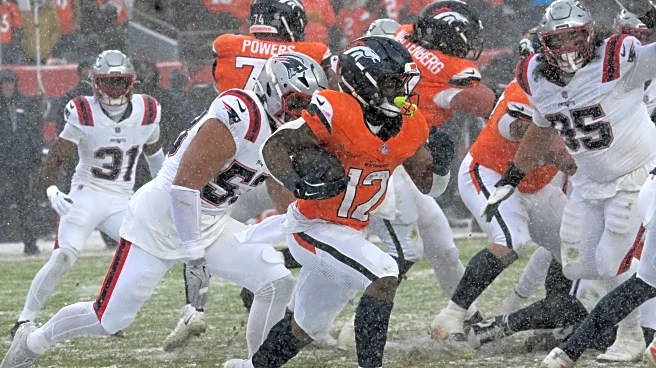




I did a high level overview of the Bronco run game earlier, but there were parts that were not included, specifically directional running, in the last article. That will be covered here. The Denver Broncos were good relative to the rest of the league when running behind some blockers and poor when running behind others (see below). Kneeldowns have been removed since the NFL still counts them as runs for -1 or -2 yards. Blue is good, red is bad, white is average.
Go grab your coffee, you are going
to need it. There is a lot of data and analysis in this one.

Denver was good when running to the left end and center (slightly above average at RG). The team was below average when running in any other gap. I find it interesting that EVERY team had a spot that was at least light blue. Even the worst running team in the league, the Loss Vegas Faiders, had to light blue directions.
Now, remember that a play can be blocked perfectly, and the RB can make a poor choice of where to run, turning a long run into a gain of 2-4 yards. So let’s look at how often teams got 1 yard or fewer on runs, 2-4 yard, 4-15 yards, and more than 15 yards. Runs that lose yards or are stopped for no gain, are the fault of the blocking. Every runner in the NFL will gain at least 1 yard (and usually more) if the play is blocked well. Runs of 2 to 4 yards came be the result of a runner making a great play on a poorly blocked play (e.g. breaking a tackle in the backfield or at the LOS) or they can be the result of a well blocked play where the runner chooses poorly, or anything in between.

The Broncos were 22nd in runs that gained one or fewer yards with 29.2% of our runs on the year gaining those values. Of course, a 1 yard run can be a successful run if it’s 3rd and 1 or 4th and goal from the 1, etc. So this doesn’t mean that the Broncos got stuffed on 29% of their runs in 2025. The Broncos had 46 runs with one yard to go in 2025. They converted on 32 – 69.6%, which was tied for 21st. The KC Thiefs converted on 86% of their runs in these situations. The Faiders were the only team to convert on less than 50%.

The Broncos also had a fairly low percentage of runs that gained two to four yards at 10.7% – 26th. The runs that gained 5-15 yards , 33.3%, the Broncos were 10th. The Bears led the league at 40.3% and the Browns were the worst at 27.1%. The percentage of explosive runs (gained more than 15 yards) for the Broncos was 4.1% (or roughly one carry in 25). This was also 10th in the league. Only the Ravens and the Chargers were above 5%. While KC was really at getting 2-15 yards, they had the lowest percentage of runs that gained more than 15 yards, 1.2%.
This is how often the Broncos gained X yards on a run. The most common gains were 1 and 2 yards, both 57 runs.

Below is a histogram that shows how what percentage of the Bronco runs gained X yards when they ran which direction.

Leaving out the edge runs, the Broncos were the best by YPC when they ran behind the center, who was either Luke Wattenburg or Alex Forsyth, gaining 4.37 yards per carry (this number is lower than the number below because I failed to remove kneeldowns when I did the pull for the whole league). When I did the pull for the table below for the Broncos – I made sure to remove the kneeldowns.
So who among Bronco runners did well when they ran where? That is below.

Dobbins was really good running to the left end, while 41 of his 199 yards came on one of his 16 runs, his other 15 runs to the left end gained still gained 155 yards (10.3 YPC). His worst direction was behind Quinn Meinerz at right guard, which is unexpected.
The average run in the NFL gained 4.6 yards (removing kneeldowns) in 2025, so RJ Harvey was only above average on runs to the left end and up the middle. He was abysmal on runs behind the left guards (Ben Powers and Alex Palczewski) – gaining only 2.1 yards per carry. Up the middle was worst spot for Jaleel McLaughlin to run, but he only had three runs up the middle. His runs behind Mike McGlinchey look good by YPC, but that was boosted by one run for 14 yards. His other six RT runs gained 14 yards (2.3 YPC).
The Broncos had 21 runs that gained 16 or more yards this season and 7 that gained 25 or more. Looking at those 25 or more runs: Nix had one; Dobbins had three; Harvey had three (the 25 yard run was an error in my data pull). Most were either to the left edge or the right edge (12 of 25). None were listed as LT. Two were RT, RG and LG. Four were middle runs. Four of five long runs by Bo Nix were scrambles with only the 18 yard TD run being a designed run.

Looking at the runs for 16 or more, Adam Prentice and Marvin Mims both had one. The others were all the same three runner who had the longer runs.
We can debate how much of this success (or lack thereof) was the result of the runner and how much was the result of the blocking in the comments, but I don’t know if there is a good metric that bolsters either side. The best information would probably by the NFL NGS rushing yards over expected. Dobbins was one of the best at getting more yards per run than the average NFL RB (4th in the NGL). While Harvey was poor, leaving plenty of yards on the field (this was discussed in my linked post at the beginning of the article).