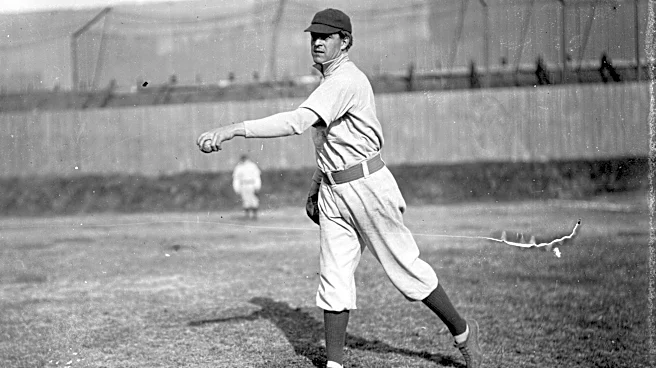


There’s not a whole lot to say about left-hander Jake Weimer, who pitched three very good seasons for the Cubs from 1903-05, winning 20 games twice, and then was traded away, thus missing the Cubs’ pennant years from 1906-08.
Already 29 and with five years worth of minor league experience — back in the day when there were no minor league “systems” as there are today — Weimer was acquired by the Cubs prior to the 1903 season. Obviously no one knew what WAR was back then, but his 1903 season was the equivalent
of 5.5 bWAR, with 20 wins and a 2.30 ERA. He issued a lot of walks — 104 — but his 128 strikeouts, in an era when most batters didn’t K much, ranked fifth in the National League. The following year, he struck out 177 in 307 innings, the K figure good for third in the league.
After yet another solid year in 1905, the Cubs traded Weimer to the Reds for Harry Steinfeldt and Jimmy Sebring. Steinfeldt would go on to have five very good years in Chicago (and yes, he’ll appear later in this countdown), so that wound up being an excellent deal for the Cubs, especially since Weimer was already beginning to decline at age 33. In July 1908 the Reds traded him to the Giants with Dave Brain for Bob Spade and $5,000, but, per Weimer’s SABR biography:
Weimer refused to report to the Giants unless he got half of this money ($2,500, equivalent to about $90,000 in 2026 dollars).
When he did not receive it, Weimer stayed home with his family in Chicago and pitched occasionally for local semipro teams. Third wife Laura Trumbull, whom he had married in 1904, gave birth to their second child, son George, in November 1908. Their first child, daughter Mary, was born in 1906. A third child, daughter Laura, would be born in 1914.
The Giants finished one game behind the Cubs for the 1908 NL pennant, and it was suggested that if Weimer had played for the Giants, the team might have won the pennant.36 As noted upon his return the following year, “Weimer is an erratic individual, but he is a star pitcher and will add great strength to the Giants.”
Weimer reported to the Giants at spring training in 1909, but he had arm trouble. He appeared in only one regular-season game, on May 28, and then went home.
And that ended Weimer’s baseball career. He settled in Chicago and became a hog trader at the Chicago Stockyards, but did keep one connection to baseball:
In 1922 he coached high school baseball at the Loyola Academy. There he mentored a 16-year-old phenom, Freddie Lindstrom, and recommended him to the New York Giants. Lindstrom was signed by the Giants and went on to a Hall of Fame career.
Weimer died June 19, 1928 in Chicago, aged 54, from appendicitis, something that was frequently fatal a century ago. Nevertheless, he’s worth remembering today. He posted 15.5 bWAR in his three Cubs seasons.