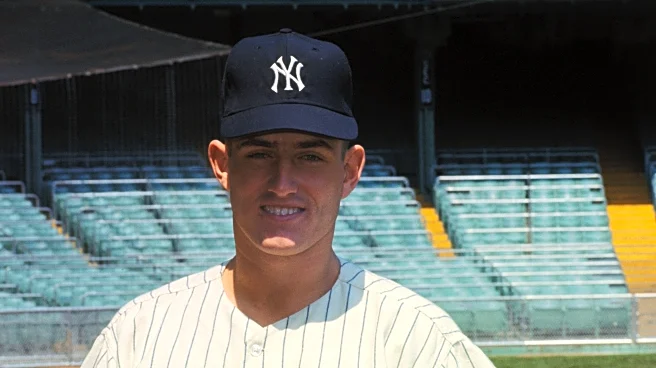

Some players show up to the big leagues just in time to win a championship, or two, or more. Many, many more completely miss the boat. Fritz Peterson was a reliable left-handed pitcher who despite his strong nine-year tenure in the Bronx worthy of a spot on our Top 100 Yankees countdown never appeared in a World Series with them. His career began four years after their most recent title, and three years before the next.
If Peterson had been part of a championship team or three, perhaps he wouldn’t
be mostly remembered for an incident which made him tabloid-fodder in 1972: a consensual partner-swap between himself and teammate Mike Kekich. If anyone was going to laugh about the uproar which ensued, though, it would be Peterson, whose congeniality endeared him to writers and teammates alike.
Fred Ingles Peterson
Born: February 8, 1942 (Chicago, IL)
Died: October 19, 2023 (Winona, MN)
Yankees Tenure: 1966-74
Peterson grew up outside Chicago and remained in the state of Illinois for college after a solid high school career. With the Northern Illinois Huskies, Peterson honed his craft on the mound—while playing some hockey on the side. He began to seek professional offers after his junior year in 1963, two years before the advent of the MLB draft. He fully intended to sign with the Yankees, and in July, he got his wish.
The Yankees, of course, had just won the World Series in 1962 and 1961, and were on their way to appear in a third consecutive Fall Classic. While the Dodgers swept them that year, and the Cardinals dealt them a bitter defeat in seven games in 1964, it seemed like young Fritz had a great chance to taste championship glory in the Bronx.
By the time he made his debut, though, the dynasty had crumbled. The Yanks lost 85 games and tumbled to sixth place in the American League in ’65, and would finish dead last in ’66, even as Peterson came up and logged a solid rookie year. The southpaw pitched a complete game in his first start, limiting the Orioles to two runs on six hits in a 3-2 victory. He went on to post a 3.31 ERA in 34 starts—good for a 100 ERA+ in a very pitcher-friendly run environment.
Fritz took a minor step back in 1967 in another cellar-dweller season before enjoying a successful 1968—as most pitchers did, frankly. But a 2.55 ERA in 1969 after the lowering of the mound proved he was for real, even as he traded wins and losses at an even rate (17-16).
Peterson was a control maven who avoided walks like the plague. He posted a WHIP of 0.996 in ‘69, the best mark in the AL. That season was the second of five consecutive in which he led either the AL or all of baseball in walks-per-nine innings. Since Peterson rarely let a man reach base for free, his starts tended to fly by. “I like to pitch fast and get the game over so I can find out who won,” Peterson once said, showcasing the sharp wit which made him even more popular among writers than his expediency did.
Ahead of the 1969 season, the Yankees traded outfielder Andy Kosco to the Dodgers for reliever Mike Kekich. This seemingly inconsequential move on paper would become a deeply important event for Peterson, who became fast friends with Kekich. Their families spent so much time together that Peterson and Kekich would joke idly about trading wives.
Well it was a joke, at first. Then it wasn’t.
By 1972, Peterson found himself in love with Kekich’s wife Susanne. In December, the Peterson and Kekich families made a one-for-one deal. The rest of the world was not thrilled.
Peterson divulged the wife swap to the media in March of 1973, drawing the ire of fans and media. A columnist derided their decision and blamed a lack of leadership from manager Ralph Houk, who had defended Peterson and Kekich. Even the commissioner of baseball, Bowie Kuhn, came down from his perch to issue an unofficial condemnation.
If, to put it in sports terms, this trade had a “winner,” it would be Peterson, whose marriage with Susanne lasted the rest of their lives. Not so for Kekich, who split up with Peterson’s first wife Marilyn only a few months later; she hadn’t been that enthused about the idea in the first place. Kekich went on the record to say that he thought the swap should have been called off shortly afterward, but the Petersons refused. It all made for an uncomfortable situation and Kekich grew estranged, doing everything he could to distance himself from the story (and a now-seemingly aborted attempt by Ben Affleck and Matt Damon to make a movie about it).
Let’s skip back to a couple years before “the swap.” Peterson enjoyed the best season of his career in 1970, as the Yankees rose from mediocrity to challenge for the AL pennant. While they finished a distant second place behind 108-win Baltimore, their 93 wins were by far the most since Peterson arrived in the Bronx. Peterson, for his part, reached the 20-win total for the first and only time in his MLB career, while pitching to a 2.90 ERA in 260.1 innings. That earned him his lone trip to the Midsummer Classic; in the game, he faced Willie McCovey with the bases loaded, allowed an RBI single, and was relieved by teammate Mel Stottlemyre. The Senior Circuit won 5-4 in 12 innings.
The southpaw continued to pitch well in 1971 and 1972, but the Yankees had returned to their mediocrity, with consecutive fourth-place finishes in the AL. Following the wife-swap in December, Peterson struggled out of the gate in 1973. Fans and media naturally blamed the swap, but he had been struggling with arm fatigue and shoulder pain. In what would ultimately be his final year in pinstripes, Fritz went 8-15 with a 3.95 ERA. The Yankees finished fourth yet again.
Early in 1974, Peterson was traded to Cleveland after starting the season in the bullpen. He rebounded somewhat in 1975, then wrapped up his career after struggling with injuries and inconsistency across 13 appearances in 1976. His overall career numbers across nine seasons in New York: a 109-106 record and 3.10 ERA (106 ERA+) over 1,857 innings, with 893 strikeouts as opposed to only 332 walks. His solid career never coincided with a World Series appearance, but the Yankees would return to the Fall Classic in 1976, then win their 21st championship in 1977.
Peterson wore many hats on retirement, but started a writing career late in his life. His first book was Mickey Mantle Is Going To Heaven, released in 2009, a Ball Four-esque account of his old playing days with an Evangelical flavor. His second book, The Art of De-Conditioning: Eating Your Way to Heaven, was a more humorous account of his decision to stop watching what he ate after retiring. Finally, he wrote a more historical-minded account called When the Yankees Were on the Fritz—about the dim era of Yankees baseball which coincided with his career.
Peterson died from lung cancer in October 2023 at the age of 81, though somewhat oddly it wasn’t reported until the following April. While his exploits were largely overlooked and his career often distilled to a controversial life decision, he was a proud Yankee, even when being a Yankee wasn’t always something to be proud of.
See more of the “Yankees Birthday of the Day” series here.