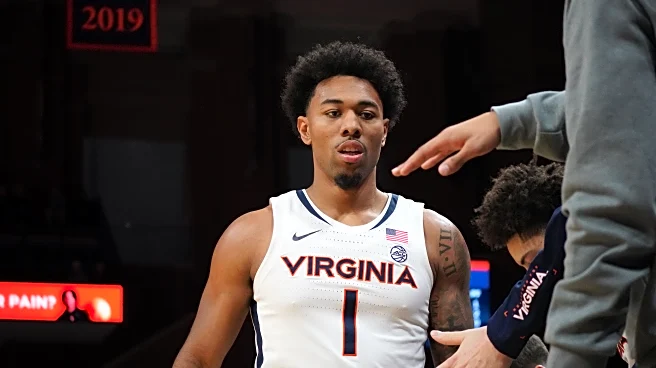



After an all-conference season at San Francisco, Malik Thomas transferred to Virginia with similar expectations on head coach Ryan Odom’s brand new roster. In non-conference play, Thomas’ numbers were not quite at that level — averaging 11.1 points, 1.8 assists, and 3.2 rebounds per game. In the six ACC games since, those numbers have spiked to 18.7 points, 2.0 assists, and 6.3 boards, with an uptick in minutes as a result.
Ultimately, the Cavaliers guard has undergone a complete transformation from
someone who was struggling to find his identity on a good-not-great team, to arguably the most important piece on the 14th ranked group in the nation. So, what exactly has changed?
For starters, everything seems to be going a lot better when the shot is simply falling — every hooper that has ever touched the hardwood will tell you that exact same thing. Thomas’ three-point percentage in conference play is 43.8% compared to just 28.8% beforehand.
Because Thomas has the hot hand, the rest of the team has made it a priority to feed him whenever possible. He ended up nailing six triples in both contests during UVA’s recent road trip and those shots have come in a variety of different ways — catch and shoot, off-balance, in transition, off the dribble, deep in the shot clock, you name it.
In Ryan Odom’s system, three-point shooting is the most important trait for a primary scoring option. However, unlike a Pat Kelsey Louisville or a Nate Oats Alabama, the presence of an interior threat is equally important in keeping defenses honest. And that is where Thomas has been able to make his most significant adjustment in transferring across leagues.
In the WCC, Thomas had enough of a physical advantage to will his way into buckets at the rim consistently. He is still talented relative to the rest of the ACC, but not quite to the same extent, and he has begun to understand that.
One of the most noticeable differences between non-conference Malik Thomas and the ACC Malik Thomas is how he attacks with the ball, particularly in transition.
Originally, he felt like he could overcompensate for his shooting struggles by slashing his way into 20-point nights. In reality, Thomas would often end up driving into heavy traffic, resulting in a turnover or a poor shot.

The contrast to now is stark. As the defense has likely seen on film, they ought to collapse onto Thomas as he forcefully drives towards the basket. Now, instead of going for the tough finish, he comes to a stop, and kicks it out to the open shooter trailing the play. Thomas has made this type of play several times amidst his hot stretch, particularly in the Louisville game.
As the team has undergone a defensive revelation, Thomas has made considerable strides from a personal standpoint as well. Virginia’s defense has become increasingly known for their back end rim protection, with Johann Gruenloh and Ugonna Onyenso propelling the ‘Hoos to the third highest block rate in the nation at 17.3%.
That allows UVA’s guards and wings to be tasked with aggressively pursuing perimeter ball-handlers and funneling shooters off the line into the teeth of the defense. They do not even need to be great for that to work, just good enough.
Good enough is exactly what Thomas brings to the table defensively. At 6-foot-5, 215 pounds, Thomas is physical enough to hold his own in the high post against another forward. While he will not force an abundance of turnovers — nobody besides Chance Mallory really has those steals numbers this year — he is light enough on his feet to switch onto a quicker guard and stay in front of him.
Most notably, Thomas has stepped up on the glass, helping minimize Virginia’s kryptonite of defensive rebounding. As a unit, the Cavaliers are now towards the middle of the pack, allowing second chances on 30.4% of opponents’ misses, which is a victory considering the 20 offensive boards (16 during regulation) they allowed to Virginia Tech a month ago.
Thomas coming into his own raises the ceiling of this team entirely. Making a run in March typically entails an individual player catching fire and hopefully, he is battle-tested in getting tough buckets during crunch time. While Virginia has multiple of these options, namely Thijs De Ridder and Jacari White, Thomas is at the top of that list. During this January stretch, Thomas has proven that he could absolutely be the guy when the moment calls for it, all while playing intelligently and under control.