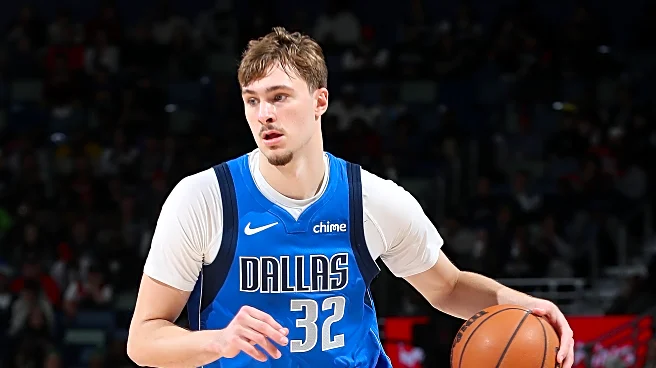




The Dallas Mavericks leaned further into the tank on Monday night, falling 129-111 to the New Orleans Pelicans in a game that never truly felt competitive down the stretch. Dallas showed brief life early, but couldn’t sustain it as the Pelicans controlled the pace and physicality for most of the night. Naji Marshall led the Mavericks with 32 points, continuing his strong stretch, while Cooper Flagg added 21 points, 8 assists, and 7 rebounds in another all-around performance. For New Orleans, Zion
Williamson dominated with 27 points on highly efficient shooting, and Trey Murphy III chipped in 17 points as the Pelicans generated consistent offense and pulled away comfortably.
The Mavericks opened with good early energy, getting contributions across the board as P.J. Washington knocked down multiple threes and Cooper Flagg immediately impacted the game as both a scorer and playmaker, helping Dallas briefly grab control. Flagg was especially active early, finishing in transition and creating for others, while Marvin Bagley added efficient scoring with a three and a lob to keep the offense flowing. But that rhythm didn’t last, as the Pelicans—led by Zion Williamson’s relentless rim pressure and a scoring burst from Saddiq Bey—flipped the game by attacking the paint and getting to the line. Dallas’ offense stalled late in the first with missed shots and turnovers, while New Orleans consistently generated clean looks, shot 57.1% compared to Dallas’ 41.7%, and took control of the glass, leading to a 32-26 deficit.
The Mavericks tried to stabilize things in the second quarter, with Naji Marshall finishing inside and Max Christie knocking down a three to briefly spark the offense, but that push quickly faded. Zion continued to live at the rim while Trey Murphy III added timely shot-making, and New Orleans kept forcing Dallas into tough, late-clock looks. As the quarter went on, the Mavericks’ offense completely unraveled, with missed layups, blocked shots, and empty possessions piling up while the Pelicans generated second chances and free throws to extend the lead. Even when Dallas showed small flashes late, every run was immediately answered, and the execution gap remained clear. By halftime, it was 67-54, with the Mavericks still unable to find any consistent rhythm on either end.
The third quarter opened with Dallas trying to make a push, as P.J. Washington knocked down a three and Naji Marshall followed with a pull-up and transition finishes, briefly trimming the deficit to around 89-76 and giving the Mavericks some life. Marshall stayed aggressive early, scoring on multiple possessions and even setting up Washington, as Dallas showed a short stretch of rhythm. Still, that window closed quickly as Zion Williamson got downhill for layups and free throws while Trey Murphy III added a reverse finish and helped generate turnovers into easy points. Midway through the quarter, it fully unraveled—after a Washington dunk cut it to 96-82, Dallas had chances to build momentum but came up empty on a missed Washington three, a blocked Marshall layup, and a bad turnover from Derrick Queen, all in a short stretch. New Orleans immediately capitalized with a Matković three, Murphy layup, and Johnson finish, pushing the lead right back out and erasing any progress, and from there the Mavericks couldn’t convert stops into offense as missed jumpers and empty possessions piled up. By the end of the quarter, it had turned into an 86-103 deficit, and the fourth never offered any real energy or comeback window.
It quickly shifted into an extended run for the two-way and end-of-rotation guys, with Dallas opening on mostly empty possessions, including missed threes from Ryan Nembhard, while New Orleans calmly added points at the line through Jordan Hawkins. The Mavericks had a few scattered moments, like an A.J. Johnson alley-oop to Nembhard, but nothing that resembled a real run as stalled possessions continued. New Orleans didn’t need to do much, simply maintaining control with a Matković three and free throws from Saddiq Bey to keep the margin comfortable, and from there it fully turned into garbage-time basketball with both teams trading misses and turnovers. Dallas never seriously threatened, and it quietly closed as a 129-111 final, a finish that felt more like a formality than a comeback opportunity.
Another Good Loss
This loss matters more than it looks because Dallas is stuck in one of the most volatile spots on the lottery board, where every single result swings real odds. Right now, the Mavericks are sitting around 6th–7th in the lottery standings, tightly packed with teams like the Pelicans and Grizzlies, and even one win or loss can flip that order. From the Tankathon data, that difference is massive around this range; you’re talking roughly 8% odds at No. 1, but if you slide just a couple spots, those odds drop quickly, while your chances of falling out of the top tier increase.
That’s what makes games like this so important. The Pelicans are in a unique spot where they don’t even control their pick, so they have no real incentive to lose, which creates an opportunity for Dallas to pass them in the standings if they keep losing. At the same time, Memphis is right behind them, meaning the Mavericks are essentially in a three-team tug-of-war where every result reshuffles positioning.
So this isn’t just another late-season loss; it’s a direct movement in a crowded lottery race. Instead of risking a meaningless win and dropping a spot, Dallas stays in range of jumping higher, which matters because worse records mean more ping-pong ball combinations and better chances at a top-four pick. As the season winds down, this is the reality: the difference between the 5th and 8th lottery slot could be the difference between landing a franchise player or missing that tier entirely, which is why losses like this quietly carry real long-term weight.
Another Fun Flagg Game
Cooper Flagg was once again one of the few bright spots for Dallas, continuing what has quietly been a really strong stretch of basketball over the past week. He finished tonight with 21 points on 10-of-21 shooting, along with 8 assists and 7 rebounds, consistently creating offense even as the team around him struggled to find rhythm. What stood out wasn’t just the scoring, but how involved he was in everything, initiating sets, pushing in transition, and making the right reads when the defense collapsed. Over his last five games, Flagg has been steadily productive, putting up 27, 25, 13, 14, and 17 points, while maintaining solid efficiency and contributing across the board as a rebounder and playmaker.
More importantly, his impact goes beyond the box score. Even in losses like this, he’s been the one stabilizing presence, keeping possessions alive, generating looks for others, and showing flashes of control that you don’t usually see from a young player. The scoring has been consistent, the playmaking is trending up, and the all-around production is becoming the norm rather than the exception. As the Mavericks lean further into development down the stretch, Flagg isn’t just putting up numbers; he’s starting to look like the clear centerpiece of everything they’re building.