



Did you know in the 1972/73 season a player involved in this game played for both teams in the FA Cup?
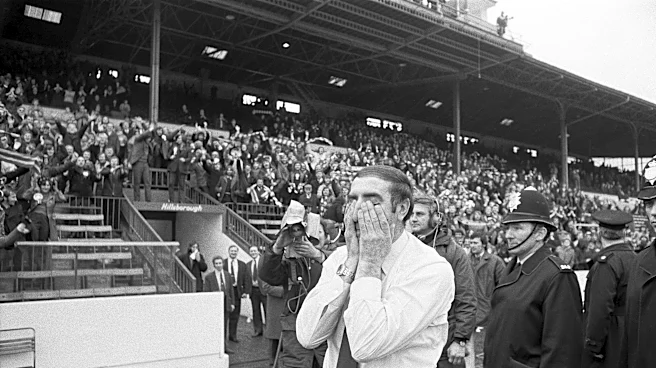
Brian Chambers, who was an unused substitute for Sunderland at Hillsborough in 1973, was transferred to Arsenal shortly after the final for £30,000 and played for them against Wolves in the 3rd/4th play-off game. The game was played at Highbury in August 1973 and 21,000 fans turned up to see Wolves win 3-1 in the sunshine.
The crowd was not the biggest attracted for this game; that accolade belongs
to the 1972 game between Birmingham and Stoke. The FA had decided, given the apparent apathy toward the game, to play it at the venue of one of the two clubs involved and stage the game in August after the final, instead of somewhere in London on the Friday night before the final. 25,000 people turned up at St Andrews and saw second-division Birmingham become the first team to win an FA Cup tie by a penalty shoot-out.
The 3rd/4th play-off was scrapped after 1974 when only 4,432 people turned up at Filbert Street to see Burnley take 3rd place by virtue of a Ray Hankin goal.
For the record – 3rd/4th play-off winners:
April 1970 Man Utd 2 – 0 Watford at Highbury (15,105 att).
May 1971 Stoke 3 – 2 Everton at Selhurst Park (5,031 att).
August 1972 Birmingham 0 – 0 Stoke at St Andrews. Birmingham won 4-3 on pens (25,841 att).
August 1973 Arsenal 1 – 3 Wolves at Highbury (21,038 att).
May 1974 Leicester City 0 – 1 Burnley at Filbert Street (4,432 att).

Chambers would probably not have made the bench if David Young had not been suspended under the bookings totting-up system in operation. Arsenal’s 1966 World Cup winner Alan Ball was also suspended and should have missed the game, but Arsenal timed a “strategic appeal” perfectly and Ball played.
Richie Pitt could have been playing for Arsenal against Sunderland in this game if things had worked out differently.
Pitt had gone out on loan to Arsenal earlier in the season. He did not enjoy a particularly good relationship with Bob Stokoe, who shortly after arriving at the club bought David Young from Newcastle and made it clear to Pitt that Young was his first choice. An injury to centre-forward John Hughes in his very first game just before the replay with Reading at Elm Park saw Pitt (who was actually on his way to Arsenal for a second loan spell) drafted into the team and play alongside David Young in the centre of defence, to allow Dave Watson to fill in for Hughes up front. Pitt played so well that Stokoe could not drop him and the move to Arsenal was put on ice!

Sunderland were scheduled to play six second-division games between 10 March and 4 April prior to their semi-final with Arsenal. It was a brutal schedule with the Football League insisting Sunderland play these games as they had fallen so far behind some of their relegation rivals – they had seven games in hand on some of them. The fixture pile-up had been caused by a flu outbreak at the club during the festive period, and the number of replays in the FA Cup run the Lads were having to play. Luckily, the game just before the semi-final against QPR at Roker Park had to be postponed because of the weather, giving Sunderland four clear days before the big game at Hillsborough.
Vic Halom scored Sunderland’s first goal in the semi-final and had a great game. Had it not been for an injury to centre-forward John “Yogi” Hughes (Billy Hughes’ brother) in his very first game against Millwall in the league at Roker Park in late January, Halom would have likely played against Sunderland for Luton in the quarter-final game.
The Dagenham Girl Pipe Band (the only female pipe band in the world at the time) provided the pre-match and half-time entertainment at the Hillsborough semi-final in 1973. Sunderland fan and song-writer Tim Rice (who would find great fame in partnership with Andrew Lloyd Webber) was lucky enough to have hitched a ride in the Dagenham girls’ bus to the game – they shared the same agent at the time.
Had Arsenal beaten Sunderland in 1973, they would have been in their third final in succession. They beat Liverpool 2-1 in 1970/71 and were beaten by Leeds 1-0 in 1971/72. Not too many pundits thought Sunderland could beat Arsenal; indeed, Alan Ball declared boldly in the press on the morning of the game that “there is no way Arsenal can lose this game”.
The weather that had forced the cancellation of the QPR game earlier in the week before the semi-final persisted to the day of the game. Biting freezing rain and wind, as well as snow on the journey down, saw atrocious conditions on the day of the game. In a portent of things to come, Arsenal’s flag became snared around its pole and remained so for the whole of the game, whilst Sunderland’s flew proudly throughout the match.
The Sunderland players that gathered in the dressing room after this game had finished will no doubt have been excited about playing at Wembley. However, only one player in the squad that day at Hillsborough had ever played at Wembley before! Richie Pitt was that solitary player; he had played there for England Schoolboys, for whom he played at Under-15 and Under-18 level, earning six caps in total.
Despite the shock of losing this game and the disappointment of not making it to Wembley for the third year in a row, the 1973 league Division One runners-up were magnanimous in defeat. Goalkeeper Bob Wilson and manager Bertie Mee praised the Sunderland fans for their vocal backing and asserted that Sunderland deserved to win the game. Alan Ball was fulsome in his praise of Sunderland’s fighting performance and said that Arsenal just could not settle into the game because of the Black Cats’ harrying and willingness to run for the whole game.
Sunderland of course went on to beat Leeds in the final in one of the biggest upsets in FA Cup history.If you would like to read more about the semi-final played on this day in 1973 why not enjoy: https://rokerreport.sbnation.com/2023/4/7/23672955/fa-cup-fairytale-here-comes-the-bride-as-the-lads-march-on-to-wembley