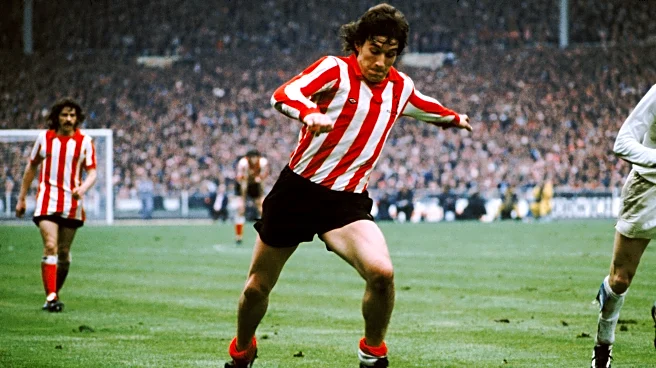



Vic Halom is one of those players from our 1973 FA Cup winning team that fans of the time still get misty-eyed about.
Born in Swadlincote and raised in Burton-upon-Trent, he actually began and spent the first years of his professional career in London, starting as an apprentice at Charlton and making his league debut for them before moving to Leyton Orient in 1967 and then Fulham in 1968.
Three years at Craven Cottage helped mould him into the centre-forward that he became, and when Luton Town were
looking for a replacement for Malcolm McDonald — who’d moved to Newcastle — they brought Halom ‘north’ from London to Kenilworth Road.
Playing in the Second Division, Halom established himself as one of the better up-and-coming centre forwards at that level and boasted a strike rate of around a goal in every three games — as he did throughout his career.

Meanwhile at Sunderland, Bob Stokoe had inherited a side that was struggling near the foot of the Second Division during the winter of 1972/1973.
Looking to bring in a forward to lead the attack of his side, Stokoe had signed John Hughes from Crystal Palace in January 1973 for £35,000. Hughes had been a huge player in his day for the Celtic team that ended up winning the European Cup — and was the brother of Sunderland forward Billy.
Sunderland themselves had begun a turnaround in form when Hughes arrived, winning their third-round FA Cup tie against Notts County after a replay, but they were still in eighteenth place in the table when Hughes came to make his debut against Milwall on 27 January 1973.
Cruel fate played a part in bringing Halom to Roker Park, for although Sunderland won the match 2-0l, Hughes suffered what would turn out to be a career-ending knee injury in the opening minutes of the game.
Billy Hughes recounted that his brother went running past him and shouting “My knee’s knackered”, but tried to play on, saying nothing at half time before having to go off in the second half.
Thus, Sunderland got through their fourth-round FA Cup tie and replay before Stokoe had signed Halom for £30,000 from Luton, with the forward making his debut in the league against Sheffield Wednesday.
Halom was a big, strong and aggressive centre forward who was a complete handful for opposition centre halves, not allowing them to settle and not unlike Brian Brobbey in that respect. When asked what his new signing would bring to the Sunderland team, Stokoe thought for a moment, possibly searching for one of those Cantona-like quotes of the future, and said, “We’ll go like a bomb!”

Indeed, Sunderland did go “like a bomb”.
In seventeenth place when he made his debut, Sunderland had risen to sixth by the time the league season came to an end a few months later.
Halom scored on his home debut (a 4-0 win over Middlesborough), while the next game was a 2-2 draw against Manchester City in the fifth round of the cup. The replay at Roker Park brought in a crowd of over 51,000, contrasting against crowds of just over 12,000 just before Christmas. In one of the most famous games played at our old ground, Halom opened the scoring with a cracking goal — which you can see below — in a 3-1 win.
He got another huge goal in the semi-final win over Arsenal where he terrorised the gunners defence throughout, finished the season with seven goals in all competitions and became one of the eleven club legends who lined up to win the FA Cup final against Leeds in May.
1973/1974 saw Halom on top of his game for Sunderland.
The club competed in European competition and he scored twenty one goals in all competitions, including a League Cup hat trick against Derby County — one of the top clubs in England at the time.
He added a further nine goals in 1974/1975 as Sunderland knocked on the door of promotion, but by the time the club did achieve promotion in 1975/1976, he began to suffer from a series of niggling injuries which affected his contribution.
Halom then moved to Oldham, where he did recapture his old form for the next four years before finishing his career with Rotherham United.
As we look forward to the fifth round of the FA Cup, it’s fitting to commemorate a key player in one of our best wins at this stage of the competition — a cup legend and a great player for Sunderland.