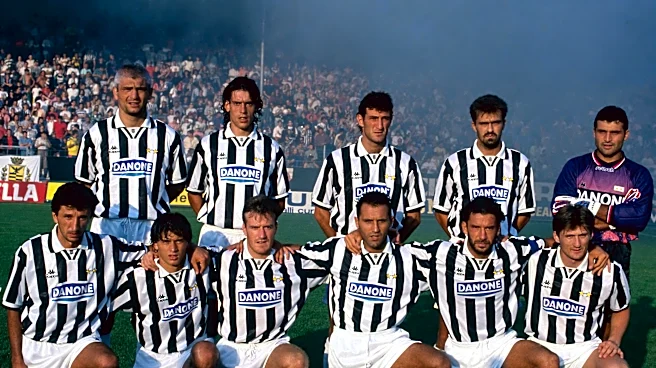




September 4, 1994, marked the quiet beginning of an era that would redefine modern Juventus. Opening their 1994–95 Serie A campaign away against Brescia at the Stadio Mario Rigamonti, Marcello Lippi launched a project that would soon dominate Italian and European football. The 1–1 draw itself was unremarkable, but this was the start of a team that would end an agonizing nine-year Scudetto drought and produce the first of four consecutive European finals — starting with the 1995 UEFA Cup final and following
it up with three straight UEFA Champions League final appearances from 1996 to 1998.

The lineup fielded that afternoon reads like a hall-of-fame ballot. It bridged two eras of greatness, pairing prime attacking genius in Roberto Baggio and Gianluca Vialli with the emerging hunger of Antonio Conte and a nineteen-year-old Alessandro Del Piero. With Angelo Peruzzi anchoring the backline and a relentless midfield engine taking shape, this was the moment Lippi’s tactical vision first took flight. Beyond the star power, it was also a pivotal afternoon for two newcomers taking their first Serie A steps in black and white: defender Ciro Ferrara and a teenage midfielder named Alessio Tacchinardi.
Ferrara’s full Serie A debut for the Bianconeri came just five days after his official club debut in a Coppa Italia fixture against Chievo Verona. Arriving from Napoli as one of the most complete defenders of his generation, Ferrara immediately slotted into the heart of the defense with unflappable composure. Over the next eleven seasons, he became an indispensable pillar of the club. Ferrara was the ultimate big-game center-back — hard-tackling, tactically ruthless, and immensely respected in the dressing room. By the time he hung up his boots, he had accumulated 358 total appearances for Juventus, five Scudetti, a Champions League trophy, and an Intercontinental Cup, entrenching himself as one of the greatest defenders to ever wear the shirt.
Tacchinardi’s introduction came at halftime, replacing Luca Fusi to make his very first Serie A appearance for Juventus. A raw, tactical prodigy brought in from Atalanta, the teenage midfielder quickly evolved from a promising youngster into the tireless engine of Lippi’s midfield. Known for his tactical discipline, bone-crunching tackles, and occasional long-range screamer, Tacchinardi gave Juve the balance it needed to compete with Europe’s elite. Across his own eleven-year tenure in Turin, Tacchinardi amassed more than 400 appearances, lifting six Scudetti and the 1996 Champions League.
In the grand scheme of things, that 1–1 draw at Brescia was a humble start. But it served as the quiet launching pad for two men who would go on to personify the grinta, tactical intelligence, and winning culture of the club for over a decade.
Ferrara and Tacchinardi would both become bedrock figures of the Lippi era and beyond, amassing hundreds of appearances, a wall full of domestic trophies, and the ultimate prize in European football. They proved that greatness in Turin isn’t just about the marquee superstars in attack, but the relentless workhorses behind them who carry the weight of the jersey year after year.
What felt like a routine opening-day fixture in 1994 turned out to be the first step of a legendary journey — one that helped reshape the identity of Juventus for a generation.