






Welcome to our annual Lakers season in review series, where we’ll look back at each player on the team’s roster this season and evaluate if they should be part of the future of the franchise. Today, we continue our series with a look at Jaxson Hayes.
Coming off a year in which he was thrust into a starting role after trading away Anthony Davis midseason and then a playoffs that saw him benched entirely in favor of 48 minutes of small-ball groups, Jaxson Hayes came into his third season with the Lakers
looking for a bit of redemption that would only really come by being properly slotted back into a reserve role.
With Deandre Ayton signed as a starter, Hayes did just that, reestablishing himself as a more than capable backup center who flashed increasingly strong chemistry with both Dončić and Austin Reaves in bench groups. He even proved productive and ready to step into a larger role on nights when Ayton was unavailable or not at his best.
Hayes did not play well every night, as his issues with discipline and focus could resurface on any given night. But Hayes did mostly play hard, and his combination of motor, athleticism and general pick-and-roll know-how allowed him to positively impact the Lakers offense in ways that truly complemented his team’s best playmakers.
Ultimately, relative to his salary and slotting in the rotation, Hayes was one of the more impactful performers in executing his job and playing his role on a night-to-night basis. Whether he’s ever able to expand beyond a backup role on a team with real title aspirations is a question with more doubts than not, but that’s not to say he cannot help a good team. After all, he did that this year and it looks like he’ll continue to be able to do so for years to come.
How did he play?
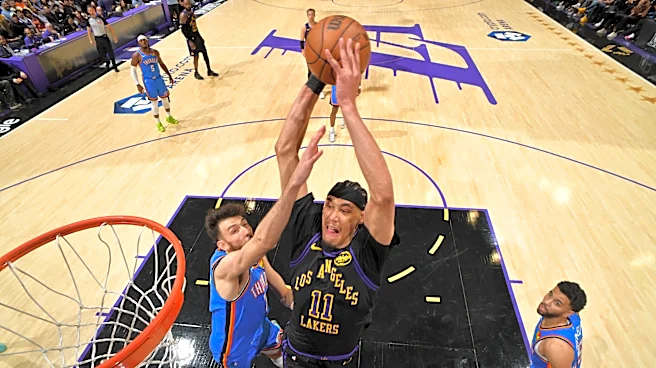
Of Hayes’ three seasons with the Lakers, I think this past year was easily his best. He shot a career-best 75.6% from the field, was a monster finisher around the basket with 122 dunks (second on the team to Ayton’s 123), fouled less while showing more discipline on defense, showed real improvement on the offensive glass and played with better motor over the course of the full year.
His finishing was particularly impactful, especially as a contrast to Ayton’s more varied attack that relied more on short jumpers, baby hooks and flip shots in and around the paint. Hayes made progress with these sorts of shots too, but he remains one of the more ferocious finishers in the league and had countless highlight dunks over the course of the season.
Whether in the pick-and-roll or just running the floor in transition, Hayes’ dynamism as an above-the-rim threat helped grease the wheels of the Lakers’ offense by drawing attention to the paint so the team’s outside shooters could get good looks and by serving as a release valve for the team’s primary shot creators. With a great catch radius and good hands, Hayes’ finishing truly was helpful.
Of course, there are limitations to being almost purely a roll man within this team’s offense and when teams switched or were able to play the Lakers’ pick and roll with just two defenders without surrendering the lob, Hayes could be neutralized and mostly taken out of the game offensively. But when teams did overcommit to Luka and Reaves, or if their general coverages were not tight enough, he could make them pay.
That said, he still made his fair share of mistakes. The illegal screens and committing a silly foul/sniping at the refs when he thought he was wronged are two of the more enduring mistakes he needs to clean up. His focus could also drift at times and if he was not locked in, he would deservedly find himself back on the bench or see his minutes reduced.
But, for the first time in his Lakers tenure, Hayes’ minutes felt less defined by the negative aspects of his game than by what his positive contributions were, which is huge progress from where he was even a season ago.
What is his contract situation moving forward?
Hayes enters this summer as an unrestricted free agent. After making a shade under $3.5 million this season, and coming off one of his better years while squarely in his physical prime and focusing on getting stronger, I would imagine he’d be looking for at least a small raise, whether on the Lakers or elsewhere.
The Lakers do have Hayes’ Bird rights and could easily bring him back at a reasonable number, but it remains to be seen if they’ll renounce those rights to try to maximize their cap space or if they’ll simply keep his relatively small cap hold on their books. If the latter, it would clearly signal their desire to keep him in the fold as a rotational big whose offensive game really does complement the team’s best playmakers.
Should he be back?
I would certainly support Hayes returning next season, especially if he’s making close to what he did this year (or a slight raise). Hayes fits well with Luka — while also sharing an agent with him and just getting his Slovenian passport to play on the national team with him too — and his general athleticism and speed are assets I believe the Lakers should continue to try to leverage as a part of their team-building strategy around Dončić (and Reaves, should he return).
Further, I’m a firm believer that as players age and show even small bits of growth while playing through their prime seasons, teams would be wise to not let guys like that walk after investing multiple seasons into their development. Hayes fits that profile neatly, and I think the Lakers would benefit from continuing to see if he can round out his game in the right ways to have him develop into an even more productive rotation player.
You can follow Darius on BlueSky at @forumbluegold and find more of his Lakers coverage on the Laker Film Room Podcast.