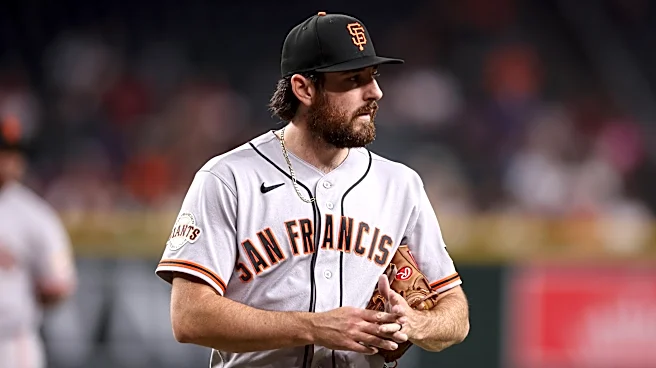


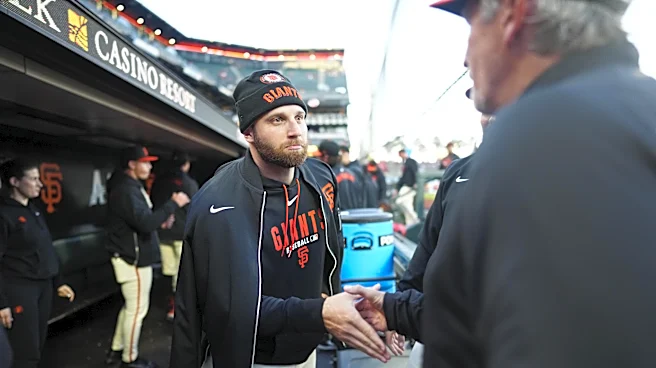
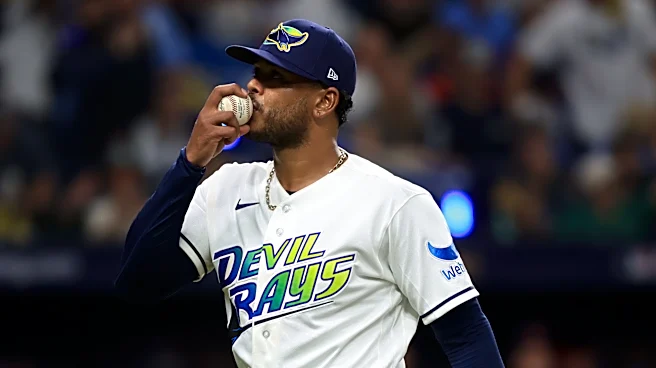
Earlier this week, the Brewers acquired right-handed reliever Ryan Walker from San Francisco in what Brew Crew Ball’s own Paul Dietrich called a “classic Brewers move.” Walker was reportedly set to be designated for assignment this offseason before the Brewers swooped in, sending two minor league pitchers (28-year-old reliever Blake Holub and 2026 11th-round pick Gavin Perry) to acquire him.
So why would the 65-win Giants move on from Walker, a high-leverage reliever in 2024 and 2025? Simple: he fell
off a cliff in 2026, posting a 7.16 ERA and 5.52 FIP in 32 2/3 innings in between Triple-A stints.
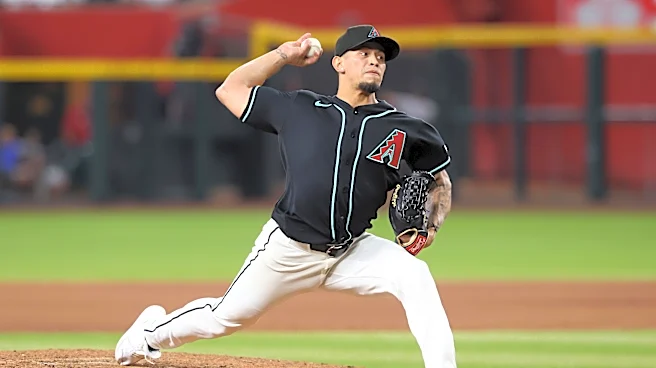
While he was still serviceable in 2025, that season already brought up some red flags; namely, Walker’s ERA more than doubled, although his FIP (3.30) suggested that things were still mostly good under the hood. Walker himself attributed his decline in 2025 to mechanical issues, telling reporters that he believed he was “over-rotating” during his unique crossfire delivery, causing issues commanding his sweeper. He’s a two pitch pitcher (sinker and sweeper), so being able to throw both pitches for a strike is paramount to his success; if he can only locate one pitch, hitters can sit on that pitch and tee off.
Most articles written about Walker echo Walker himself, chalking his decline up to continued control issues that have made it easier for hitters to sit on pitches in the zone. When you look at his walk rate in 2026 (12.3%), it’s easy to come to that conclusion, but the advanced stats paint a more complicated picture.
Walker’s edge rate (42.4%) and first-pitch strike rate (62.1%) both improved from 2025, showing that his command did in fact get better. It’s not like he couldn’t find the zone last year. The bigger problem was that hitters stopped chasing and stopped swinging and missing at his pitches.
Chase Rate by Season:
2024: 29.2%
2025: 26.1%
2026: 24.9%
Whiff % by Season:
2024: 28.6%
2025: 21.6%
2026: 14.9%
These stats don’t show a pitcher who lost his ability to find the zone; they show a pitcher whose stuff stopped fooling hitters. Walker did walk far more hitters in 2026, and some of that is simple math, since pitches just off the plate become balls when hitters stop chasing. But his zone rate also fell (52.9% to 49.9%), as did his meatball rate (9.6% to 8.2%), which suggests he may have been pitching around hitters rather than trusting his stuff in the zone.
So, why did his stuff stop fooling hitters?
The sweeper actually gained 1.7” of sweep (horizontal break), and his sinker has kept roughly the same shape since 2024, save for an extra inch of arm-side run. Unless the increase in movement has made the pitches easier to identify, it stands to reason that it’s not the shape of the pitches that has made them more hittable.
One potential contributing factor is velocity. Although Walker’s velocity hasn’t exactly cratered, both pitches have gotten slightly slower: the sinker dropped 0.5 mph and the sweeper 0.7 mph. Still, that’s not a big enough drop to be the whole reason.
The more compelling explanation is that Walker became predictable. His sinker usage climbed from 54.7% in 2024 to 65.2% in 2026, while sweeper usage fell from 44.8% all the way down to just 30.7%. It’s very, very hard to be successful when you’re throwing the same pitch almost two-thirds of the time and you only have one other pitch.
This conclusion is also supported by the advanced stats; in 2024, hitters made contact on fewer than half of the pitches they chased (49.4%). By 2026, it was nearly three-quarters (73.7%). His zone contact % also increased nearly 10 percentage points, from 80.6% in 2024 to 89.7% in 2026.
It’s also worth mentioning that Walker’s 2026 season was worse than his expected stats would suggest. While his ERA was an astronomically high 7.16, his xERA was only 4.45; bad, but not “DFA him” bad. Some of that may have had to do with the Giants’ defense, which was pretty bad last year. Also, he was way worse against lefties (2.70 WHIP) than righties (1.41), and lefties did most of their damage against his sinker (-3 run value vs. -1 against righties). That’s a usage fix the Brewers can make immediately.
In short, the stats show that there’s still something to work with, making this a classic Brewers pitching lab reclamation project. It didn’t cost much to get Walker, and the Brewers will have some work to do (tinker with his pitch selection, maybe add a third pitch, and make sure that mechanical inconsistencies no longer remain), but they’ve done this before.
The nearest example might be Rob Zastryzny. Zastryzny leaned on a sweeper that worked as a chase pitch but struggled against opposite-handed hitters, so he added a cutter that he could throw in the zone (as detailed in Brewer Fanatic). A similar fix could be in order for Walker, who has played around with both a four-seamer and a changeup before. A four-seamer would give hitters a different look up in the zone, while a changeup would give him something slower that fades away from lefties. Either one would make his sinker and sweeper less predictable.
So, keep an eye on Walker in spring training. There are three things to watch: whether he adds a third pitch (or at least throws the sweeper more), whether his whiff rate rebounds, and whether his walk rate comes back down. Any of those would be a good sign that the Brewers are getting something closer to 2024 Walker than 2026 Walker.