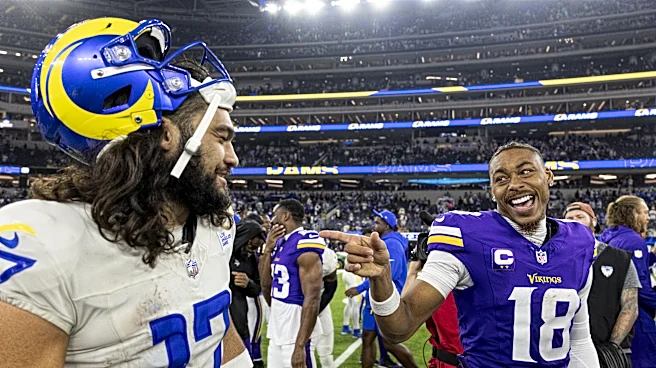





The idea of Justin Jefferson ever becoming available on the trade market feels almost impossible on the surface. Franchise receivers in their prime rarely get moved, especially one who has already established himself as arguably the NFL’s best route-runner and most dangerous offensive weapon. Yet every NFL season produces at least one blockbuster surprise, and if the Minnesota Vikings stumble out of contention by the midseason trade deadline, speculation surrounding Jefferson would immediately dominate
league conversations.
That is where the Los Angeles Rams could become one of the most fascinating teams to watch.
The Rams have consistently shown they are willing to sacrifice draft capital for elite talent when they believe a championship window is open. General manager Les Snead built a reputation around aggressive roster-building moves during the team’s Super Bowl run, trading premium picks for stars such as Jalen Ramsey, Matthew Stafford, and Von Miller. The organization has never been shy about pushing chips to the middle of the table.
What makes this situation especially interesting is the Rams’ handling of their future draft capital. Around the league, there has been growing discussion about the value of 2027 first-round picks because of the expected strength of that class and the uncertainty surrounding future quarterback prospects. Multiple reports and analyses have pointed out that Los Angeles notably held onto its 2027 first-round selection despite opportunities to move it during draft weekend.
That decision may not have been accidental.
The Rams could be positioning themselves to take another major swing during the season if they believe the roster is one elite player away from another Super Bowl appearance. Jefferson would represent exactly the type of transformational talent worth surrendering a future first-round pick for.
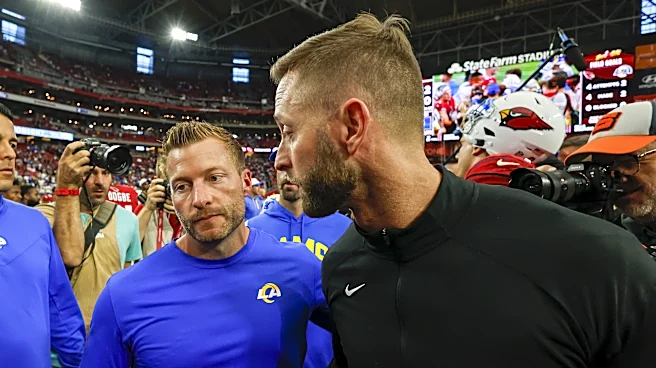
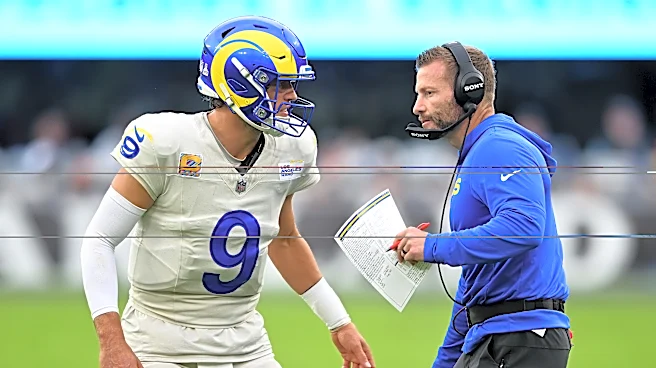
Imagine a Rams offense featuring Jefferson alongside Puka Nacua, Davante Adams, and Stafford under head coach Sean McVay. McVay has always thrived when deploying versatile route-runners who can create mismatches all over the field. Jefferson’s ability to dominate man coverage, stretch defenses vertically, and create explosive plays after the catch would elevate the Rams offense into arguably the league’s most dangerous passing attack.
From Minnesota’s perspective, a trade would only become realistic if the organization begins thinking long-term financially and competitively. Jefferson signed a massive four-year, $140 million extension with the Vikings in 2024, resetting the receiver market.
While the Vikings recently restructured Jefferson’s deal to lower his 2026 cap number, the future cap hits become enormous in 2027 and 2028. If Minnesota struggles to contend in the first half of the season or decides to acquire future picks in a loaded 2027 class, teams would undoubtedly call about Jefferson’s availability.
The Rams make sense as a potential suitor because they are operating on an accelerated timeline. Stafford is nearing the end of his career, and Los Angeles appears determined to maximize every remaining year of his championship window. The selection of Ty Simpson in the 2026 NFL Draft also gives the franchise long-term flexibility at quarterback, potentially allowing Snead to continue using premium draft assets on established veterans instead of future quarterback pursuits.

Justin Jefferson would fit perfectly into the Rams’ “X” receiver role because of his ability to consistently win on the outside against press-man coverage. His elite route-running, body control, and vertical explosiveness would give Sean McVay a true boundary target capable of dictating coverage every snap. That alignment would also allow Puka Nacua to remain in the slot more frequently, where he has become one of the NFL’s toughest receivers to defend. Nacua thrives working underneath zones, attacking linebackers and safeties, and creating yards after the catch in traffic. Pairing Jefferson outside with Nacua inside would force defenses into impossible matchup decisions across the field. The Rams would then Puka Nacua as their zone-beater and Jefferson as their man-beater.
Of course, there are still major obstacles. The Vikings would likely demand a massive trade package, potentially including the Rams’ 2027 first-round pick plus additional premium assets. Minnesota would also need to believe it could remain competitive without Jefferson or receive enough compensation to justify moving a generational receiver.
The most difficult part of this won’t be the draft capital to secure Justin Jefferson, it will be navigating the contracts of current players, extension-worthy players, and Jefferson. Let me make this clear, it is possible!
The Rams have $105 million in cap space for 2027.
The Rams have $246 million in cap space for 2028.
The players currently on the roster that are no-doubters for extensions in that timeline are Matthew Stafford, Puka Nacua, Kevin Dotson, Kobie Turner, and Jared Verse. Those guys will demand a lot of money. No argument there. But the Rams have the ability to front load, back load, and add void years onto deals to give themselves the flexibility to add a generational talent like Justin Jefferson.
Projected Extensions
- Matthew Stafford: 2 years $110 million / $55.0 million AAV
- Puka Nacua: 4 years, $170 million / $42.5 million AAV
- Kevin Dotson: 3 years, $75 million / $25.0 million AAV
- Kobie Turner: 3 years, $84 million / $28.0 million AAV
- Jared Verse: 4 years $192 million / $48.0 million AAV
Those five deals would cost the Rams approximately $198.5 million. But again, the Rams have the ability to front load and back load contracts. The Rams could pay more on the back end of Nacua and Verse’s contracts because of the length of the deals. That would extend more money in the years of 2029 and 2030.
Freeing Up More Cap Space
And if you still think money is tight, well, the Rams were creative with some of their recent contacts and they could always move on from players to get even more cash available to afford Justin Jefferson.
- Before 2028, the Rams could save $10 million by releasing Kyren Williams
- Before 2028, the Rams could save $7.25 million by releasing Nate Landman
- Before 2028, the Rams could save $12.75 million by releasing Quentin Lake
Those three moves would save the Rams $30 million in 2028 alone.
Now if you argue that I am depleting the roster, my argument would be:
- Rams turn the ground game over to Blake Corum (3rd rounder) and Jarquez Hunter (3rd rounder)
- Rams turn the linebacker duties over to Shaun Dolac
- Rams draft Quentin Lake’s replacement in 2027 late rounds (as they normally do with defensive backs)
Win-Now
If Justin Jefferson is made available, the Rams have to be willing to act. It’s an aggressive (but also defensive move). A blockbuster deal is the M.O. of the Los Angeles Rams. But making a deal also prevents a team like the San Francisco 49ers or Kansas City Chiefs from adding him and drastically improving their Super Bowl odds. I don’t think the compensation / draft capital matters to the Rams in this case and making a deal now that they have Ty Simpson in the fold, makes being aggressive easier!