










Much has been made about the WNBA’s officiating this season, which, to be fair, does not make it unlike any other season.
But a sharp increase in foul calls has drawn the public ire of coaches and players alike, leaving many to wonder if last offseason’s “points of emphasis” regarding physical play and freedom of movement had overcorrected for a problem that may not have been as big as originally perceived.
In any case, it’s something that WNBA coaches and players are going to have to adjust to, and thus
far, no team has done a better job of playing within the new rules than the Phoenix Mercury.
As one of the WNBA’s biggest early-season disappointments, one might not expect the Mercury (4-10) to be stacking up favorably in any statistical categories, but they’ve done a remarkably good job at controlling the foul game. Featuring uber-physical players like Alyssa Thomas and Kahleah Copper can only be a good thing for a team trying to draw fouls, and through 14 games, the Mercury rank No. 4 in the WNBA in free throw rate (0.374).

But that’s only one side of the coin. Phoenix has also done an excellent job at limiting how often they send opponents to the line, posting an opponents’ free throw rate of 0.256 – the lowest in the WNBA.
Take the difference between these two stats – we’ll call it “free throw rate differential” – and the Mercury rank as the WNBA’s best team at drawing shooting fouls while limiting how often they themselves foul. Their free throw rate differential is 0.118, ahead of second-place New York (0.083) and third-place Washington (0.053).
How much does this mean, really?
Taken alone, probably not much. No one can claim that the Mercury have actually been a better team than the Liberty, nor that the league-leading Minnesota Lynx (No. 12 in the WNBA in free throw rate differential; -0.056) are in any sort of imminent danger.
While the “Four Factors” are generally good predictors of team success, that’s usually if a team ranks favorably in two or more of them. Using the Mercury as an example, they rank No. 12 in effective field goal percentage (47.2 percent) and No. 14 in opponents’ effective field goal percentage (53.5 percent), all but nullifying their advantage at the free throw line.
Rebounding has suddenly become a huge issue for the Chicago Sky
Speaking of early-season disappointments, the Sky are now 4-9 after an overtime road loss to Indiana, and they’ve dropped eight of their last nine games after a promising start.
It’s easy to point to injuries as the reason why; Courtney Vandersloot and DiJonai Carrington have yet to play a game, and Azurá Stevens is still getting acclimated after missing the team’s first five contests. Meanwhile, Rickea Jackson is nursing a torn ACL, an injury that sent the Sky into a tailspin they’re still trying to put a stop to.
Chicago ranks near the bottom of the WNBA in several statistical categories, particularly offensively: The Sky are No. 13 in offensive rating (99.2 points scored per 100 possessions) and No. 14 in both effective field goal percentage (46.2 percent) and true shooting percentage (51.8 percent). Given the amount of Chicago’s offensive talent that is currently in street clothes, these scoring struggles aren’t much of a surprise.
What might be a much bigger surprise is how poorly the Sky have fared on the boards. In past seasons, rebounding was by far Chicago’s greatest strength, and it was often the only thing that kept the team in games.

Now, however, it’s become a glaring weakness. The Sky rank No. 14 in the WNBA in offensive rebounding rate (26.5 percent) and dead last in defensive rebounding rate (63.5 percent). The fact that the Sky are having trouble scoring efficiently is bad enough; that they’re having such a hard time getting extra offensive possessions (as well as ending those of their opponents) exacerbates those offensive struggles significantly.
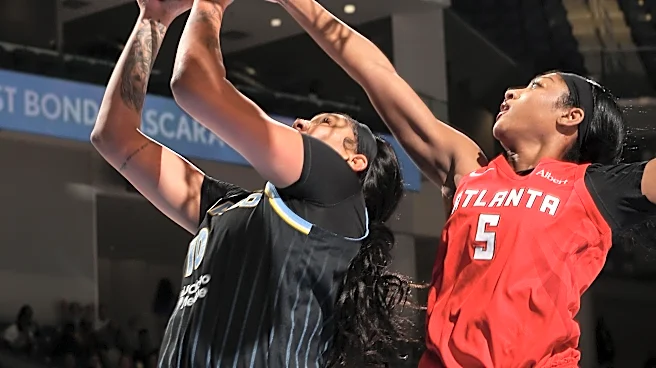
There is, of course, one major change that took place between this season and last season, when the Sky led the WNBA in offensive rebounding rate: the trade of Angel Reese to the Atlanta Dream.
Since she was drafted in 2024, no player has been more impactful on her team’s overall rebounding numbers than Reese, and it should shock absolutely no one that the Dream have suddenly become the league’s most prolific offensive rebounding team.
That being said, there are five players on the court at a time, and despite Reese’s talents as an individual rebounder, there’s no good reason why her departure from Chicago should have resulted in a first-to-worst slip. It’s one of many areas the Sky are going to need to clean up if they’re going to climb out of the hole they’ve dug for themselves.
Can the Valkyries keep making enough 3s to overcome their subpar 2-point scoring?
This is something we touched upon recently, but it deserves mentioning again.
The Golden State Valkyries have gotten off to a scorching start shooting the basketball, leading the WNBA in 3-point makes (12.1) and attempts (31.9) per game. They also rank No. 3 in offensive rating, scoring 110.7 points per 100 possessions—a major improvement from their inaugural season, when they ranked No. 10.

What’s interesting is that while the Valkyries have clearly been the league’s best 3-point shooting team, they’ve also been its worst on 2-pointers. According to Basketball Reference, Golden State is shooting just 43.3 percent on 2-point shots—dead last, and nearly three whole percentage points behind No. 14 Seattle—and ranks only ahead of Chicago in shooting percentage inside the restricted area (56 percent).
Is this why the Valkyries depend so heavily on the 3-pointer in the first place?
Though you’d have to ask head coach Natalie Nakase yourself, it’s surely a factor. Golden State has a talented roster, but not many of its players excel at putting pressure on the rim, and none of the bigs on the roster could be considered consistent post-up or putback threats.
One could put it this way: The Valkyries have been good at making difficult shots and bad at making easy ones.
While the “math game” of maximizing possessions by launching as many 3s as possible has alleviated at least some of Golden State’s 2-point scoring concerns, the Valkyries will have to find a way to get easy buckets in the paint if they’re going to hang with the WNBA’s top teams. The question is: Can they keep knocking down 3s at their current rate to make up for the offensive weaknesses elsewhere on the court?