


12. Herick Hernandez – LHP
How he got to the Braves: 2024 4th round pick (#129 overall)
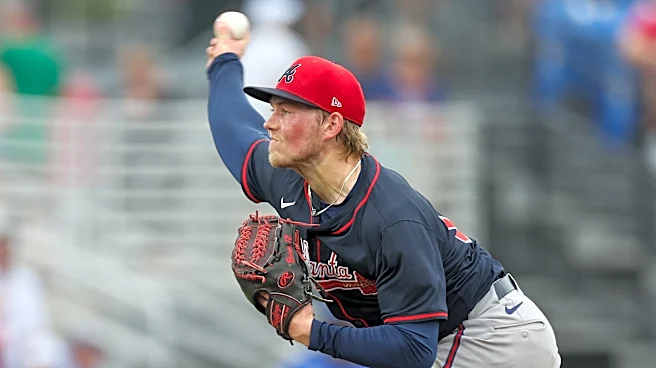
The Braves took Herick Hernandez in the fourth round two years ago and the lefty out of Miami is already in Triple-A. He’s split the year between three levels, though the one start in Augusta was a rehab start after missing a little time early on in the year. In his 11 starts in Double-A he has posted a 2.80 ERA, 1.42 WHIP, and 64 strikeouts to 31 walks in 45 innings. In his first two starts with Gwinnett he has allowed eight runs in 8.2
innings, striking out seven but also walking seven.
Hernandez was dominating for Columbus and had posted a 12.8 K/9 rate thanks to a nasty curve and a fastball which has good life on it. He has the four-pitch mix needed to start, but his problem has always been his well below average command. When he is on he has proven to be unhittable in the minors, but he is also a guy walking 6.1 BB/9 this year and 5.8 for his career.
Hernandez is already about to turn 23 in the first half of August, so if he can’t get the command ironed out by the end of next year he would likely be looking at a reliever role in the big leagues. Hernandez has real potential as a middle reliever or lefty setup man, but the Braves would obviously prefer if he was able to reach his middle of the rotation upside as a starter first. Now that he is in Triple-A, his big league ETA is any time as he could potentially get a call to help out of the pen should the need for a lefty arise.
11. Conor Essenburg – OF
How he got to the Braves: 2025 5th round pick (#157 overall)
Last year the Braves spent on Illinois prep two-way star Conor Essenburg in hopes that he had a promising power bat to develop. The early returns have been promising as he has hit .250/.397/.452 with 10 doubles, two triples, eight homers, 46 walks, and 80 strikeouts in 237 plate appearances for Augusta. The strikeout totals have been high, but the 19-year-old, who won’t turn 20 until mid-September, still has plenty of time to work on cutting down on them. He has split the year between right and center field – though his likely future would come in right, where he has a big arm to profile as a prototypical right fielder.
Essenburg is still filling in his 6’2’, 200-pound frame and learning how to get his power to translate more frequently but his advanced approach and a feel for making hard contact are big plusses for a kid who has only been a full time hitter for the last year. Essenburg will have the upside to be a legitimate solid big league starting outfielder who has value for both his bat and glove. He is probably not going to be ready for the big leagues until sometime in 2029, but he is looking like a strong pick early on.
10. Kaiden McCarthy – RHP
How he got to the Braves: 2026 2nd round pick (#48 overall)
Kaiden McCarthy was the first of the overslot prep arms the Braves invested in during the 2026 MLB draft, and he comes in with an electric fastball that is the cornerstone of a balanced arsenal. McCarthy is a young arm even for a prep player and doesn’t turn 18 until next week, and blends present day talent with a moldable future. Coming from cold-weather Vermont McCarthy’s exposure to scouts was lesser than his peers, but he impressed enough that most projected him as a day one pick if he was signable, and that is what happened. McCarthy has shown a feel for spin as a prep player and flashed a changeup, though the latter pitch is not well developed yet as is common with high power prep arms. McCarthy mostly gains attention for a fastball that can touch 99 mph, which he can throw with both a four seam and sinker variant.
McCarthy is going to be a project and comes with all of the drawbacks that hard-throwing prep pitchers have, though he has a clean delivery and a the athleticism to project to average command at the next level. The Braves will have the opportunity to mold the rest of his arsenal to their liking, and with him already showing the potential to spin two average or better breaking balls there is plenty to work with. McCarthy will require patience, but the Braves have had success developing young pitchers with his athleticism/experience profile in recent years. His lower mileage as a cold weather arm could be a benefit to his health, though as we have seen that is hardly a predictable metric and hard-throwing prep arms always come with concern of future arm trouble. McCarthy is a bit undersized at an even six-foot-tall, and though that serves his four seam fastball well up in the zone it raises the requisite concerns about durability. McCarthy and the rest of his pitching cohort are going to likely make significant moves next season once we get looks at them in Single-A, though for right now he is a player that comes into the system with our confidence to stamp him with the first of the top 10 prospects.
9. Jensen Hirschkorn – RHP
How he got to the Braves: 2026 3rd round pick (#84 overall)
Drafted using the savings from going under-slot on the first two picks Jensen Hirschkorn enters a farm system with some of the highest performing teenage pitching in baseball. The Braves needed upwards of $3.9M to sign Jensen out of his commitment to LSU and a very quick glance of some video easily shows why the Braves are gambling on the big, talented arm. Coming into the draft, Jensen was considered the #15 rated player in the entire draft according to Baseball America, and a clear five-star prospect.
Standing at a mammoth 6’7”, Jensen is already a presence on the mound despite the ability to add on a solid amount of weight onto the frame. Jensen, at 18, already projects at having three plus pitches thanks to some very advanced command for his age. His ability to command his fastball, that currently sits 95-96 that many believe will increase with more conditioning, at the top of the zone consistently puts him ahead of most of his class. Jensen also has a very good ability of generating spin which has helped him with his slider that also grades as plus. Lastly, while his changeup is behind both the fastball and slider, it shows enough depth that it is also projected to be a plus pitch. Even as someone that’s watching video – it’s already difficult to pick up the ball out of his hand because of his natural arm action making him that much more difficult to hit which can be seen by his 0.71 ERA as a high school senior.
With his plus slider, it will be interesting to see if the Braves employ their normal pitcher strategy and have him toy with a sweeper. If not, they may focus on the fastball, and potentially add a cutter, or two-seam, as the Braves have done to pretty much every single pitcher in the organization. Jensen has some of the highest upside in the organization, including position players, and with his plus command on all three pitches he will likely move faster than you expect from a prep pitcher. Along with Cam Caminiti, and Briggs McKenzie, the Braves will roll out a three headed monster a top their prospect list for quite some time.
8. Diego Tornes – OF
How he got to the Braves: 2025 International Free Agent
The Braves top international free agent last year, Diego Tornes hit .279/.395/.402 with five doubles, five triples, 24 steals, 23 walks, and 32 strikeouts in 147 plate appearances in the DSL last season. He moved up to the FCL this year where he has hit .196/.274/.304 with four doubles, four triples, eight steals, eight walks, and 27 strikeouts in 124 plate appearances – though his FCL season ended a little early due to injury.
Despite his stats Tornes has looked like a potential five tool player with serious power potential, even though he hasn’t hit a professional home run to date. His FCL numbers this year weren’t ideal, but his underlying numbers looked better than his stat line indicates. Tornes is potentially fast, powerful, and has big time bat speed along with having a real chance to stick in center defensively.
Tornes is likely to move to Augusta next season for just his age-18 season. The upside for the young Cuban is enormous, maybe higher than any hitter in the system, it is just that he is years away from being ready. I would say his ETA looks like 2030, with a chance to move that up if things really start to click sooner for him.
7. Owen Murphy – RHP
How he got to the Braves: 2022 1st round pick (#20)
With all of the pitching prospects the Braves paid to bring into the fold in 2026, Owen Murphy is a great example of the blueprint Atlanta has followed in spreading money between a handful of pitchers. As the headliner of an impressive 2022 class Murphy came in with high expectations and has done nothing but beat them at every step of his journey. In his first full season he struck out nearly 30% of batters faced between two levels, then went two High-A in 2024 and posted one of the best seven-start stretches in recent memory. Murphy started 2024 with a 1.54 ERA/2.22 FIP and 38.7% strikeout rate across 41 innings, but went down with a UCL tear and missed the rest of that season and most of 2025. He returned to High-A in 2025 less sharp and with a noticeable decline in stuff, but another offseason of rest has Murphy stronger than ever in 2026. He got off to a shaky start due to some uncharacteristic command issues at Double-A, but received a promotion to Triple-A nonetheless and really found his stride in mid-May. In his final nine Triple-A starts Murphy had a 2.86 ERA/3.11 FIP with a 30.1% strikeout rate, and earned his first big league call up on July 6th. Murphy has been solid in inconsistent action, pressed to Atlanta more out of need than readiness, and armed with knowledge of his shortcomings has returned to Triple-A to further develop his arsenal.
Murphy’s arsenal hinges on a plus fastball, which is not a phrase typically associated with a player who averages 92.4 mph on his fastball in Triple-A this season. Murphy saw some velocity regression after being drafted though largely it has rebounded since Tommy John surgery, but his other fastball traits are impressive enough to escape his below average velocity. Murphy’s fastball has plus carry and he does such a terrific job of commanding the pitch at the top of the strike zone that he still produces a good whiff rate and plus results on the pitch. The Braves have done a lot of work to lock down exactly how his secondaries will look at the major league level, and right now he is nearly 80% fastball-slider with curveballs and changeups mixed in to combat left-handed batters. He throws his slider hard and spins it well, and it has produced good results at Triple-A and projects to be an average pitch. His changeup is the pitch he hasn’t fully developed into a major league quality weapon yet, and stands as the next barrier to him cracking a major league rotation as a full-time starter. He has the command of his arsenal and the two pitches primed to work through major league lineups multiple times, but he needs a real third weapon to reach his potential and right now his changeup is not that pitch. Murphy projects as a reliable back end starter and has a high chance to reach that projection at this stage in his development, though he may not have the ceiling of other starters in this range. Murphy’s plus command makes everything look better and gives him less variability than others his age with his lack of experience, and finding a consistent feel for how to attack lineups deep into games is an area Murphy has improved on. Murphy has managed to maintain his success missing bats at the upper levels, and like many with velocity limitations he can run into home run trouble but keeps his fastball away from the middle of the zone enough that it hasn’t been a killer to an otherwise sparkling profile statistically. Any regression in his command could be problematic, but given his age, simple mechanics, and plus athleticism there is no reason to think he won’t do anything but continue to improve in coming seasons. It’s a narrow profile but one that Murphy and the Braves are honing to perfection.