



The Yankees of the mid-2000s were a team that had grown long in the tooth, particularly in the rotation. A team already leaning heavy on veterans: namely Mike Mussina, well into his thirties, and Randy Johnson, who had already blown out 40 candles. Ahead of the 2007 season, Johnson returned to Arizona, but the Yankees simply swapped out senior southpaws, bringing back a soon-to-be-35-year-old Andy Pettitte to take the Big Unit’s rotation spot.
So, what do you do when most of your best players are
on the opposite side of 30? Sign a 44-year old starting pitcher a few months into the season. What’s one more?
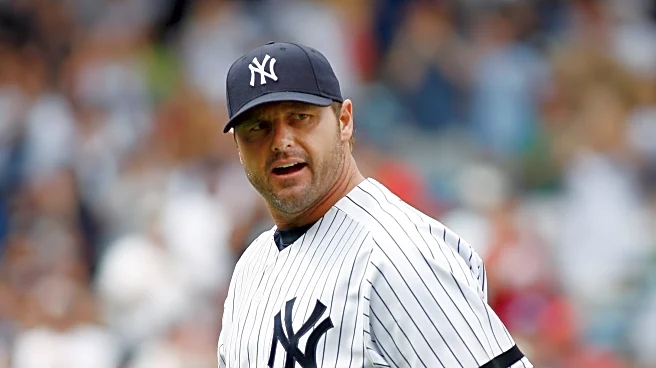
Of course, said 44-year-old was Roger Clemens, one of the most prolific and dominant starting pitchers of all time. The Rocket had won a pair of titles with the Yankees in 1999 and 2000 before capturing the 2001 AL Cy Young Award. It seemed like he would retire a Yankee, as he told the media that ’03 would be his last season. But after the Yankees let Pettitte walk in free agency to the Astros, Clemens was convinced to change his mind and lead their rotation with Pettitte, just as he had in New York. It was a homecoming for the graduate of Houston’s own Spring Woods High School, and it turned out that Clemens had more in the tank, winning his seventh Cy Young in ’04 and having the case for another in ’05 with a league-leading 1.87 ERA for the NL champions.
Clemens kept considering retirement though, and despite pitching for Team USA in the inaugural World Baseball Classic, he chose to remain unsigned as Opening Day 2006 came and went. The Astros were determined to have him back, and on May 31st, they got their man on a prorated contract that also allowed him to skip certain road trips. Following another stellar season in his forties however, Clemens was again leaning toward retirement as he skipped Opening Day 2007.
Once more, the Rocket was convinced for another relaunch. But this time, he was coming back for one last ride in pinstripes. After showing up out of nowhere in George Steinbrenner’s box at Yankee Stadium and announcing his return mere days after Hughes’ injury, Clemens put together a perfectly cromulent final campaign in MLB — but the Yankees would fall in the Division Series for the third consecutive season.
Roger Clemens
Signing Date: May 6, 2007
Contract: One year, $28 million (prorated to $18.5 million)
First, we have to talk about the spectacle at the Stadium that May afternoon. The Yankees had gotten off to their typical-of-this-era cold start, going 9-14 in April and entering their Sunday matinée with the Mariners two games under .500. They’d endured a slew of injuries to start the season that had already cost their strength and conditioning coach his job. The most painful one yet hit rookie standout Phil Hughes, who had to be pulled from a no-hitter in the seventh with a hamstring strain on May 1st.
New York needed a morale boost. So, at the seventh-inning stretch, with the Yankees leading 3-0, Clemens made his dramatic re-entrance.
Clemens’ short speech was not an all-timer, but there was an undeniable show-business element to the whole affair that we rarely see in sports outside of pro wrestling. Of course, fans at the ballpark and watching on TV could watch the whole thing play out, but those tuning into WCBS’s radio broadcast of the game would need to be told what was happening.
Leave the honor to Suzyn Waldman.
Of course, we are big fans of Suzyn here on Pinstripe Alley, so it is with great appreciation that I say her introduction of Clemens was a bit much. “Oh my goodness gracious! Of all the dramatic things I’ve seen — Roger Clemens standing right in George Steinbrenner’s box, announcing he is back! Roger Clemens is a New York Yankee!” she proclaimed. It’s safe to say the former theatre actress appreciated the drama of the moment, but the soundbite would take on a life of its own.
Clemens signed a one-year deal valued at $28 million. It was prorated to $18.5 million though since he signed late and did not make his season debut until June 9th, and in the meantime, he tuned up in the minors with Tampa, Trenton, and Scranton/Wilkes-Barre.

Let’s go ahead and fast-forward to June 9th. The Yankees were in a similar spot to where they were when Clemens announced he was back, sitting at 28-31 and battling Baltimore and Toronto for second place in the AL East, well behind the front-running Red Sox (39-21). Thankfully, the Rocket was in good form after the long layoff.
With the Pirates in town, Clemens pitched six strong innings, allowing three runs on five hits while striking out seven batters in a 9-4 win.
After this game, the Yankees would go 65-37 the rest of the way, though not because Clemens was at the top of his game. To be sure, there were sprinkles of vintage Rocket here and there, like consecutive eight-inning, one run efforts to begin July — which helped pare down his ERA from 5.32 to 3.64, the lowest it would go during the year. The first of those, a victory over the Twins, was the 350th win of his MLB career.
Regrettably, there were also some ugly nights, like August 2nd, when two days before his 45th birthday, Clemens was chased from the game after allowing eight runs in the second inning (only three of them were charged as earned runs due to a two-out error by Robinson Canó). This was clearly not the same Clemens who had recently won further accolades in Houston despite his age. This Clemens could usually scrape by, but couldn’t lead a playoff rotation.
Still, the Yankees’s second-half surge had begun in earnest, and they polished off the regular campaign by going 19-8 in September, securing the American League Wild Card spot. Clemens finished his final season with an even 6-6 record across 18 appearances (17 starts and one relief appearance) and 99 innings. He pitched to a 4.18 ERA (108 ERA+) with 68 strikeouts and a 1.313 WHIP — not too shabby for a guy who was born when Eleanor Roosevelt was still alive. Clemens’ last regular season start, fittingly, came at Fenway Park, where he held his original team to one unearned run on two hits in six frames. The Yankees won, 4-3.
As the Wild Card team, the Yankees would travel to Jacobs Field to square off with Cleveland in the ALDS. Cleveland that year boasted an intimidating pitching staff led by AL Cy Young Award winner CC Sabathia and Roberto Hernández — then known under his nom de guerre, Fausto Carmona. But in Game 1, it was Cleveland’s bats who led the way, clobbering Chien-Ming Wang and the Yankee pitching staff in a 12-3 win. Then in Game 2, the infamous Midges Game of Joba Chamberlain lore, Carmona dominated and the Bombers were walked off by Travis Hafner in the 11th inning.
So the Yankees went back to the Bronx fighting for their playoff lives as Clemens got the ball for Game 3. His start didn’t go as he might have hoped, with Cleveland scoring a run in the first and the second. In the third inning, after striking out Víctor Martínez with a man aboard, Joe Torre came to the mound. The trainer came with him, and Clemens subsequently exited with a hamstring strain, walking off a major-league mound one last time.
Hughes was brilliant in relief as the Yankees came back to win Game 3, 8-4. That was unfortunately the last gasp of the Torre Era Yankees, and they fell 6-4 the following night. They had been eliminated in the ALDS for the third-straight season and the fourth time in six years.
The surprise return of Roger Clemens to the Bronx had all the pomp and circumstance of a hero returning home. But the Texan flamethrower, fighting against Father Time, provided only a modest boost for a team already fully-stocked with late-career stars. This would probably have been the end for Clemens regardless, but the decision was made for him two months after his final start, when he was named as a PED user in the Mitchell Report. He became a lightning rod that no one wanted to touch, and his Hall of Fame trajectory was perhaps permanently imploded.
That 2007 playoff series was the last the old Yankee Stadium would ever host. In a few short years, there would be a new Yankee Stadium. Both Clemens and the old yard would soon enter baseball’s past together, and Clemens was acutely aware of just how little time he had left in the House that Ruth Built. After his first start of the season, he told reporters, “I’ve got to take a little deep breath now… this Stadium’s not going to be around much longer. It sure is a joy.”
See more of the “50 Most Notable Yankees Free Agent Signings in 50 Years” series here.