
Passiveness has cost Real Madrid a lot. The team’s out of possession woes have been exposed. Passivitiy gives opponents the opportunity to return in the game when the score is tight, enabling them to steal points from Real Madrid.
Passivity is clearly apparent in how Real Madrid acts through different game states:

When Real Madrid are ahead:
- Possession drops from 58% to 49.8%. It is intentional, and at the same time, the opponents find themselves in a situation where they have to try to get back into the scoreline.
- xG, crosses, and shots are the same when winning and drawing; however, accuracy improves because the team is already in a positive game state, which means players aren’t under as much stress when taking shots.
- The number of counterattacks is nearly double in the neutral game state because Real Madrid gives up possession, sits deeper, and relies more on the pace of players like Kylian Mbappé and Vinicius Junior to hit large spaces.
- The number of possession losses increases as well, because the players tend to be more adventurous and less risk-averse.
- There is an increase in long passes (19.4) compared to when the team is level (15.43). Real Madrid clips long passes 5.91% of the time when drawing. However, the number jumps to 6.5% when the team is ahead. It’s worth noting that neither Real Madrid has a target striker nor is there a plan to hunt second balls, which increases the possession loss rate.
- The PPDA (Passes per defensive action measures how many passes the team has allowed the opponent before making a defensive action in the advanced 60% of the pitch) is already low throughout different game states and is at its lowest point when winning (18.5).
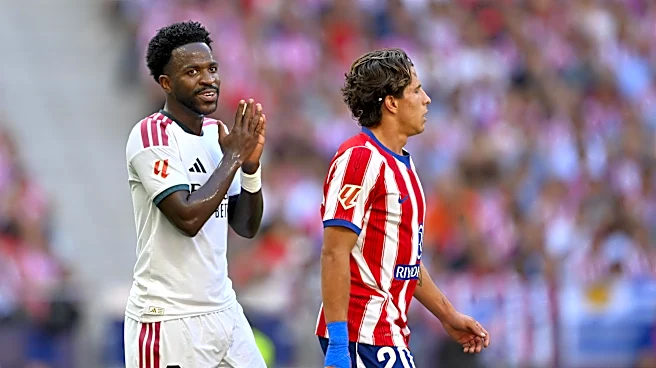
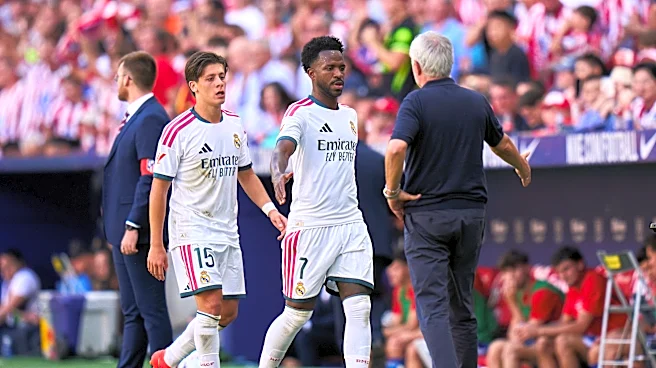
Atlético Madrid was a real test for Real Madrid and José Mourinho. The Metropolitano has been a tough nut to crack, and with the display the team showcased, it has become
a curse for Los Blancos. The strategy José Mourinho adopted was no different from the one Real Madrid relied on against Inter: trying to get into a positive game state quickly enough and defend the lead by sitting deeper in order to force Atlético Madrid to play under less favourable circumstances. However, Diego Simeone’s side didn’t give their rivals in Madrid what they aspired to. Not only that, but Real Madrid spent most of the time in a neutral game state and were forced to deal with a trailing position while being one player down.
This is how Real Madrid’s possession numbers looked throughout the game:

First of all, Real Madrid’s possession was below 50% throughout the game. Moreover, half an hour in, the possession rates kept plummeting. According to Wyscout, Real Madrid generated nothing from counterattacks in the Madrid derby. Additionally, the white team created close to nothing from open play (0.17 xG) and failed to exert any sort of territorial dominance, as highlighted in the field tilt graph:

In the piece Real Madrid’s Problems Vs Real Betis, In Detail, we highlighted that:
“Surrendering possession and resorting to defending deep over certain periods gave the opposition team the opportunity to look for different routes to generate threat and return in the score, especially when Real Madrid doesn’t display compactness and coordination during these phases. In fact, it becomes riskier in neutral game states, as the team concedes play near the penalty box, which means it becomes susceptible to giving up more crosses, shots, set pieces, etc and as a consequence, the probability of conceding goals increases.”
In the Derby, Real Madrid experienced playing in a neutral game state for a long period and defending in a passive way. On the other side, Atlético Madrid was comfortable, didn’t find themselves pinned in their final third, and kept the ball for the majority of the time in the attacking half. As a consequence, Simeone’s side controlled the game more efficiently and exploited Real Madrid’s defensive frailties to exacerbate José Mourinho’s side’s situation and force the visitors to chase the game with a player down.
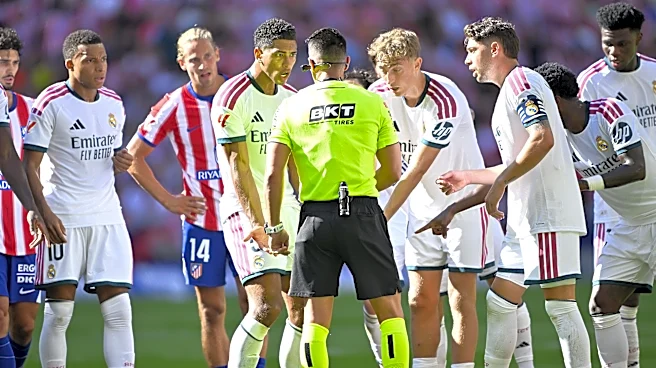
The red card was rock bottom for Real Madrid and was a culmination of the team’s approach to the game. The incident leading to the red card painted the picture of what Real Madrid is curently is. The lack of intensity and urgency paved the road for Atlético to escape the traffic on their right side easily and switch the play to the underloaded side, where David Hancko found an island in front of him to scamper forward, noticing Giuliano Simeone’s channel run beyond Dean Huijsen. The latter behaved in a reckless way, holding the Argentinian winger by the arms for the referee to send him off:

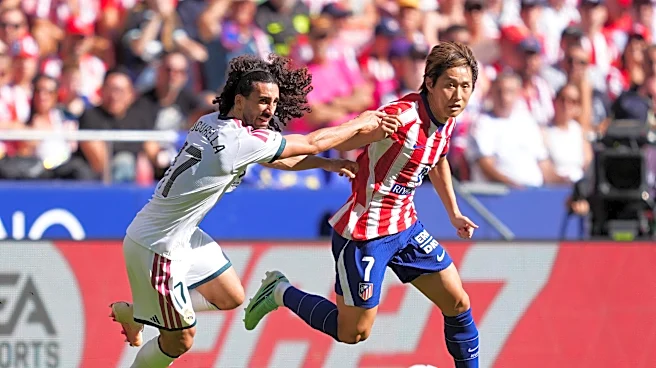
Five minutes after Grimaldo’s goal, Real Madrid paid the price for their passive approach for the second time. Atlético Madrid enticed Mourinho’s side to step up from the 4-4-1 medium block. Mbappé and Valverde jumped onto the center-backs; Diomandé ran from in-to-out toward Llorente. Tchouaméni and Bellingham marked Koke and Cardoso. David, Baena, and Kang-In pinned Konaté, Rudiger, and Cucurella. Hence, Romero picked out Simeone free on the right flank. Kang-In pulled off wide, opening up the diagonal lane between Simeone and Baena. The trio broke down Real Madrid’s midfield via a third-man combination. Neither Diomandé nor Cucurella reacted intensely against Kang-In and Simeone. The latter comfortably crossed the ball for Jonathan David to tap it in between Dumfries and Konaté:

There is a famous quote from Pep Guardiola, shedding light on the purpose of ball possession: “We do not pass to move the ball. We pass to move the opposition.” When Real Madrid surrenders possession, the players need to run, chase, press, step up intensely, retreat quickly, etc., which increases the rate of physical fatigue compared to when the team opts for a proactive approach.
European Journal of Sport Science published a study about “The influence of ball in/out of play and possession in elite soccer” and found that:
“Ball possession markedly effected physical intensity, with the rates of distance covered running (+31%), at high-speed (+30%) and in total (+7%) greater out than in possession.”
So, not only does giving up the ball and defending in a loose shape increase the probability of defeat, but it also contributes to more fatigue and physical load compared to when the team dominates possession.