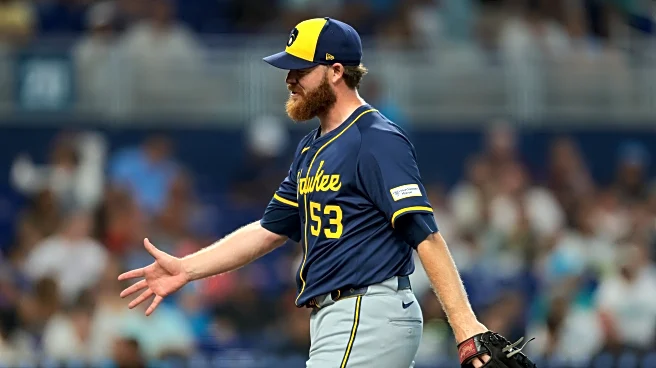

When Freddy Peralta was traded from the Brewers, we lost not only a beloved franchise hero, but we also lost one interesting storyline from the season: had Peralta remained a Brewer and been healthy throughout the season, he would’ve passed Yovani Gallardo as the franchise’s all-time leader in strikeouts. As it stands, Peralta is instead third, with 1,153, behind Ben Sheets (1,206) and Gallardo (1,226).
With that particular race no longer relevant, I thought I’d look and see if there were any other
notable franchise milestones that could be eclipsed in 2026. A disclaimer: there aren’t any major team records in danger of falling, but there are still some interesting things to keep an eye on for those who are curious about team history.
Will Christian Yelich move into fourth place in WAR among position players?
Fourth place doesn’t seem like that big of a thing, and I’d agree with that. But here’s the thing: in Milwaukee franchise history, the gap between third and fourth is huge, so we can think of this less as “fourth place” and more as “best of the rest.” Robin Yount is the clear clubhouse leader at 77.4 WAR — a record which may never be broken, considering the challenges the future Brewers would have at keeping that level of superstar for their whole career — followed by another Hall of Famer, Paul Molitor (59.9), and the 21st century representative on the list, Ryan Braun (47.2).
After that, there’s a big gap, and then things bunch up a bit. The next four gentlemen are all within 4.5 WAR of each other, and Yelich is in the middle of that group:
- Cecil Cooper, 30.7
- Don Money, 28.4
- Yelich, 27.5
- Jeff Cirillo, 26.2
So, Yelich needs 3.3 WAR to become the sole owner of fourth place on this list. That seems quite doable on the surface, but Yelich has eclipsed 3.2 WAR only once in the past six years, and his new role as a designated hitter makes it even harder; last season, when he played 150 games and had a 121 OPS+, Yelich earned 3.1 WAR. At this point, I’d say it’d be at least somewhat surprising if Yelich passed Cooper this season. With three years remaining on his contract and other teams unlikely to trade for his high salary and injury risk, Yelich likely plays enough with the Brewers to pass Cooper no matter what, but if he does get past him this season, it’s a very good sign for the club.
Yelich should also move up the leaderboards in several other notable categories: a healthy-ish and even mediocre season should see him move up to fourth in stolen bases, third in walks, and fifth in runs scored. He is just two home runs behind Ben Oglivie for seventh on the franchise list (Yelich has 174, Oglivie 176); he certainly could threaten Cooper in sixth (201) with another season like 2025. Gorman Thomas and Geoff Jenkins come next, and while it’s not inconceivable that he could catch those two in 2026, it would require a huge season: Thomas is at 208 homers, 34 ahead of Yelich, and Jenkins is at 212, 38 ahead.
How long before Brice Turang is the franchise leader in WAR by a second baseman?
The Brewers have had a bunch of good third basemen in their history. They’ve had several great first basemen. They’ve had one all-timer at shortstop. Second base? Not so much.
The franchise leader in WAR among second basemen would be Gumby, Jim Gantner. Gantner is a beloved figure in the team’s history, a guy who grew up in Fond du Lac, went to college in Oshkosh, and spent all 17 years of his major league career with the Brewers. Ganter was, we’ll say, serviceable. He was a good defensive player who could hit some singles, but he didn’t really take walks, and he didn’t really hit for any power. In 17 years, Gantner had more than 2.6 WAR in a season only once; he finished his career with 22.6 WAR via Baseball Reference, at a rate of 1.3 per season and 2.0 per 162 games.
In second place on the second base list is a personal favorite, but not someone who I exactly think of as a franchise icon: Rickie Weeks. Weeks’ career was marked by frustratingly unfulfilled potential, bad defense, eye-popping home runs, and untimely injuries. He played in parts of 11 seasons in Milwaukee and earned 12.5 WAR with the team.
Just behind him is Turang, with 11.8 career WAR. With 4.7 and 5.6 WAR via Baseball Reference in his last two seasons, Turang now owns two of the top four single seasons by a second baseman in franchise history (5.6 is tied with Paul Molitor’s 1979 season for first; the other entry here is Don Money’s 5.1 WAR season in 1977), and he’s got a pretty solid argument for being the best second baseman in franchise history. Assuming he doesn’t take an unexpected step back, Turang should solidify that argument this year. I don’t expect we’ll see an 11 WAR season in which he’d pass Gantner for the franchise record, but he should put himself in a position where he could challenge that in the 2027 season.
If this is Brandon Woodruff’s last season in Milwaukee, what records will he hold?
As we start the 2026 season, Woodruff holds a handful of franchise records already, but they’re all rate stats that he could conceivably lose if he doesn’t have a good season. There are also a couple of other rate stats in which he could move up the leaderboard if he DOES have a good season, so that’s worth watching as well. Given that Woodruff will be an unrestricted free agent after the season, the expectation is that he’ll ply his trade elsewhere in 2027, though that’s not certain. If this is his last season in Milwaukee, though, here are some things to keep an eye on:
- Woodruff is first in franchise history in ERA (3.10) among pitchers with at least 500 innings pitched or 50 decisions; second place is Dan Plesac at 3.21. He’s also the franchise leader in ERA+ (136, with Corbin Burnes second at 129).
- He’s also first in WHIP, at 1.034; second place is Burnes at 1.055.
- Woodruff is also the franchise leader in K/BB ratio, at 4.584; he’s got a decent cushion here, with Burnes second at 4.223.
- It would require quite a season to move up this leaderboard, but Woodruff is third in H/9, at 7.007, which is behind both Burnes (6.877) and Peralta (6.709).
- Woodruff also ranks third behind Burnes and Peralta in K/9 (10.522, compared to 11.039 for Burnes and 11.146 for Peralta). This one seems unlikely, given that Woodruff’s strikeout stuff was off his earlier pace last season.
- A healthy season would see Woodruff move into fourth in strikeouts (he enters the season with 871), passing Jim Slaton, who is at 929. Teddy Higuera’s fourth-place mark of 1,081 is not completely out of the question, but Woodruff would need to match his career-high strikeout total (211 in 2021) to pass him.
- Assuming the Brewers are good, Woodruff should pass Brent Suter for the best win-loss percentage in franchise history (Suter is at .655, Woodruff is second at .654).
Woodruff’s standing in franchise history was solidified a long time ago, but a strong season could really make discussions about him as the best starting pitcher in the team’s history necessary. (Right now, the top four are, in some order, Woodruff, Higuera, Burnes, and Sheets.)