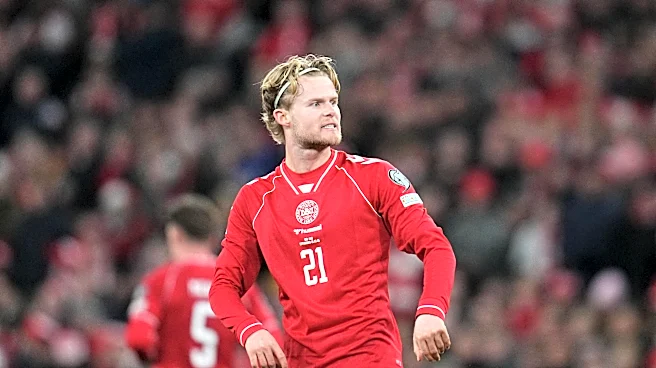






Atlético Madrid’s summer business is accelerating. Alejandro Grimaldo has arrived from Leverkusen, Kang-In Lee is close to joining from Paris Saint-Germain, and on Saturday the club confirmed that Sporting CP midfielder Morten Hjulmand had signed a contract to 2031 (worth approximately €6 million per year) upon completing a €40 million transfer.
Who is Morten Hjulmand?
Hjulmand was born on June 25, 1999, in Kastrup, a small town on the southern tip of Amager island in Denmark, just outside Copenhagen. He came through FC
Copenhagen’s youth system before making an unlikely move to Austrian second-tier side Admira Wacker at 18, where he spent three seasons developing as a professional with minimal fanfare and consistent game time.
In January 2021 he joined Lecce in Serie B for around €1.5 million, which may yet go down as the most underpriced transfer for a defensive midfielder in Italian football’s recent history. He captained them through their 2021/22 Serie B title win, helped them establish themselves in Serie A and left for Sporting CP in August 2023 for €18 million after Sporting had just sold Manuel Ugarte to PSG for €60 million and needed a like-for-like replacement.
At Sporting, Hjulmand won back-to-back Primeira Liga titles in 2023-24 and 2024-25, adding a Taça de Portugal in his second season. He was handed the captain’s armband within a year of arriving, succeeding Bruno Fernandes and Sebastián Coates in the role. In 141 competitive appearances for the club he scored 10 goals and provided 12 assists.
His Fotmob rating of 7.65 across the 2025/26 league season is among the highest for defensive midfielders in any major European competition. At 27, he has 24 senior caps for Denmark and started every group game at Euro 2024 in Germany. He was pivotal in their attempts to qualify for the World Cup, which ended in a play-off defeat to Czechia in qualifying.

Where does Hjulmand play and how does he fit in?
Hjulmand is a number six, a genuine defensive midfielder who sits in front of the defence, screens, intercepts, organises and recycles. Breaking The Lines described him when he arrived at Sporting as having “great anticipation which allows him to read the opposition’s next attacking moves, giving him an impressive 2.15 interceptions per 90 (top 1%).” WhoScored rates his passing as very strong and his tackling as strong, with no significant weaknesses flagged across the last two seasons.
What makes Hjulmand unusual in this profile is that he is not a destroyer. He is often described as a player who reads the game well to try to intercept, rather than rely a crunching tackle. He uses strong positioning and reading of the game to avoid having to make aggressive interventions, and he only slides in when he has calculated the tackle rather than reacted to instinct. That is a different calibre of defensive intelligence to the traditional Simeone enforcer type, such as Thomas Partey, and it is exactly why Atlético pursued him specifically.
The fit at the Metropolitano is direct. Koke is 34 and in the final chapter of his career. Atlético have carried him as the central organiser of their midfield for a decade, but the next phase needs a specialist behind him, or in his stead, who can do the defensive work the captain used to share across a more energetic press. Hjulmand provides that cover without sacrificing the technical quality to build from deep, which Simeone increasingly demands. The Atlético squad review that followed Saúl and Thomas Lemar’s exits made clear the club needed more physical authority and leadership in central areas, while Johnny Cardoso’s injury-hit first year didn’t solve the issue.
Who does Hjulmand play like?
The comparison Sporting supporters reach for is not one Atlético fans will need to strain to place: Gabi. The former Atlético captain and newly-minted assistant coach wore the armband for nearly a decade and defined the intensity, the leadership from the base of midfield and the positional authority that characterised Simeone’s best teams. Hjulmand is more technically polished than Gabi was at the same age, and his career arc through lower-division football into top-level captaincy mirrors something of that developmental profile.
The other player to whom Hjulmand has drawn comparisons is Pierre-Emile Højbjerg, another Danish international who once was linked to Atlético and occupies a similar position for club and country. The comparison has tactical accuracy, though Hjulmand has consistently outperformed Højbjerg in interception and progressive passing metrics over the last two seasons, and at 27 against 29 he has more runway.
Does Hjulmand have any links to Atleti?
None direct. His career has run through Denmark, Austria, Italy and Portugal before this window, but there are contextual threads worth noting. Sporting’s midfield pipeline, from João Palhinha to Manuel Ugarte to Hjulmand, has now fed clubs across Europe’s top leagues consistently, and Atlético’s scouts have been watching this production line closely alongside their long-term interest in the Portuguese market.
Hjulmand also will be aware that Atlético tried to sign him in January with an opening bid of around €25 million that Sporting rejected. The fact he chose Atlético over Arsenal, Chelsea, Manchester United and Real Madrid, all of whom were credibly linked is its own statement of intent.

What’s been said about Hjulmand?
The most striking testimony belongs to Rúben Amorim, who managed him at Sporting and is now at AC Milan. Amorim had already worked with Palhinha and Ugarte, two of the finest defensive midfielders in recent European football. His verdict on Hjulmand was a strong statement: “I love João Palhinha and Manuel Ugarte, I ask them to forgive me but I would say that Hjulmand is the most complete player of the three.”
After Hjulmand scored a long-range equaliser in a 4-2 win over Braga during Amorim’s final game in charge of Sporting, his coach called it “a great goal by a fantastic player and captain who arrived at Sporting a year ago.”
When Amorim left for United, Hjulmand framed it without sentiment, insisting that “I see it as a positive challenge to try to be champions without Rúben, which is the main objective of this season,” before Sporting indeed won the league without him.
The Danish football media have been consistent in their praise throughout Hjulmand’s rise. Tom Kundert of Portugoal described him as a “born leader, vocal and commanding, yet serene and secure when taking responsibility with the ball.” His Euro 2024 goal against England, a 25-yard volley that equalised to level after Harry Kane’s penalty in a 1-1 draw in Frankfurt, announced him to a wider European audience, but Danish fans who were in the stadium that night would not have been surprised.