








In the summer of 1987 Colchester keeper Alec Chamberlain was a top target for newly-appointed Sunderland manager Denis Smith.
At that point, the almost-23-year-old was one of the hottest goalkeeping prospects in the country, having earned rave reviews during 200 or so games for the fourth tier Layer Road club.
Smith had turned to Chamberlain after missing out on his former York man Andy Leaning – the keeper joining Sheffield United around the time Smith was finalising his move to Roker.
Chamberlain
held positive talks with Smith over an £80,000 move, however contracts were delayed by Chamberlain’s wedding and honeymoon. And by the time the Cambridgeshire-born custodian was back on UK shores, League Champions Everton came sniffing – and the prospect of a move to Merseyside to play second fiddle to Big Nev was the appealing one.
Fast forward six years, and a lot had happened for both Sunderland and Chamberlain. The club had got promotion at the first attempt, and a couple of years later were back in the top flight, before suffering relegation once more, a couple of close shaves to avoid slipping back into the third tier, and an FA Cup final to boot.
Chamberlain, meanwhile, had failed to break through at Everton and after a loan at Tranmere, had joined top flight Luton Town, for whom he played around 150 games – including coming up against Sunderland during the 1990-91 season in the First Division.

Fast forward to 1993, and Terry Butcher was preparing for his first full season (or rather what he hoped would be his first full season in charge) and was splashing the cash.
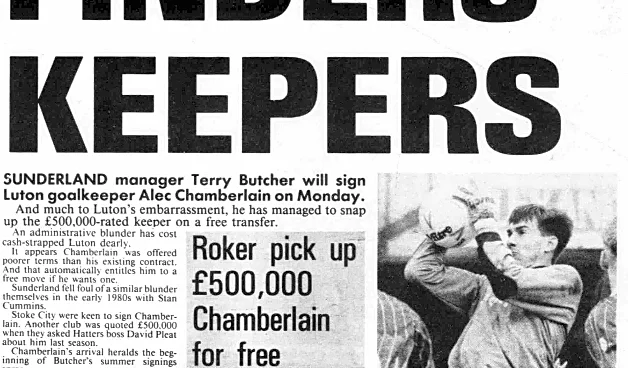
He wanted a new goalkeeper to replace the 35-year-old Tony Norman, who for whatever reason he didn’t seem to fancy, and had identified Chamberlain, who was rated by Luton in the £500,000-plus category when Stoke enquired about his availability the season before.
At the time, Sunderland’s boardroom was in a state of unrest – when wasn’t it in the 80s and early 90s? – with former chairman Sir Tom Cowie seemingly on the verge of buying the club back from Bob Murray.
Murray had been caught in between a rock and a hard place to some degree. His appointment of Terry Butcher was clearly inspired by the success another former England captain was having up the road, while – according to the Sunderland Echo’s Graham Robinson – the news that Keegan was about to fork out big money on Everton’s Peter Beardsley and Benfica’s Sergei Yuran was going to force Murray into giving Butcher more money to spend than he’d initially intended to.
However, when Butcher did some digging around Chamberlain – who’d been on the books at Ipswich with his potential new manager – he found that, due to an administrative error at Kenilworth Road, the keeper would be available on a free.
In those days, if a player’s contract expired the club held onto the registration – and if they’d been offered at least the same terms they would be entitled to a transfer fee, regardless of whether the player signed the new deal or not.
If no terms – or reduced terms – were offered, the player would be entitled to leave on a free. Somehow, someone at Luton managed to offer the player, who was about to turn 29, poorer terms, thus waving goodbye to a potential £500,000 pay day.
On this day in 1993, the deal was due to be completed imminently – with Chamberlain set to be the first arrival in what was billed as a summer spending spree.
Derek Ferguson of Hearts was also believed to be close to a move to Wearside, as was Swindon’s out of contract midfielder Martin Ling, who was rumoured to be arriving with Chamberlain.
Chamberlain, of course, did arrive at Roker Park, and had a relatively successful time – playing 108 games. He was a regular in his first season, but Tony Norman won his place back in Chamberlain’s second term (which created an opportunity for him to join Liverpool on loan as understudy to David James, and win a League Cup winners medal!).

During Peter Reid’s spell in charge, Chamberlain was first choice initially, however Reid when brought in untested teenager Shay Given and put him straight into the team, the writing was on the wall.
Chamberlain turned down new terms at the end of that promotion season, choosing to join Watford – where he stayed for 11 years, turning out almost 300 times, and becoming the oldest Premier League player at 42 when coming off the bench in 2007.