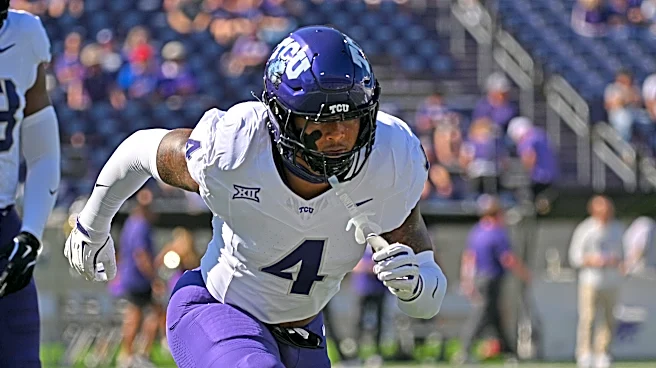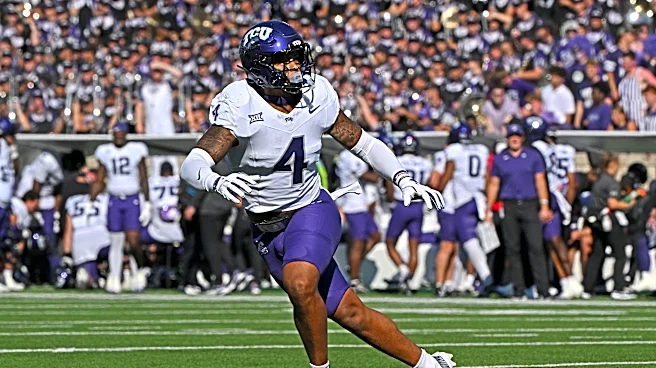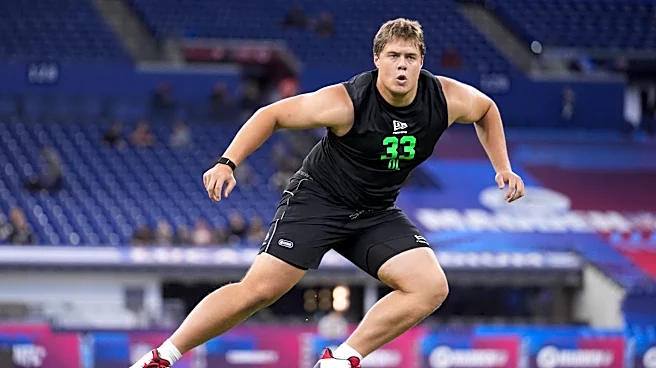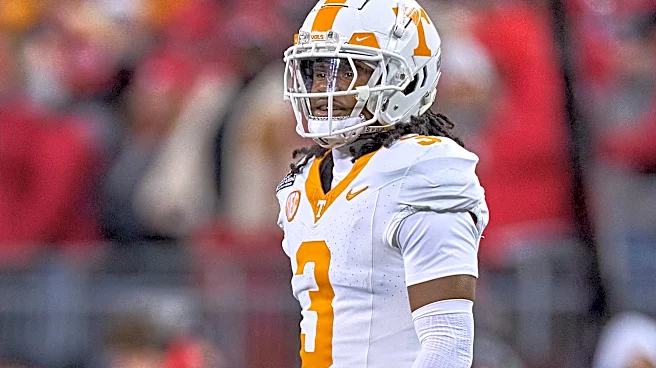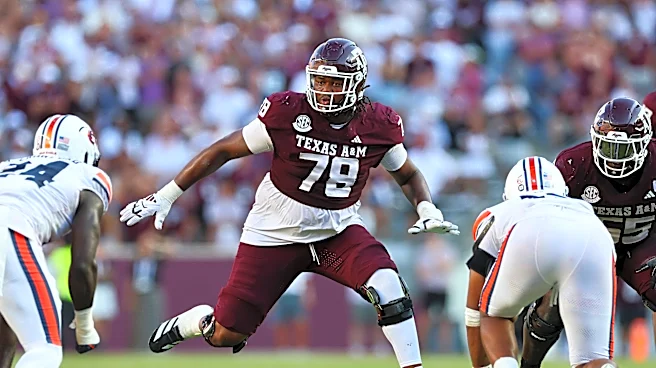







Starting with offensive tackle Caleb Lomu in the first round, the New England Patriots made nine selections in the 2026 NFL Draft. While there is some cautious optimism about the class as a whole, time will be the ultimate judge of the team’s success and whether or not the Patriots’ selections will prove their value relative to their draft position.
That more than anything else will ultimately decide how New England’s draft class will be regarded further down the road. Naturally, that is something
that can only be properly assessed in a few years’ time.
As for right now, the question of value — which oftentimes is used as the basis for post-draft analysis — can only be answered in theory. This is where the Consensus Big Board compiled by Arif Hasan of Wide Left comes in. It compiles 134 big boards to see how the draft community viewed the prospects beforehand.
Obviously, there are differences between those boards and the ones used by NFL teams simply because the latter have significantly more information available. That said, more than anything the comparison between those two spheres of scouting illustrates where differences exist and where, for one reason or another, there might be a dissonance between the public evaluation of a player and how the league views him.
So, with that in mind, let’s find out how the Patriots’ 2026 draft class compares to that consensus board. (Minus means the player was drafted before it was believed to be his turn — i.e. a “reach” if that is the word you want to use — while plus means the opposite)
OT Caleb Lomu
Pick: 1-28 | Consensus big board: 28 | Difference: 0
The Patriots moved up from the 31st to the 28th overall selection in a trade with the Bills in order to secure the last of the top-level tackles available in this year’s draft. While they had to invest some extra capital to facilitate that trade — a fourth-round pick also exchanged hands — Caleb Lomu himself was selected precisely in the range he was expected to come off the board.
ED Gabe Jacas
Pick: 2-55 | Consensus big board: 50 | Difference: +5
Entering the draft, the Patriots had three big needs. One was addressed in the first round, with the other two both taken care of on Day 2. The first was the defensive edge, which saw the addition of Illinois’ Gabe Jacas with the 55th overall choice in the second round — a pick also acquired in a trade, this one with the Chargers for picks No. 63, 131 and 202.
Like Caleb Lomu before him, Jacas also was drafted in the same general area the consensus had him in.
TE Eli Raridon
Pick: 3-95 | Consensus big board: 126 | Difference: -31
The Patriots and the consensus board went hand-in-hand in the first two rounds, but New England went a different direction in the third. Eli Raridon was projected as a late fourth-round pick, ranking 126th overall. The Patriots, however, picked him 31 spots earlier than that at No. 95 overall.
Obviously, some context is necessary. For starters, there had been a run at tight ends earlier on Day 2, with seven players coming off the board in the previous 40 selections before New England was back on the clock at No. 95. The team could have gone tight end with its original second-round pick (No. 63), but edge was in even higher demand and the drop-off after Round 2 steep.
The same was true at tight end, especially considering that New England had no fourth-round pick to follow up the 95th selection. Raridon was the last stop on the train in that part of the draft, which is illustrated by the next TE getting picked all the way at No. 133. The Patriots, meanwhile, were next on the clock at No. 171, right in the middle of another tight end cluster.
Raridon was a reach compared to the consensus board, but the circumstances made it a worthwhile one in the team’s eyes.
CB Karon Prunty
Pick: 5-171 | Consensus big board: 512 | Difference: -341
Now, this is where the fun begins. Karon Prunty was one of the biggest reaches in the draft before the true late-round fliers in the seventh round: he was selected a full 341 picks higher than his big board rank and thus the only player in the top 200 with a big board rank above 400.
His ranking isn’t the only noteworthy data point, though. Prunty’s ranking also had a variance of 60.3. What does this mean? Using 100 as the base, every variance score higher suggests polarization and everything lower consensus. This means that the draft community was pretty much in agreement: the Wake Forest cornerback was nowhere close to being drafted.
And yet, he was. In the fifth round.
There is a clear difference between how the league viewed him versus what the experts saw in him. Prunty, for example, was no under-the-radar player; besides the Patriots, other teams like the Packers and Panthers also brought him in for pre-draft visits. Ultimately, it was New England pulling the trigger at No. 171 after an extensive research process.
It remains to be seen whether the apparent gamble pays off.
OT Dametrious Crownover
Pick: 6-196 | Consensus big board: 124 | Difference: +72
The Patriots decided to double-dip at offensive tackle, and the second pick at the position turned out to be the Patriots’ biggest steal of the draft. Picked at No. 196 in the sixth round, Dametrious Crownover was selected 72 spots lower than the consensus board would have suggested.
Of course, as with Karon Prunty, simply slapping the “steal” label on the selection does not do it justice and glosses over quite a bit of context. What that context might look like is impossible to say without information into every team’s draft process. Fact is, however, that he went two rounds lower despite a variance score of 94.2.
“I’m not really sure why,” said Patriots executive vice president of player personnel Eliot Wolf.
“He’s played a lot of football. He’s an older prospect. That’s maybe something that – primarily played on the right side, so maybe some versatility type things. But no, he’s a player that, like we talked about earlier, I mean, he’s 6-7, 320 with long arms. He’s really light on his feet, and he’s going to have a chance to come in here and compete and obviously going to have to start playing more than one position. But he was definitely excited when we spoke to him. He’s a guy we spent some time with throughout the process, and ultimately, he fell to us there in the sixth.”
LB Namdi Obiazor
Pick: 6-212 | Consensus big board: 297 | Difference: -85
Simply using the consensus board as reference, the Patriots went back in the other direction with their second sixth-round pick. Namdi Obiazor was considered a possible free agent at No. 297 with a variance of 67.1, but the Patriots brought him aboard at No. 85.
Need might have played a role in that, but New England was seemingly not under pressure to pick a linebacker and specifically this one with the 212nd pick. There was only one LB drafted in the previous 20 picks, after all. Still, it seems clear that the combination of him being near the top of the board and helping out at a position facing questions from a depth perspective all contributed to this selection being made.
QB Behren Morton
Pick: 7-234 | Consensus big board: 293 | Difference: -59
Morton is in the same basic boat as Namdi Obiazor before him. The Texas Tech quarterback also was selected significantly sooner than the consensus board had him ranked. And yet, once again the circumstances made this a reasonable pick in the team’s eyes.
Yes, it might have been early; yes, other players might have had a better shot at making the team. However, they seemingly didn’t want to risk heading into free agency without a third quarterback on the roster, and so they took a late-round flier on the top one left on their board.
RB Jam Miller
Pick: 7-245 | Consensus big board: 248 | Difference: -3
The Patriots rode the reach/steel rollercoaster earlier on Day 3, but with their last two picks in the draft went back to the consensus. First was Alabama’s Jam Miller, a between-the-tackles running back who will provide depth behind Rhamondre Stevenson and TreVeyon Henderson. Miller was picked right in his projected range, as was…
ED Quintayvious Hutchins
Pick: 7-247 | Consensus big board: 250 | Difference: -3
Ranked 250th on the big board, Hutchins came to New England as pick No. 247. There were 41 higher-ranked players still available at this point, but the Patriots obviously saw something that prompted them to make the investment.
“Really, really physical player. Has some length, has some traits that we like,” said Eliot Wolf. “Went back and watched some of the special teams when he was younger and that really stood out as well. Had the opportunity to work him out at our local day, which was really cool for him and his agents to decide to come work out. A lot of times guys that worked out at the Combine aren’t willing to do that, and he showed what kind of competitor he is with his willingness to come over there. I think he helped himself definitely.”
Ultimately, teams have their own evaluations and individual, prospect- and club-specific factors that go into player grades. That is impossible to incorporate without the same information being available, which is why the debate between steals and reaches oftentimes lacks nuance.
And while we cannot provide all of that in a 1,643-word analysis, we can at least try to offer some context as to why the Patriots might have felt comfortable making certain selections — even if the consensus board might disagree with them from a value perspective.