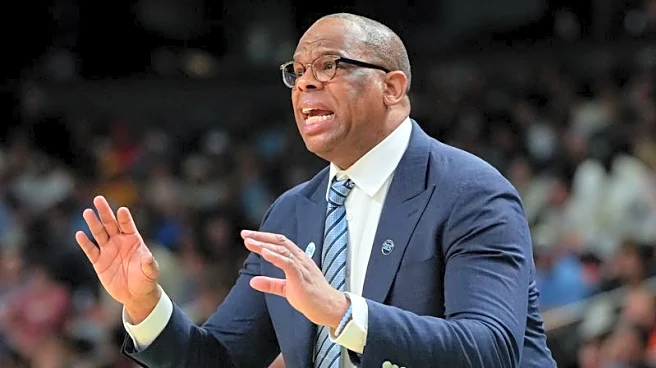


Usually, when you name a Most Improved Player, you give it to someone who made a big jump from last year to this year. This is a bit problematic for the ‘25-‘26 Tar Heels, as only two players from last year’s team played any significant minutes. Zayden High played sparingly until Caleb Wilson’s injury forced Hubert Davis’s hand; he had a few good moments but overall didn’t have a huge impact. Seth Trimble will forever be a UNC legend for making the game winning three against Duke, but overall, he regressed
in some categories even as as he progressed in others.
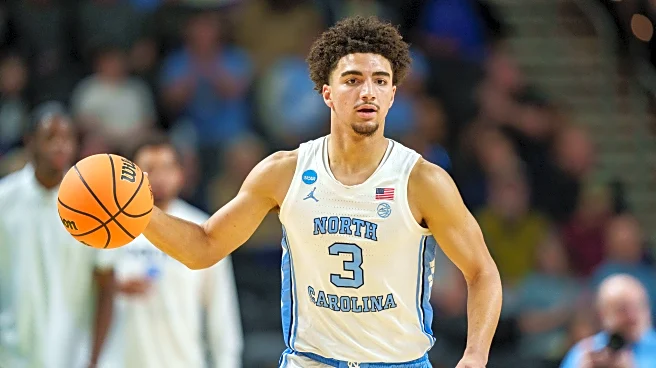
So, that leaves us to give the award to the player who showed the most dramatic improvement over the course of the season. For me, that person is easily freshman point guard Derek Dixon, who helped stabilize the point guard position for a team that had more questions than answers entering the season.
Dixon entered UNC as a four-star combo guard from Washington D.C., and was generally viewed as a depth piece with potential. The Heels had brought in Colorado State point guard Kyan Evans to be the starter alongside Seth Trimble with Dixon, Jaydon Young, and Luka Bogavac competing for minutes behind them.
Evans struggled from the beginning of the season to adjust to playing in a major conference. Dixon flashed his shooting potential early, hitting three three-pointers in a game against UNC-Central. Within a few games he was matching or exceeding Evans in minutes played per game despite coming off the bench; he rewarded the Heels with performances like his stat line against Georgetown: 5-7 shooting and 3-5 from distance for 14 points, three rebounds and three assists.
By mid-January, it was obvious that Dixon was the best option for Carolina at point. He started his first game on the road against California; while UNC would go on to lose the game, Dixon scored 14 points and recorded three assists. He would remain entrenched as the starting point guard for the rest of the season, as Evans faded to backup duties.
While his season-long numbers are not overly impressive, Dixon’s numbers after becoming a starter are very solid for a freshman point guard learning on the job. He averaged 8.5 points and 3.5 assists per game in his last 16 games. His three-point shooting prowess was both unexpected and welcome. He finished the season making 39.7% of long-range shots, second best on the team after Henri Veesaar (and not including Isaiah Denis’s 4-8 mark). Like any good Tar Heel, he did some of his best work against Duke; his drive and dish is what set up Trimble’s three in UNC’s win over the Blue Devils at the Dean Dome. And while UNC lost the rematch, Dixon went 5-8 from three and led the team with 17 points. He closed the season by putting up 11 points, five rebounds and six assists against VCU.
Keeping Dixon will almost certainly be a priority for the new coaching staff. He was one of the few players that visibly got better throughout the season. At times, his play reminded me of Marcus Paige; while there’s no way of knowing for sure, I suspect the UNC assistant is at least partly responsible for his growth. If he makes a leap in his sophomore year, he could be one of the better passing point guards in the ACC and stabilize a position that’s been a question mark for the Heels in recent years.