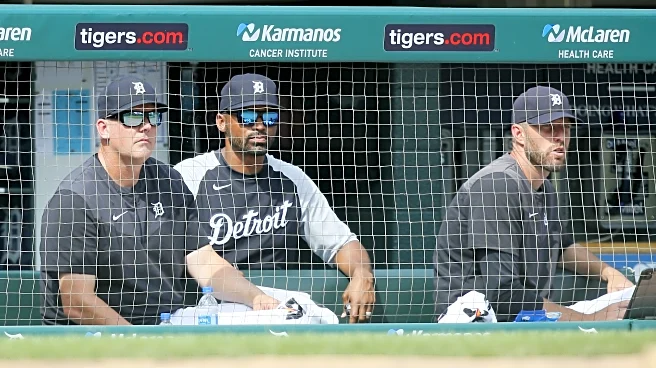



Over the last five years, we’ve written often about the outstanding job A.J. Hinch and his staff does in terms of getting the most out of a good, but far from dominant roster. From pinch-hitting, to bullpen usage, to creativity when things go wrong, to details like taking the extra base, the Tigers continue to do a lot of little things right to paper over weaknesses and play to their strengths. Sports Info Solutions gave us another example in an article written by Mark Simon on Monday.
Sports Info
Solutions provides data and analysis to teams in many different sports, and has been a leader in that field over the last decade in particular. They are the creators of the defensive runs saved (DRS) metric used by FanGraphs and many other sites to evaluate team and player defense. And the defensive metrics on the Tigers the past two seasons are fairly eye-opening.
In 2024, the Tigers were a combined negative four defensive runs saved if you add up each players” individual DRS numbers. Yet the team was plus 40 in defensive runs saved in defensive positioning, far outweighing the modest collection of defenders’ actual ability.
In 2025? The Tigers were a negative 11 runs saved on defense individualy. And yet their positioning saved 47 runs, for a net +36 runs saved. Pretty impressive.
Defensive runs saved, on a player by player basis, functions much like Statcast’s outs above average. Each play made or not made is judged by where the fielder is on the field at contact, how fast the ball is moving and its trajectory, figuring the most direct intercept point, and judging difficulty of plays by those means. However, DRS also visually grades plays so that unique factors, like a baserunner crossing in front of a defender and blocking their view momentarily, the ball changing direction or off of the pitcher’s mound or the edge of the infield grass, and other factors that the raw data can’t pick up, can be taken into account. Statcast is much more straightforward. The ball was hit to this spot, this hard, and did the fielder take a good route, have the range to get to the spot, and did they make the play cleanly.
Defensive statistics are never going to be perfect, and their are valid arguments for both DRS and OAA. Still, actual defensive value is tricky to evaluate, particularly when you don’t have several years worth of data. Personally I tend to just rough it out between them, figuring that somewhere between each number is likely closest to the truth.
The difference here is that Statcast doesn’t issue a positioning metric for teams. Essentially, Sports Info Solutions is adding another layer of defensive analysis by grading how close to where the ball is actually hit a given team’s fielders are over the course of a season. Teams that routinely position their defense best in accordance with each individual hitters’ tendencies, have the advantage of being in a better starting position to make each given play.
I’m simplifying the whole methodology here, so if you’d like to learn more, read the full article here, with notes on individual players. You can go deeper and check out Sports Info Solutions numerous articles on the topic on their site, though they keep their full methodology under wraps.
Of course, this isn’t solely about George Lombard and Joey Cora positioning their fielders in accordance with the opposing teams’ spray charts produced by the Tigers’ analytics department. There’s also the component of getting the hitter to hit the ball where you want it to go, or to strike out. This is a group effort that also leans heavily on Chris Fetter’s game-planning and pitch sequencing acumen, and translating all that to his catchers to call the game.
Fetter and his staff’s ability to combine pitching strategy and defensive positioning to exploit hitter tendencies was a big part of his work with the Michigan Wolverines, and it’s part of the secret sauce that made him a sought after coach at the major league level. A.J. Hinch and the Tigers did well to land him, and as we’ve seen, the Tigers results often seem better than the raw pitching talent they’ve had over the last five seasons. This despite the fact that outside of Tarik Skubal and a few others, they haven’t actually made that many young pitchers radically better in isolation.
What’s interesting about these results, is that they suggest that the Tigers can make average defenders play like above average ones by positioning them better and getting the ball hit to that position more regularly. You might grade negative in DRS, but if you’re routinely being positioned closer to spot you need to be to make a play, the team is in good shape even if your individual defensive grades aren’t actually good. The plays you’re required to make are just made easier from the start.
Managers often talk about putting their players in the best position to succeed, but Hinch and his coaching staff have taken this very literally, to the Tigers’ benefit.