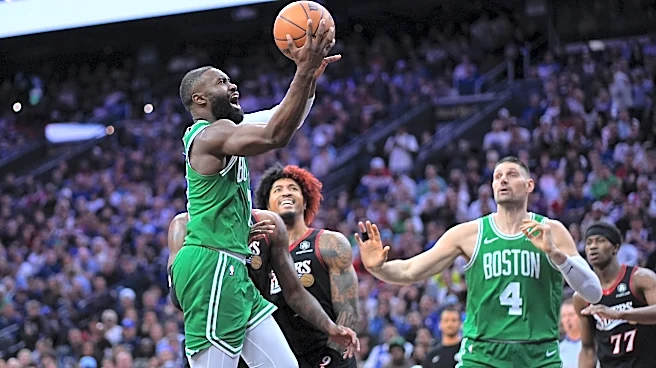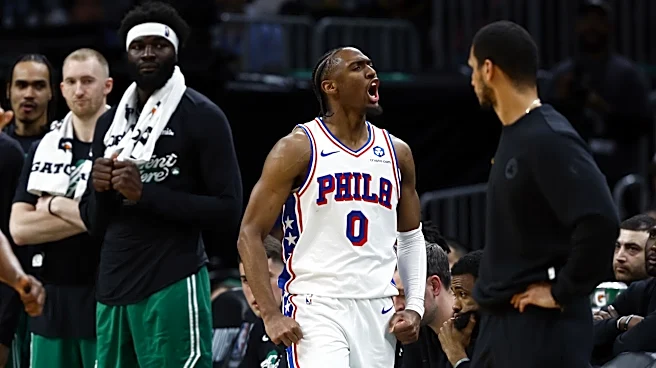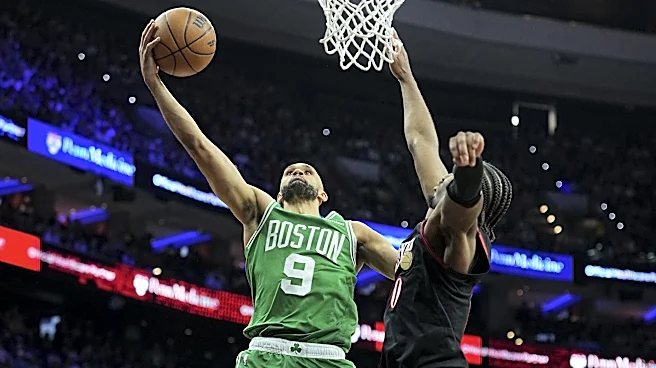





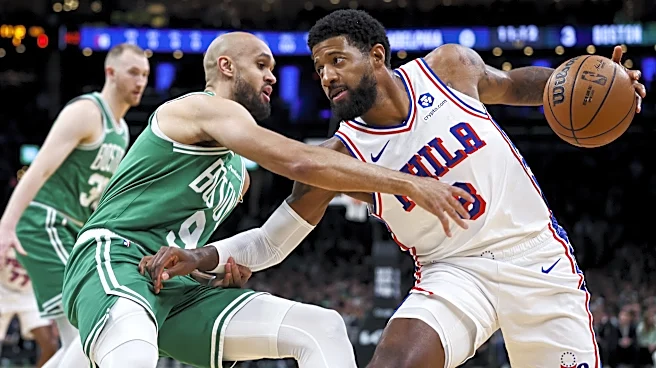
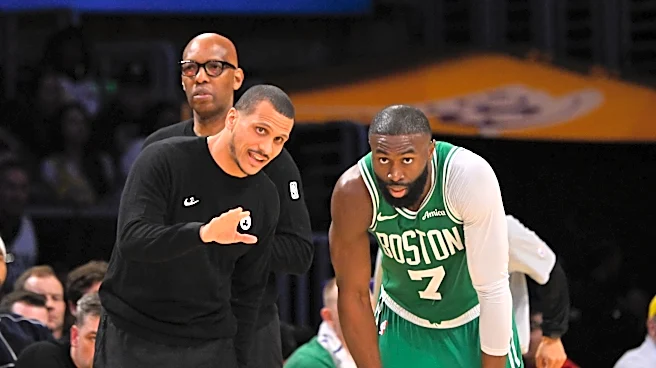
Game 1 had been a Boston blowout. Game 2 had featured a barrage by the Sixers’ bumptious backcourt. But Friday’s Game 3? That looked and felt like playoff games often tend to look and feel, especially those between ancient rivals like Boston and Philadelphia.
It was a night that saw Sixers forward Paul George take a single shot in the first quarter, then take a different sort of shot to his, uh, lower abdomen while defending Jaylen Brown in the second. It was a night that saw Boston center Neemias
Queta, who’s from Portugal (via Utah State), frequently grapple with his Sixers counterpart, Adem Bona, who’s from Nigeria (via UCLA). Bona fouled out in a little over 22 minutes, while Queta fouled four times in not quite 13.
It was also a night that saw Queta — would he be a Portuguese Man o’ War? — bear hug the Sixers’ other center, Andre Drummond, as they battled for position in the third quarter. That compelled Drummond to elbow him in the chin and the officials to scurry to the replay monitor, intent on determining whether the veteran was guilty of a “hostile act.” Drummond was assessed a technical foul.
There was plenty of jostling on the scoreboard, too. The Celtics led by 10 a couple times, and were still ahead by five after three quarters. Then Tyrese Maxey started cooking, and suddenly the home team was up by a point with 8:42 left in the game. Boston responded with an 8-0 flurry to make it 92-85, but there was still half a quarter to play, still plenty of time for the combatants to exchange more body blows.
Six times in the last 4:15, the Sixers made it a one-possession game, but every time Boston had an answer. That the C’s ultimately emerged with a 108-100 victory and a 2-1 series lead is a tribute to their championship pedigree. They won a title two years ago, and stand a decent chance of at least getting to the Finals this season as well.
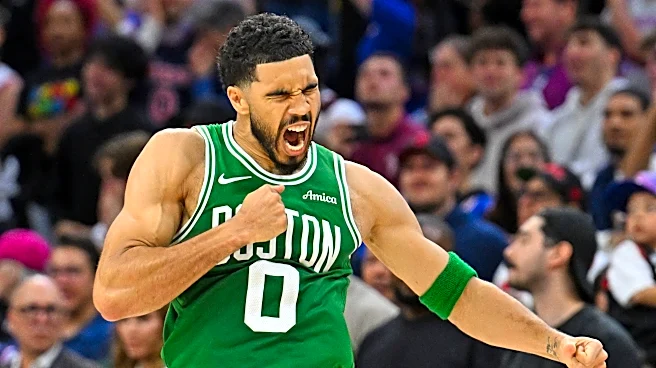
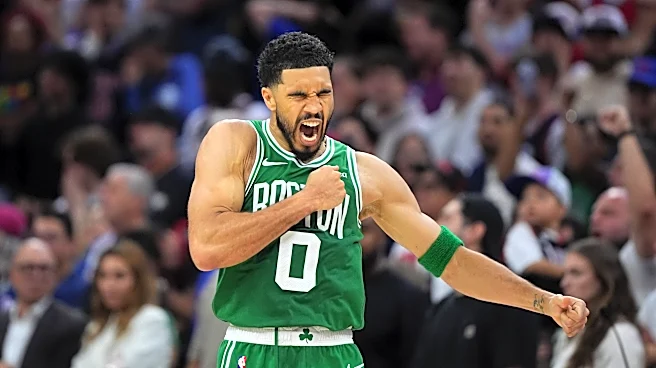
That’s because they have two cornerstones in Brown and Jayson Tatum, a capable supporting cast and an understanding of what it takes to win this time of year — of just how slight the difference is between victory and defeat.
Down the stretch Friday, veteran guard Derrick White twice claimed offensive rebounds, the first resulting in Brown’s jumper with 3:49 to play, the second leading to Tatum’s clinching three-pointer with 25.6 seconds left.
“The second chances that they got, they capitalized,” George said. “That was the game.”
Backup guard Payton Pritchard also nailed a right-wing three with the shot clock melting away and 1:17 remaining on the game clock, making it 103-98. Forty seconds earlier, Tatum had connected from the arc to extend a one-point lead to four. His final shot, after White did the dirty work, gave Boston a 106-100 cushion.
Tatum notched 11 points in the fourth, Brown eight. Each finished with 25 in all.
But a bounce of the ball here or there, and things might have turned out differently. That’s how slight the margin of error was — and, really, how it usually is in the playoffs.
“A hundred percent,” Maxey said. “A turnover leads to a basket, an offensive rebound leads to a three. It’s like every time, every single time, you know what I mean? We’re doing a hell of a job defensively, guarding them — a hell of a job in the halfcourt, everybody fighting and doing a really good job. But it’s like offensive rebound, three ball, turnover, three ball or layup. Missed boxout, layup.
“But when you play good teams, that’s what it is. That’s what it is. You’ve got to be sharp, extremely sharp in the playoffs. Man, you’re seeing it.”
Maxey finished with 31 points, but needed 31 shots to do so. George had 18 points and Kelly Oubre Jr. 17, but VJ Edgecombe shot 5-for-17 from the floor and missed all seven of his three-point attempts while scoring 10 (albeit while claiming 10 rebounds and handing out five assists).
And overall there was a regression to the mean by the Sixers’ shooters. After going 4-for-23 from the arc in the first game, they went 19-for-39 in the Game 2 victory, a glittering 48.7 percent. On Friday they were 12-for-35 (34.3 percent), which is more in line with their season norm.
Boston, which is forever firing, was 20-for-47 (42.6 percent) from deep, considerably better than its regular-season accuracy (36.7). That means the Celtics owned a 24-point advantage on three-point shooting on the night. Their reserves also outscored the Sixers’ subs, 35-14.
So those were the big reasons for the Boston victory. There were a ton of small ones, too.
In the postseason, Maxey said, “The attention to detail is really, really, really, really, really small. I kind of learned early on in my playoff career that the playoffs are broken down into single-possession games. Every single possession matters. And you don’t want (a) possession to come back to bite you.”
White, normally a dangerous shooter, is clunking along at 35.3 percent from the floor and just 20 percent from the arc while averaging a mere 9.7 points a game in the series.
“Obviously it’s frustrating, but I’m out there,” he said. “I’ve got to do everything I can to help us win games. … And if it’s not shooting, it’s got to be everything else.”
On at least two occasions he swatted Maxey’s layup attempts from behind, after it appeared the Sixers guard had a clear path to the rim in a halfcourt situation. Maxey adjusted in the second half, going more to his midrange game, and promised to incorporate more floaters going forward, too.
Another small detail, then. Same for the splint Maxey has been wearing on his injured right pinky, which appears to be affecting his three-point shooting, and which he said he will have to wear the rest of the way.
“I think this is a really close 2-1 series,” he said.
George does not disagree, saying the Celtics so far have done “what they had to do.”
“But,” he added, “this was a very winnable game for us, so there’s no additional pressure (in Sunday’s Game Four). … We’ve got a chance to even it up Sunday and that’s the only thing that matters. It’s on us. We still feel we’re in the driver’s seat, so just do what we’ve got to do Sunday, and everything else will take care of itself.”
Driver’s seat? That seems like a stretch. But the point is, neither team can afford to get too comfortable. The difference between them is not as great as their respective seedings might have you believe. It’s a matter of doing the little things, making the most of the opportunities that are available.