
Boy, the America East sucked this year, didn’t it?
In KenPom’s ratings, we ranked second-to-last among all 31 Division-I conferences. In my power ratings, seven of the nine teams ranked below 315th nationally, and three ranked below 350th.
But we lost a lot of talent this year. Bryant and Lowell lost entire rosters’ worth. Maine and Binghamton were brutalized by injuries.
But, ultimately, as the America East beat writer for Mid-Major Madness, I do not care. I love this conference and am excited to watch
every minute of America East Tournament action.
Let’s talk about how I expect it to play out.
The Bracket

The America East Tournament will be held between March 7 and March 14, with games hosted at campus sites. The quarterfinals will be on Saturday, March 7, the semifinals will be on Tuesday, March 10, and the championship game will be at 11 AM ET on Saturday, March 14 (streamed on ESPN2).
The teams are reseeded after each round.
Tano’s Final AmEast Power Ratings
Team-by-Team Breakdown
UMBC Retrievers (1)
Jim Ferry did such an excellent job building the roster.
The additions of longer wings (Caden Diggs, Paul Greene, DJ Armstrong) really helped the dribble defense — UMBC is far-and-away the conference’s best ball-screen coverage unit. Meanwhile, the dangerous offense mostly ran the same, spearheaded by a trio of speedy guards (Armstrong, Ace Valentine, Jah’Likai King) who played off each other very well in Ferry’s rim-attack-and-kick offense.
But the Retrievers really established themselves as the conference’s best team once Jose Roberto Tanchyn found his footing. The 6-foot-10 Division-II Palm Beach Atlantic transfer gave them all the length and rebounding needed underneath to turn UMBC into a well-rounded perimeter and interior defense. He also fits perfectly into Ferry’s offense thanks to his ability to stretch the floor, shoot, and play off the bounce.
UMBC is not unbeatable, but the Retrievers are the deserved favorites. They also haven’t lost at home in conference play (8-0), which is important, given they won’t leave Baltimore for the entirety of the run.
Vermont Catamounts (2)
Vermont’s interior defense started trending up once Noah Barnett returned to support Gus Yalden. The dribble defense started trending up with Sean Blake’s improvements, TJ Long’s return from injury, and Lucas Mari’s ability to define his role as an off-ball offensive player.
The offense has always been nasty. Vermont boasts no shortage of shot-makers. The two-man game between Yalden and TJ Hurley is near-impossible to stop — those two can run any set of actions and make any shot.
Vermont is a very solid two-way half-court team. However, the Cats have been rather inconsistent around the edges.
In the two-point win over UMass Lowell, they struggled with rebounding and transition defense. In the two close games against Binghamton, they struggled to match up physically.
However, it’s worth mentioning that in Vermont’s four conference losses, opponents shot a whopping 38-for-87 from 3 (44%). The Cats have been packing it in on defense more than ever, and while they can get shot out of the gym, those losses could be chalked up to poor shooting variance.
It would be unwise to doubt John Becker and a talented roster, but the margins are thin if Vermont wants to upset UMBC.

NJIT Highlanders (3)
After an incredible 10-2 start to conference play, the Highlanders lost their final four regular-season contests in convincing fashion.
Two things happened.
Early in the year, the offense was the league’s best. Grant Billmeier surrounded Sebastian Robinson’s dribble-drive ability with varied shot-makers in the backcourt (David Bolden), on the wing (Ari Fulton), and in the frontcourt (Melvyn Ebonkoli). However, the triples started falling late in the year, showing cracks in the underlying process, which was filled with mid-range jumpers (the league’s longest average 2-point shot distance, seven feet). You could see this happening in real time via Robinson, who started settling for way too many turnaround pull-up jumpers in the high-painted area.
Also, early in the year, Ebonkoli and Jordan Rogers anchored a very stout shell-like dribble-denial defense that walled off the paint and rim. For some reason — one I haven’t fully diagnosed — that shell started cracking late in the year, especially when the Highlanders allowed over 40 paint points to each of Albany, Vermont, and UMBC down the stretch.
The ‘Landers are limping into the AmEast Tournament, and I wouldn’t be surprised if they exited quickly.
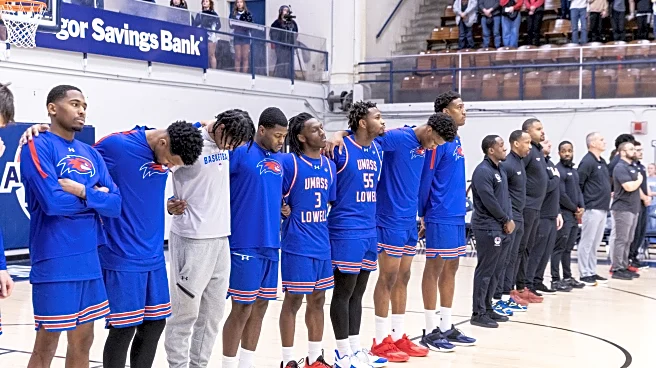
UMass Lowell (4)
Pat Duquette did a borderline-incredible job this season.
Despite losing his entire roster from last season, the River Hawks look like the same team. They’re a dangerous flex-motion, cut-heavy, rim-oriented offense that bashes the offensive glass and is elite in transition. They also have turnover problems and don’t play defense.
Austin Green has basically become Max Brooks, and Angel Montas has basically become Quinton Mincey — except Montas is way better. Montas is a legit POY candidate. He’s such a talented scorer who fits perfectly in Duquette’s offense, hence why he averaged 20/6 in conference play while shooting over 50% from the field.
I think there’s some sneaky upside with Lowell in the conference tournament, given Darrel Yepdo has started to find his stride in the second half of conference play. Pairing a decent version of Yepdo with Xavier Spencer gives this backcourt some real pop, especially in the shooting and dribble defense departments, both of which have been lacking this season. Additionally, maybe the River Hawks can find some more minutes for Victor Okojie, a very talented freshman with a high ceiling.
Regardless, they could out-score anyone on a given night, and maybe they’ll get lucky in a few shootouts with late-game and shooting variance. Plus, they’d avoid UMBC until the final if NJIT gets upset.
Albany Great Danes (5)
Albany is such a tough team to diagnose.
I don’t trust Dwayne Killings, and the Danes have dealt with a revolving door of injuries all season.
Amir Lindsey is still the AmEast Iron Man, averaging 18/5 across 38 minutes per night. He’s surrounded by a bunch of lengthy, athletic shooting wings — my favorite of the bunch being Zach Matulu, who returned recently from injury and has made a big two-way difference.
Typically, they’ll run an isolation-heavy offense spearheaded by Lindsey and Jaden Kempson, but I have no idea if the latter is healthy.
Defensively, Killings threw out a ton of amoeba zone coverages. On the one hand, it did help the Danes stay in front of the dribble, and they can still force turnovers — combined with their glass-crashing on the other end, they typically hold a shot-volume advantage in most games. Plus, Okechukwu Okeke is a decent anchor who can block shots. However, it also gave up a boatload of unguarded catch-and-shoot 3s, and Albany couldn’t rebound a thing on the defensive end.
Maine (6)
Despite injuries that obliterated the Black Bears, Chris Markwood proved his coaching chops and led his team to seven conference wins.
It was two things.
As he always does, Markwood developed his guards. Logan Carey and Mekhi Gray became legit dribble-drive threats in the ball-screen motion offense. Combined with TJ Biel’s elite rolling ability and Ace Flagg’s improved pick-and-pop shooting and short-roll passing (he finally found his jumper), the Bears showed some life on offense at times.
Meanwhile, those two guards evolved into very pesky on-ball defenders at the top of Markwood’s 2-3 zone. With Flagg and Biel at the bottom of the zone, Maine wreaked havoc on opposing offenses for large swaths of conference play.
There are also two problems.
When the 3s stop falling, the spacing gets messed up, and Maine’s offense regresses into mush.
If opponents can handle the extended pressure, it is pretty easy to cut behind Maine’s front line and form a lay-up line at the rim. The Bears are also horrific on the glass, ranking last in the AmEast in both offensive and defensive rebounding rate while sporting a whopping -147 differential in league play (more than double the next-worst team).
The biggest issue? Biel might be hurt. He was injured in warm-ups earlier this week and hasn’t seen the court since. The program has been hush-hush about his status, so I have no idea whether he’ll be available. That would be a huge loss.

Bryant (7)
Gross season from Bryant. I thought they botched the Jamion Christian hire. Given he was coaching in Italy and got started late, he missed most of the portal guys and was forced to go young, starting three freshmen for most of the season (three good frosh, for what it’s worth). Their “star” portal grab, Quincy Allen, got hurt and is shelved for the year.
The offense went through a strange evolution.
Christian started out with a plodding, motion-based offense that generated a lot of late-shot-clock 3s for bad wing shooters. He ditched that and attempted to install more of a spread ball-screen attack spearheaded by frosh point guard Ty Tabales, who wasn’t ready to run that type of offense. Finally, the Bulldogs found some life toward the end of the season by leaning into more big-to-big DHO actions between Keegan Harvey (who played so much better down the stretch) and frosh phenom Timofei Rudovskii, alongside microwave scoring performance from Aaron Davis — all three of these dudes are big, can put the ball on the floor, and can shoot.
But as the offense found life, the defense regressed. The Bulldogs were OK on defense early in the season because they leaned into their length and switchability, forcing a lot of isolation while denying catch-and-shoot opportunities. Their defense fell off a cliff, but some of that was due to unlucky shooting variance, and some of it was due to Allen’s injury — he was arguably the team’s best defender.
By the end of the road, the thing that stuck out most was a complete inability to execute late in games. Late blown leads to New Hampshire, Binghamton, and Albany stick out.
There were some flashes of solid play because the young guys have high ceilings, but ultimately, this is a squad that doens’t generate good shots, turns the ball over like crazy, and plays average-to-below-average defense.
New Hampshire (8)
The Wildcats won four straight games in late January, moving to 4-3 in conference play. They lost eight straight after that, and would’ve lost nine straight if not for Tyler Bike’s miraculous buzzer-beating 3 against Bryant in the season finale.
Offensively, everything fell apart once they stopped hitting their 3s. The Wildcats run everything through Belal El Shakery and Comeh Emuobor in the post, but they’ll work inside-out for triples. But once the latter stops working, you’re stuck with a relatively inefficient offense predicated on bashing your way through double teams to the rim.
Defensively, New Hampshire was buttoned up for most of the year, defending the rim alright, keeping teams out of transition, and rebounding everything. But as the year went on, the Wildcats simply weren’t good enough in their base man-to-man half-court defense.
Official (Absolutely Wrong) Prediction
Vermont and UMBC should make it through the first round — although you never know.
The other side of the bracket is where it gets interesting.
I’m picking Lowell to beat Albany because the Danes can’t keep the Hawks off the glass. Lowell won the rebounding battle 98-to-55 across the two games, negating Albany’s typical shot-volume advantage. Then, the better offense won out — I trust the Hawks’ forward-heavy flex-offensive structure to cut through an amoeba zone defense.
Meanwhile, I think Maine has legs against NJIT. The Highlanders’ offense has been stuck in the mud, and I think the Black Bears’ pesky perimeter defenders could shut off Bolden and SebRob at the point of attack. On the other end, Maine has to hit its 3s, but NJIT’s dribble and interior defense have looked shaky, and the dam could break against Carey and Gray’s dribble-drive ability. Then again, the Bears probably need Biel.
Regardless, that gives the River Hawks some legs. UMBC would host Maine, while Lowell would travel to Burlington, where it held a five-point lead with two minutes remaining just a few weeks ago. I thought Vermont really struggled to keep the Hawks away from the glass and out of transition, and I think Lowell is trending up behind an improved Yepdo.
Ultimately, I suspect the Retrievers hold serve in Cantonsville, led by my stud X-factor, Tanchyn.
Championship Game: UMBC over UMass Lowell, 85-70