

Quick: name the most valuable Phillies pitcher by Wins Above Replacement.
Well, that wasn’t very difficult, was it? You said Cristopher Sánchez so quick I barely had time to take a sip of my tea. That’s okay. The first question is the warm-up. Now name the second-most valuable.
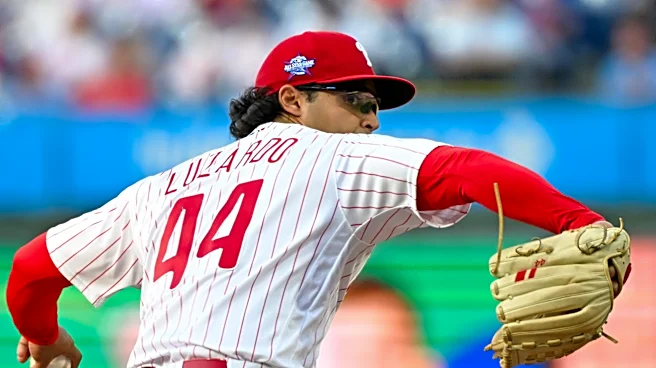
Did you say Jesús Luzardo? Good/bad news: you’re right/wrong. He’s the second-most/fourth-most valuable pitcher on the Phillies by WAR. Actually, he’s the second-most/only the seventh-most valuable Phillie overall by WAR. Zack
Wheeler has been on fire since he returned, but Luzardo still has produced more value/less than half as much value than him.
Don’t adjust your monitor: nothing is wrong with the above paragraph. All of those statements are true, simultaneously. And this isn’t some sort of Schrödinger’s Phillie, where Luzardo is both extremely valuable and somewhat less so until you open the box.
See, there’s two main types of WAR: FanGraphs WAR, or fWAR, and Baseball Reference WAR, or bWAR (sometimes rWAR). And they disagree on Luzardo. The fine folks at FanGraphs have Luzardo at 1.7 fWAR, trailing only Sánchez’s 2.8, and a bit ahead of Wheeler’s 1.4. Meanwhile, the renowned recorders at Baseball Reference have Luzardo at 1.0 bWAR, far behind Sánchez’s 3.7 and Wheeler’s 2.1. A difference of 0.7 WAR in the evaluation of Luzardo may not sound like a lot, but fWAR has him as more valuable than Wheeler so far, and bWAR has him as just about half as valuable. That’s a pretty sizable difference. So what’s going on here?
First, to level-set: this is not a case where either formulation of WAR is wrong. fWAR and bWAR, as we’ll get into shortly, are both setting out to measure the same thing— how valuable a given player is—, but through decidedly different approaches. Neither one is incorrect on Luzardo; they’re just defining value differently. Despite the title of this piece (lamentably straightforward, I was fresh out of puns), we’re not really going to be determining how valuable Luzardo is here. Rather, by taking a look at how the two main forms of WAR ended up disagreeing on Luzardo’s value, we’re going to get a more holistic sense of how he’s performed so far.
So, why do fWAR and bWAR diverge when it comes to Luzardo? It comes down to what inputs they use for assessing pitchers. fWAR for pitchers is based on Fielding Independent Pitching (FIP). FIP tries to eliminate the impact of defense by taking only the plays that are determined solely by the actions of the pitcher and the batter into account: strikeouts, walks, home runs, and hit by pitches (to be technical, FanGraphs treats infield flies as strikeouts when calculating FIP for fWAR purposes, whereas standard FIP doesn’t). bWAR, on the other hand, is based on runs allowed, and innings pitched. There’s more to the calculations than just that, of course. But that information is all we need to explain the variance on Luzardo.
Luzardo has been good to great at most of the things that go into FIP. His 27.7 K% is in the 84th percentile. His walk rate of 6.5% is in the 81st. His 0.73 HR/9 is tied for 21st among qualified pitchers, and the total number of gopher balls he’s allowed (5) doesn’t pop any eyes. He’s hit four batters so far, which is more than most pitchers, but that doesn’t seem to be dragging his FIP down (or up, rather) much. His FIP of 2.82 is ninth-best in baseball, and so it’s no surprise that he’s doing well in the FIP-based fWAR.
But you can see the caveat coming: FIP, and thus fWAR, doesn’t take into account batted balls other than homers. And you can’t tell the story of Luzardo’s season without discussing those. Luzardo has been solid at avoiding homers, but he’s too often been sent into spirals by balls in play. Of all the pitchers in baseball who’ve pitched enough to be deemed qualified for the leaderboards, only one has suffered a worse BABIP than Luzardo: pity the suffering (and wonderfully alliterative) Cade Cavalli. That alone can’t explain Luzardo’s performance so far; Sánchez has the fifth-highest BABIP against in baseball, and he’s doing things that are giving us cause to bring up Grover Cleveland Alexander and Carl Hubbell (not that it’s ever a bad time to discuss the old greats). But hits aren’t the statistic that goes into bWAR. Runs allowed are. Luzardo has stranded 67.1% of the baserunners who reached against him. That puts him at 66 of 76 qualified pitchers; no Phillies pitcher allows a greater proportion of his baserunners to score.
On the whole, Luzardo has allowed 32 runs across 61.2 innings pitched. Hence the relatively unenthusiastic rating of Luzardo by bWAR. Wheeler’s allowed 7 runs in 37.2 innings pitched, and that’s how he surpasses Luzardo in bWAR, even as he posts a lower K% and an only slightly lower BB%.
So, which WAR variant represents the real Luzardo? They both do. Luzardo is a pitcher who strikes out tons of batters and hands out walks like a dentist hands out Halloween candy. He’s also, at least in this campaign, a pitcher who’s prone to allowing runs, who lets a large proportion of his base runners pass Go, collecting their $200 along the way. That run-proneness may not last—his xERA of 3.15 is far lower than his actual ERA of 4.38, suggesting some bad luck—, but if we’re evaluating how he’s done so far, we have to take what actually happened into account.
To focus only on the runs allowed would be to ignore the excellent peripherals that showcase Luzardo’s obvious talent. To ignore them would be to ignore something that is quite obviously rather important to his job performance. “I’ve looked at life from both sides now”, sang Joni Mitchell. She certainly wasn’t referring to bWAR and fWAR. But you ought to follow her example when evaluating Luzardo.