

Maryland men’s basketball finished second-to-last in the Big Ten during the regular season. By all metrics, the Terps were on a collision course with the offseason. But Buzz Williams and company had different plans.
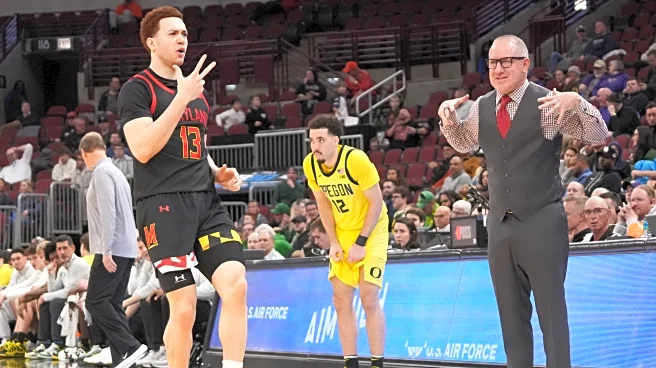
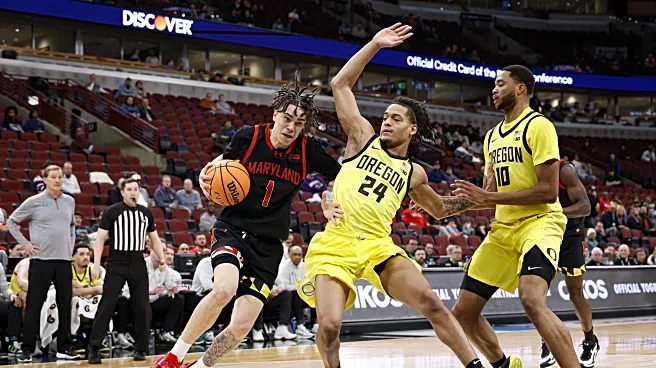
In the first round of the Big Ten Tournament, Maryland squared up with Oregon in Chicago. The same program it fell to by 10 in January, it took down Tuesday by the same amount, 70-60.
Here are three takeaways from Tuesday’s action.
Playoff intensity
The first half of Tuesday’s action was simply an anomaly.
It was as polished a half on defense as Maryland has had all season, and its ball security and decision making was sublime. But more than this, it was the vigor the Terps played with that stood out.
It’s no secret that Maryland was outclassed from a size perspective. Nate Bittle and Kwame Evans Jr. have been some of the most prolific paint players in the Big Ten this season, combining for over 14 boards per contest.
But Maryland’s frontcourt has combatted some of the premier rebounding teams in the Big Ten this season. Solomon Washington — averaging a whopping 9.2 rebounds — and company held Big Ten leading rebounder Hannes Steinbach to just three boards. The Terps nearly outdid No. 9 Illinois — the conference’s leader in rebounds — on Sunday.
Some of the pulldowns Tuesday were largely effort-based. On a handful of occasions, the ball would glance off the rim and bounce around in the open court, waiting for someone to snag it. And nearly every time, a Terp would sprint to the spot before a Duck could get there.
George Turkson Jr. hasn’t seen too much time on the court this year. A redshirt freshman, he made the trek up to College Park alongside Williams from Texas A&M. But Turkson’s feisty attitude on the glass saw him rip down six rebounds in the first half, two of which came on offense.
Williams and his squad didn’t hear a bell.
The Terps don’t hold Oregon to 3-of-22 shooting in the first half — each of those buckets came from Bittle — without sticky, cohesive defense. The Ducks didn’t even muster a single field goal until there was 8:46 left in the frame.
Maryland didn’t full-court press. It didn’t double Bittle or Evans much. But it was extremely connected on the perimeter, refusing and denying drives to the hoop from the top of the arc. Oregon certainly had some open shots from deep, but it didn’t sink a single one.
The important part? The Terps only allowed Oregon three second-chance possessions on those litany of misses. They made sure the Ducks had to play perfectly — and they did not.
Andre Mills’ skillset continues to expand
In the hours before Tuesday’s action, the Big Ten All-Freshman Team was released. Andre Mills, who has averaged 19.3 points per game since Feb. 1, was omitted from the roster.
It’s hard to articulate Mills’ sublime development over the course of the season. He has been an off-and-on starter over the course of the year, and initially looked tentative on offense. But the caliber of player that Maryland fans have been accustomed to watching over the past month is one that deserves NBA Draft lottery consideration — just not this year.
If you only saw the box score Tuesday, you would likely think that Mills was a peripheral factor to the Terps’ success. He shot just 3-of-13 from the field and 1-of-5 from 3-point range. But that doesn’t take into account Mills’ gravity and quarterbacking of the offense.
A sizable chunk of Mills’ misses were from his decisive drives. And while some rimmed in and out, a number created offensive rebound opportunities and opened up kick-out lanes that popped up continuously.
While Mills’ scoring acumen has progressed mightily this season, it was his playmaking and floor general command that opened eyes Tuesday. He finished with five dimes, and was constantly the lead point guard and player that Maryland turned to in a possession reset.
With Williams’ clear trust in the young guard, his role will only continue to be augmented.
A better second half will be needed
Hot starts are essential to success for a Maryland team that only secured four Big Ten wins this season; Tuesday’s game demonstrated that.
But Maryland won’t be able to survive the potential gauntlet that heads its way in the conference tournament with only one stellar half.
Oregon was down by 21 points at the break, but it quickly whittled the deficit down to 12 with 13:46 left. That’s not a lead that Maryland will consider safe against more challenging opponents.
One of the big factors that changed the tenor of the game was the Terps’ turnover disparity. Maryland gave the ball away just two times in the opening 20 minutes, but turned it over eight times in the second frame. The early lack of giveaways made Oregon work for every point it could muster, but later repeated turnovers gave the Ducks momentum in transition and on the fast break.
Timely shots by Elijah Saunders and Diggy Coit ultimately kept Oregon at bay, but assuming Wednesday’s game will be closer, it will be important for Maryland to control the pace and flow.