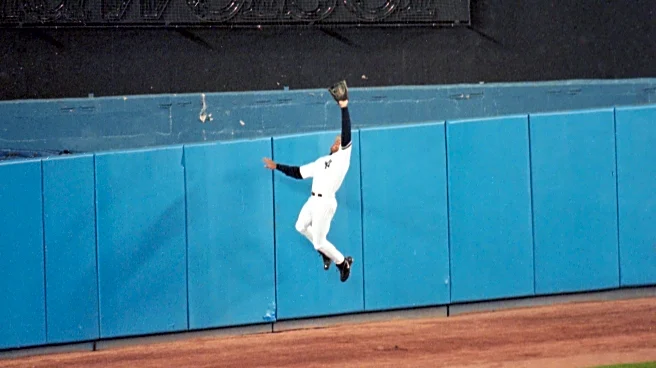

No matter a contract’s length or monetary value, if the signed player spearheads perhaps the greatest dynasty in recent baseball history, it is safe to call it a success. Bernie Williams’ decision to re-sign
with the Yankees in the fall of 1998 would fit that exact description, with the Bombers coming off of two World Series wins in three years, and immediately after one of the most dominant team seasons in the sport’s history.
Although maybe not at the very top in terms of name recognition, it would be a reasonable claim that Williams was the best player on the late-‘90s Yankee teams. Consistent, well-liked, and valuable in every aspect of the game, Bernie was everything the Yankees could have reasonably asked for. Despite the homegrown product almost leaving in free agency, New York’s late decision to bring him back, ultimately for the rest of his career, proved to be a terrific choice, and one of the highlights of our free agency retrospectives.
Bernie Williams
Signing Date: November 25, 1998
Contract: Seven years, $87.5 million
Bernie Williams signed with the Yankees all the back in September of 1985, on his 17th birthday. Coming from Puerto Rico as an amateur free agent, he would spend the next two-plus decades in the Yankees organization and earn his spot in team lore.
The lanky outfielder made his MLB debut during the 1991 season, and did a fine job in his 85 games that year, though he was subject to cruel bullying from disgraced teammate Mel Hall. By ‘93, the clubhouse was changed over and Bernie had made enough strides that GM Gene Michael refused to give in on George Steinbrenner’s constant demands to trade him for more well-known veterans. Stick’s stubbornness was merited. Bernie became a legitimately positive contributor with the bat and in the field, albeit in slightly fewer games, and the Yanks got back over .500 for the first time in five years. The following year was Williams’ first chance at a full-time role with the big club, and the rest, of course, is history.
Bernie made progressive strides between 1993 and ‘94, but broke out in a big way in his age-26 season the following year. In 1995, his best season in terms of WAR, he slashed .307/.392/.487 with a then career-high 18 homers, all while playing excellent defense in a premium position out in center field. It was a major breakout, and came at just the right time, with the Yankee franchise turning the corner right along with him. The strike kept them from snapping their playoff drought in ‘94 but they did so with a Wild Card berth in ‘95. Bernie was undaunted by the October spotlight, posting a 1.381 OPS in five games and homering from both sides of the plate in Game 3.
The Mariners broke the Yankees’ hearts in ‘95, but Williams was just as good with the bat in ‘96, this time introducing more game-changing power, setting a new career-high with 29 bombs. He helped lead the Yanks to a World Series win that year, and had his share of big moments on their postseason trek, earning ALCS MVP honors against the O’s.
Williams continued on his now-familiar run of success in the following season, and was rewarded with his first All-Star selection and a Gold Glove. In 1998, the Yankees’ historically good campaign, Bernie was at his very best. With an eye-popping .339/.422/.575 slash line, 26 homers, and a 160 OPS+, Williams was the leader of this club in terms of offensive production, and he once again delivered in the playoffs. With that fresh in mind, the newly-crowned AL batting champion headed into free agency with plenty of leverage following his banner year.
From the get-go, Bernie and his Scott Boras-led camp were on a very different page than the Yankees. They had offered the star outfielder an unimpressive extension a year prior, and a slightly better contract upon hitting free agency, both of which were turned down. Talks began to stall, and even deteriorated to the point of the Yankees nearly missing out on retaining a franchise cornerstone. In fact, the Red Sox nearly took him away with their bid, a convincing one at that, offering seven years and $90 million.
Meanwhile, the Yankees had shifted their attention to signing the controversial Albert Belle, which would have been something. But, with the Red Sox offer on the table, the Yankees made their final push, with a personal appeal from Bernie and Boras to the Boss helping raise the offer to $87.5 million. It feels hard to believe that Steinbrenner and co. wouldn’t just match Boston to retain their star, but nonetheless, Bernie Williams agreed, and would continue to be a Yankee for the foreseeable future.
Despite the offseason drama, Bernie picked up right where he left off in 1999, with a much more sizeable bank account to go with it. That year was more of the same for the outfielder, posting a 149 OPS+ across 158 games and nearly 700 plate appearances. He was rewarded with the third of five consecutive All-Star selections, and third of four straight Gold Glove awards. In the postseason, he continued to play his part, pitching in with more big hits as the Yankees charged to their second consecutive championship.
Come 2000, Williams was now in his age-31 season, but was in his prime and showed little sign of slowing down. That year, he posted career-highs with 30 home runs and 121 RBIs in the heart of the Yankee lineup, which was slightly diminished from the previous couple years and needed Bernie’s reliability. He hit .455 across the first two playoff rounds before being held hitless across the first four World Series games against the Mets. Williams saved his best for last though, homering off Al Leiter in the nail-biter Game 5 to help the Yankees complete their historic three-peat and solidify their place as one of baseball’s great dynasties.
In the third year of his contract, 2001, the talented switch-hitter continued to prove that he was worth every penny. Same old, same old for Williams, who posted a 139 wRC+, a sixth consecutive season with over 20 home runs, and a fifth straight accumulating over 5.2 bWAR. He was playing like a true star, and had been for the better part of the decade. Although the Yanks went on to lose a classic seven-game World Series that season, he still did his part, highlighted by three home runs in the ALCS against Seattle.
The following year, Williams remained remarkably consistent while actually marking a new high in plate appearances. Following his signing as a free agent, ‘02 marked his fourth consecutive season with at least a 138 wRC+ (146), while remaining consistent in overall production with 4.5 bWAR. He was rewarded with his first and only Silver Slugger Award, at the age of 33. Although the Yankees made a quick exit in the postseason, he still did his part with five hits and a homer in the Division Series.
Now more than half of the way through his big seven-year deal, Williams had already done more than enough to warrant it, leading the charge for three more pennant-winning teams, and doing so with remarkable consistency. Right around here, however, would be where he started his descent.
Unfortunately, it’s something that can happen to a lot of players, particularly center fielders. The risk of a steep drop-off in production only grows as a player goes deeper into his 30s, and on defense, Bernie’s Gold Glove reputation was already more generous than it deserved based on advanced metrics. His 2003 season would qualify as fine, but well below his standards, as he slashed just .263/.367/.411 in an abbreviated 119 game season. For what it’s worth, however, he did still hit .400 with two homers in the Fall Classic loss to the Marlins that year.
In ‘04, Williams remained at about the same level, far from bad, especially considering it was his age-35 season. But, he was no longer the force he was, leveling out to a barely above league-average hitter. 2004 was his seventh and final season with 20 homers, though one of them did clinch the AL East in late September.
2005 marked the last season of his contract, as well as probably his worst play on an MLB field. He played in over 140 games, but had become an all-around liability, posting just an 85 wRC+ with an OBP over 100 points lower than it was at his peak. As such, the Yankees were finally willing to concede that his defense in center was no longer acceptable; he still appeared in important games, but in some, Bubba Crosby played center over Bernie. His best days were behind him, and the Yankees likely saw it timely that his contract was up. A season like that, however, is a small price to pay for what he contributed in the earlier part of that deal.
Williams entered free agency following that season, and at manager Joe Torre’s encouragement, he was actually re-signed once again, but to minimal success in the ‘06 season. it was a minor step up, perhaps, but not enough to inspire hope of a major resurgence. That would prove to be his final season in pinstripes, and in the major leagues. Although Torre had again appealed to keep him that offseason, this time the Yankees’ front office decided that it was the end. Bernie played in the 2009 World Baseball Classic for Puerto Rico but otherwise never took the field again — though he didn’t formally announce his retirement until 2015, when the Yankees also retired his No. 51.
All things considered, this contract was a resounding success for the Yankees. At the time, it was top-dollar for a free agent, and Bernie Williams proved to be worth every penny (and it’s not as though Steinbrenner shied away from big contracts elsewhere as a casualty). Although Bernie may not have quite the ubiquity of a Derek Jeter or Mariano Rivera, there is an easy case to be made that he was the best player on the heart of those Yankees dynasty teams, and it would be hard to put a price on something like that.
See more of the “50 Most Notable Yankees Free Agent Signings in 50 Years” series here.