

WAR can help explain a player’s season, but changing the ingredients can change the evaluation. For six Nationals, a new statistic offers another perspective on their 2026 production—and some interesting questions heading into 2027.
Thomas Nestico of TJStats recently introduced xWAR, an expected version of FanGraphs’ wins above replacement. For hitters, it replaces wOBA with xwOBA and evaluates defense using an average of Statcast Fielding Run Value and Defensive Runs Saved. Baserunning and positional
adjustments remain in place. That makes it more than a measure of luck at the plate.
Let’s take a look at 6 Nationals hitters’ differences in xWAR, 3 of which show potential underperformance in their expected numbers, and 3 who may have overperformed.
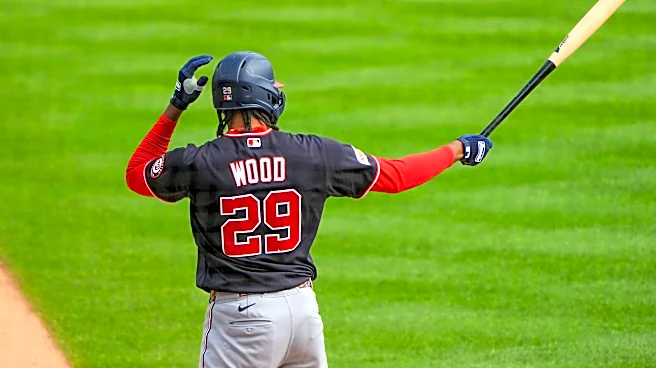
James Wood: +1.0 wins
Wood’s positive gap offers another reason to be excited about the Nats’ most imposing hitter. He already delivered 30 home runs and a 141 wRC+ in 2026, producing 4.0 fWAR despite an August oblique injury. This calculation places his expected value a full win higher. For a player who already anchors the lineup, that is an encouraging indication that his overall performance deserved even more credit. tjstats.ca It also raises an enticing possibility: Wood could become more valuable without needing a dramatic transformation in his game. A healthier season, coupled with results that more closely reflect this evaluation, would give the Nats a formidable centerpiece.
Nasim Nuñez: +0.9 wins
Núñez might be the most intriguing name here because his value depends on much more than his bat. His gap deserves a closer examination of the defensive adjustments, which can meaningfully change the evaluation of a player whose contributions center on run prevention. It should not automatically be read as evidence that an offensive breakout is coming. Instead, it suggests his conventional fWAR may undersell his overall contribution. For the Nationals, that distinction matters when deciding how much playing time to give a player with a limited offensive profile. Even modest improvement at the plate would become more consequential if his defense supplies a stronger foundation than fWAR suggests.
Dylan Crews: +0.8 wins
For Crews, the difference provides some encouragement as the Nats continue evaluating his long-term role. An additional eight-tenths of a win is meaningful, particularly for a young player still establishing himself. The next step is identifying how much comes from expected offensive production and how much comes from defense. Either way, xWAR offers a more favorable assessment of his season. That does not erase the areas where he needs to improve, but it provides useful context when judging his development. The Nationals would welcome more production in 2027, and this gap suggests his starting point may be better than his fWAR alone indicates.
CJ Abrams: −1.3 wins
Abrams had the largest negative gap of these six Nationals. However, there is an important qualification: hitters who consistently pull balls in the air can produce results that expected offensive statistics do not fully capture. His gap warrants investigation, but treating the entire difference as unsustainable production would go too far. The key is determining how much of that advantage reflects a repeatable approach rather than favorable outcomes. If Abrams continues turning pulled fly balls into extra-base damage, he could keep outperforming an evaluation built around xwOBA.
Keibert Ruiz: −1.2 wins
Ruiz comes with a similar qualification. His negative gap invites questions about the repeatability of his production, but his ability to pull airborne contact matters. Because xWAR also changes the defensive calculation, the difference cannot be attributed entirely to his offensive results. Evaluating his season therefore requires separating what the model says about his bat from what it says about his catching. For the Nats, those components carry different implications for whether he can sustain his value behind the plate.
Andrés Chaparro: −0.9 wins
Chaparro rounds out the group, with his fWAR exceeding xWAR by nearly a win. Again, his pulled airborne contact offers a reason to be cautious about predicting a decline solely from the gap. For a hitter whose appeal rests heavily on offensive production, determining whether that advantage is repeatable is especially important. Maintaining an approach that produces damaging contact to the pull side would strengthen his case for continued opportunities in the Nats lineup.
These comparisons give Nationals fans another way to examine 2026. Under this framework, Wood, Núñez and Crews get more credit, while Abrams, Ruiz and Chaparro get less. The useful question is what drives each difference—and whether that particular skill or weakness is likely to carry into 2027.