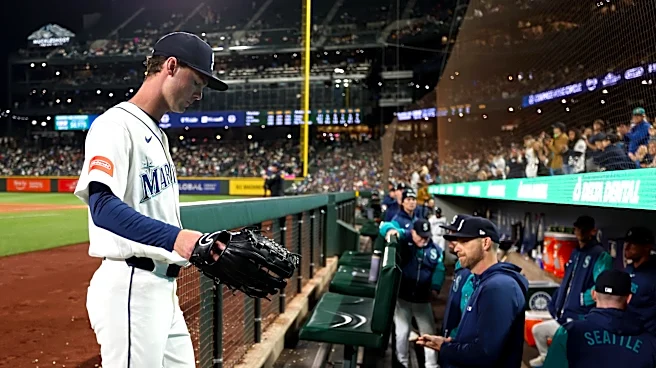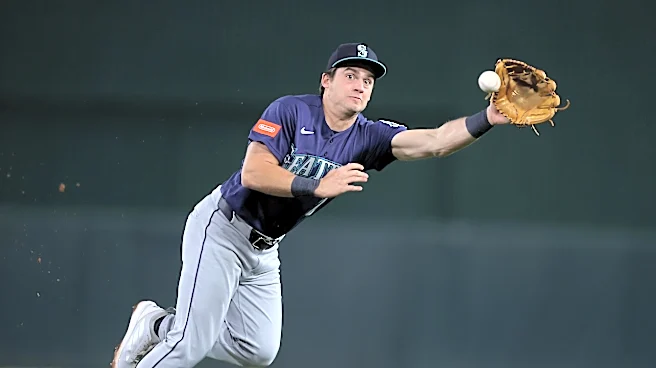




Tonight was the announcement of the 2026 Rawlings Gold Glove Awards. The Mariners, being one of the league’s worst-fielding teams, unsurprisingly had but one nomination: Cole Young at second base. That one nomination really counted, though, as Cole Young won, giving the Mariners their 45th Gold Glove award as a team, the first since 2024 (when they had two winners in Julio Rodríguez and Cal Raleigh), and the first at second base for the Mariners since 2004, the last year of Brett Boone’s historic
three-peat at the position (when Cole Young was one year old). Perhaps speaking to how haunted the second base position has been for the Mariners over the years, Young is just the third Mariner to win a Gold Glove at the position. He is also the second Mariners player to win a Gold Glove Award in his age-22 season or younger, joining Ken Griffey Jr. – not bad company to be in.
Young edged out White Sox second baseman Chase Meidroth and Royals second baseman Michael Massey to win the award. Both Meidroth and Massey had the edge via Outs Above Average (OAA), MLB’s in-house stat, and Meidroth led all AL second baseman with +10 Defensive Run Value (DRV). The official MLB writeup of the nominations listed Young as a distant third behind those two, tepidly noting “different metrics had considerably different opinions of Young’s defense in 2026.”
Where Young did shine was in Defensive Runs Saved (DRS), a stat tracked by Sports Info Solutions; Young led all AL second basemen with 16 DRS – that’s the most by a Mariners second baseman in a season since SIS began tracking the statistic in 2003. Young’s .990 fielding percentage is the third-best single-season mark by a second baseman in Mariners history, trailing only Robinson Canó (.996 in 2016 and .991 in 2015).
Of course, anyone reading this has seen Young’s play for themselves, which speaks louder than any defensive metrics, which count for just 25% of the vote total – the rest of the vote comes from managers and coaches from each league. We’ve been writing about Young’s improved defense at second base since spring training, when it became immediately obvious that Young had improved on both sides of the ball. Young improved his footwork and positioning significantly, finally settling in at second base after working at shortstop for most of his playing career. While the arm action is unconventional, I encourage anyone evaluating Cole Young to look at his footwork first; range metrics don’t like him (hence the bad OAA mark), but he’s incredibly quick and light on his feet, almost dancer-like, something he drills every day with over-exaggerated hops during his infield work. Those quick feet help him get to the “plays in the box”, as infield coach Perry Hill preaches, with an incredibly high degree of reliability.
Young worked hard on his conditioning, too, keeping him on the field – no Mariner played more games than Young, who appeared in 160 games, more than all but nine other players in MLB. That’s especially impressive considering the jump in workload after Young appeared in just 77 games in 2025, ceding his second base job to Jorge Polanco during the postseason run. It was a running joke in the game threads whenever a ball was hit to Cole Young that I would type “you fool, you have hit it to our one (1) competent infield defender” – which undersells how good Young was over there but also speaks to how shaky the infield defense was all season, between injuries, rookies, and general inefficiency; it’s genuinely frightening to think of what the infield defense would have looked like without Young.
Another running joke that is now not a joke: early on in a post-spring training podcast, I was talking about Young’s improved defense and said off-handedly that I thought people would be pleasantly surprised by how much better he looked, but “it’s not like he’s going to win a Gold Glove or anything” – at which point one of my colleagues challenged me, and I said, foolishly, that if Cole Young won a Gold Glove I would get a tattoo commemorating it. (Current Kate tattoo count is zero, just FYI.) That throwaway joke became a very real threat as the season wound on and Young just kept making plays. It got to the point where I did tell Cole about it, who very nicely offered to let me out of the deal – obviously I declined, I am a woman of my word – but said earnestly that he really, really wanted to win the award, so “one of us is going to be unhappy.” I’m very happy it is me who is unhappy.
I’m also happy that Perry Hill, who coached Young, adds to his “Gold Glove Maker” reputation, especially after being a casualty of the coaching staff turnover. Perry, if you’re reading this, the offer to ghostwrite your book (part biography, part fielding instruction manual) still stands.
With Young having taken home the Gold Glove, you can now vote for him for the Platinum Glove award here. The complete list of winners is here.