

For the past 6 months, every conversation regarding the deep bench of the Utah Jazz has been defined by 1 phrase – “You can’t put too much weight on it”. There is truth to this – the end of a regular season defined by egregious tanking isn’t a perfect equivalent for meaningful basketball, and the Summer League is oftentimes more akin in quality to a televised pick-up game than to the best basketball league in the world. This saying has persisted into October; how much weight should we really put on the fourth
quarter of a preseason contest?
While there is validity in being cautious in our evaluations of players in contexts where the lights aren’t shining quite as brightly as they do in the thick of the year, I need to push back a little bit – we need to place weight on something. Even if our limited exposure with these players comes in situations that are not perfect, 1-to-1 comparisons with meaningful NBA games, I believe we are taking a bit of an analytical cop-out to refrain from any evaluation and projection based on what we can see from the months of April to October. Summer League isn’t perfect, and preseason isn’t much better, but they both provide clues on what we can expect from a player when suddenly, they are thrown into the deep end of winning-time.
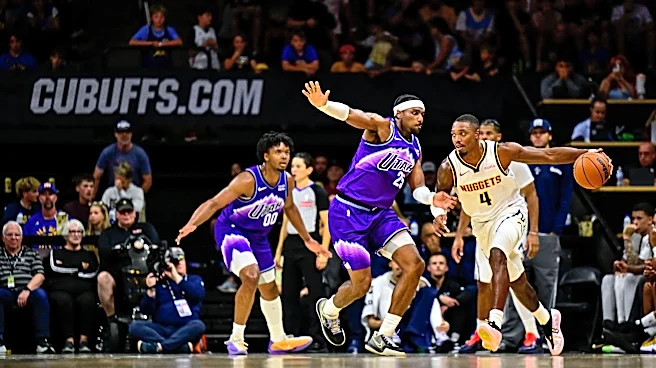
So, taking into account all of the knowledge we have gathered from the past 6 months, which of the deep-bench players has the best odds to elevate themselves from that rank and become a rotation player? I will be defining “deep-bench player” as the 5 players that the Jazz rolled out during the fourth quarter during their first preseason game against the Nuggets. Sure, it’s likely that one of Josh Green and Josh Okogie are out of the primary 10 man rotation to start the year, but their more established nature in the league goes against the purpose of this exercise. Instead, our goal today is to uncover which diamond-in-the-rough, overlooked player will take the leap this year into that “established” tier that Green and Okogie already populate.
5. Tamar Bates

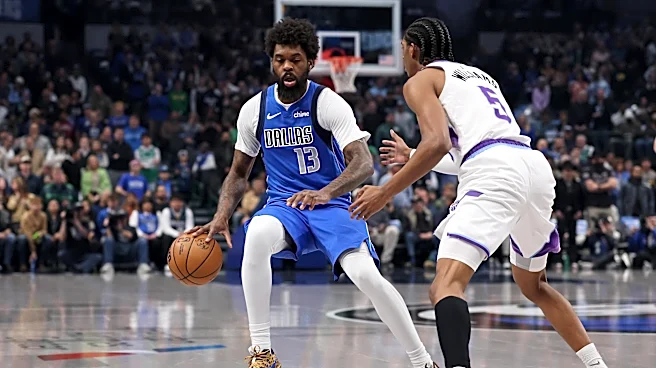
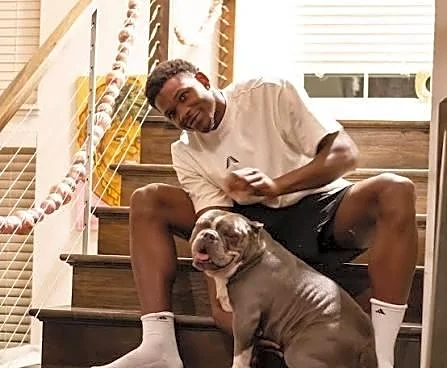
I like Tamar Bates. I think he plays hard, moves with NBA-level fluidity, and has some league-ready skills (the stand-still shooting is absolutely legit, and I’ve been impressed with his point-of-attack defense). However, more than anyone else in this ranking, Bates is facing an uphill battle towards claiming consistent minutes due to the constraints of the position that he plays. The Utah Jazz love shooting guards. They love shooting guards so much that we have (depending on your positional classifications) up to 4 guys who are all probably best suited for the backup shooting guard position. Some will, by necessity, play more as the bench small forward, but nevertheless, the Jazz’s abundance of riches at this position really limits Tamar’s upward mobility. Not only will he have to play the best basketball of his life, but he’ll probably need multiple options above him to get injured and maybe another one to play extraordinarily poorly. It doesn’t help that Bates is entirely position-locked; he’s too short and slender to play the three, and he’s never flashed the playmaking chops to be considered a point guard. Bates is fun, and I expect him to be a key contributor on the SLC Stars, but for the time being, it is likely wisest to expect to remain simmering in developmental juices than to make a rapid rise into the team’s young core.
4. Harrison Ingram

I wish it was more likely for Ingram to obtain minutes, because he so exceptionally fills a few major, anticipated gaps in the skillset of this team. Ingram is a decidedly funky player, dribbling to the the beat of his own drum. For a comparison to past Jazz players, Joe Ingles and Kyle Anderson are the most applicable – Ingram falls into the lineage of heftier forwards who lack in burst but make up for it with wit and ball skills. Those ball skills could be immensely helpful on a team desperately lacking forwards who can competently pass and dribble; Hardy would be able to coach up some interesting plays for a 235 pound forward who averaged nearly 5 assists per game during his last G-League season, and who functioned at times as a guard in college. His rebounding talents are also sorely needed – he’s got a genuine nose for the ball, evidenced by his nearly 11 rebounds per game over his G-League career. There is, in theory, a spot in the rotation for a dribbling, passing, rebounding power forward.
However, Harrison is not without his faults. To start, the shooting improvement that some predicted after his junior season at UNC where he made 38.5% of his three pointers has not actualized. In the G-League, he has been poor from both behind the three point and free throw lines. Additionally, while he is a good positional defender off of the ball, he’s a bit of a tweener when defending the ball handler. Ingram was hurt more than most by the people in charge of measurements at the combine – in college, he was reported to be 6’8, and now is listed at 6’5. He’s got a solid enough wingspan, but is simply giving up too much height to guard the bigger forwards, and cannot move his heavy frame quick enough to stick with the smaller ones. This doesn’t mean that I think he’s a negative defender; in fact, I think his headiness keeps him as a potentially solid positive at that end. However, defense likely won’t be the skill that gets him on to the court until he becomes substantially more versatile. I want to believe in Ingram’s upward mobility this season, because big and smart and talented forwards are high-upside bets (less so now that he’s 23, to be sure), but when his deficiencies are taken into account in combination with who he’d have to pass to gain minutes, playing time with the A-Team this season seems unlikely.
3. Trey Alexander

While I prefer Bates and Ingram to Alexander in a vacuum, the path for Trey to regular minutes is significantly less murky. To start, Trey plays a position that the Jazz are one injury away from suddenly looking quite lackluster. There isn’t potential for Trey to play his way over Isaiah Collier, but if Collier or Keyonte were to go down with an injury for a extended period of time, the lack of ballhandlers on the team almost necessitates a role for Alexander (or a trade for Kris Dunn). Would those minutes be successful? No, probably not, but it doesn’t hurt that Trey has played any amount of NBA minutes before, which cannot be said for Bates. His 228 total career minutes isn’t much, but I would guess that some of the quickest growth for a player comes in those first few hundred minutes, so it is still a point in Trey’s favor.
For those more unaware with Alexander’s game, he is best defined as a jack-of-all-trades type point guard. He’s a good shooter, but his percentages fluctuated in college. He’s a solid passer, but not solid enough for him to be tasked as a point guard for most of his NBA career up to this point (though, by his junior year at Creighton, he was solidly a point guard, and that has continued into the G-League). He’s quick but rarely blows by players, he defends but rarely locks up. The strongest tool in his arsenal isn’t any one skill, but rather his size – being ok at everything is a lot more palatable as a 6’5 guard than a 6’2 one. Additionally, he has been legitimately productive at the G-League level; across nearly 50 games over 2 years, he’s putting up averages of 25/5/7 on respectable shooting splits. There’s a chance that he’s ironed out the creases in his game present while he was at Creighton and that he is now simply an improved all-around player. I haven’t quite seen anything in his (albeit very, very short) Jazz career that makes me change my collegiate evaluation of Alexander, but his combo of size, production, and position give him a real chance to jump to consistent minutes. I’d prefer a midseason trade if injuries occur, but Alexander’s minutes ceiling is high.
2. Mo Bamba

I was contemplating whether Bamba deserved to be mentioned in the same breath as these other 4 players. He’s played in nearly 7 times the amount of games as the rest of the list put together and he’s bounced around the league for nearly a decade. However, if the criteria is being “established”, I think Bamba has yet to hit that bar, even if he is a fairly well known commodity. To his credit, he has not stopped scratching and clawing and fighting his way to NBA success (7 teams in 8 seasons!), and I think there is a very possible world where, this season, his hard work finally lands him a real role on a good team. Bamba has been in-and-out of the Jazz system a number of times, which gives him a certain level of comfort with the scheme and staff that the newcomers lack, and he seems ready to adopt a leadership role.
When you consider the fact that Jusuf Nurkic has played an average of 52 games per season through his 12 game, there is a very possible hole to be filled at the center position at some point during the year, and it’s not like Jaxson Hayes is some insurmountable hurdle at the backup center position either. We have 3 centers on the roster (I would really prefer to see Flip and JJJ almost entirely at the 4), and one of them is Bamba – he is boosted on this list by virtue of that alone. However, and maybe I’ve fallen victim to one of the classic blunders, I still have some belief in Bamba becoming a semi-valuable NBA player, regardless of his place on Utah’s center ladder. He’s big and he’s hitting threes and, in theory, he’s only become more comfortable defending the pick and roll as his career has progressed. I don’t ever want him starting, but I trust him to eat minutes as a bench big, assuming the rest of that bench lineup is consistently competent. However, even if consistent minutes aren’t in the cards for him this year, Bamba’s attitude may allow him to provide value from a deep-bench role.
1. Blake Hinson
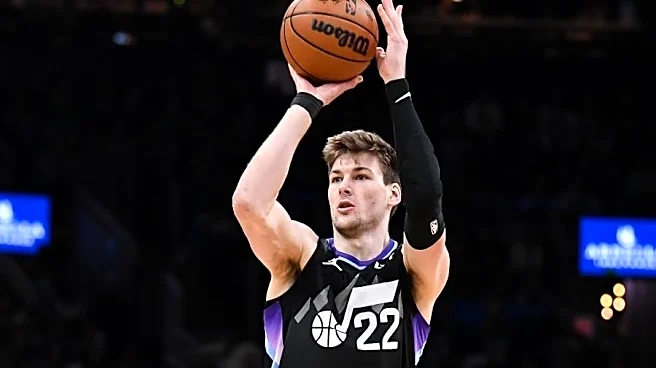
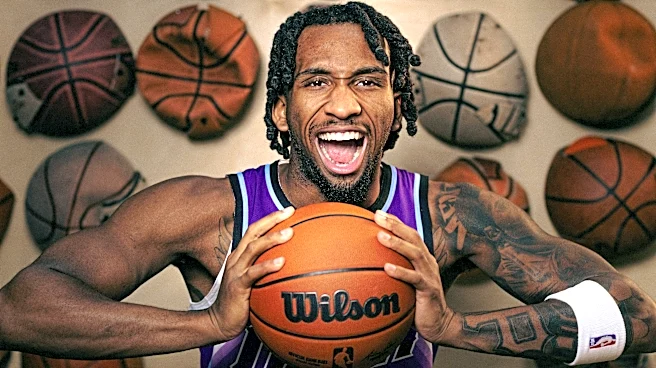
While Hinson doesn’t have the easiest positionally path to playing time (that would go either the point guard or center on this list), but he occupies the top spot due purely to his overwhelming talent advantage. I’ve had to look hard to find the reasons that the rest of this list may end up deserving minutes by the end of the year, but with Hinson, it’s easy – the Jazz seem to have really found something with him. It all starts with his shooting, where he is legitimately dynamic. Off the catch or off of movement, from a few feet out closer to the line, open or contested, Hinson is knockdown from just about anywhere. I love the combination between his frame and verticality on the jump shot – he has a similar build to Bojan Bogdanovic, but instead of the 2 inch leap that accompanied Bogie’s shots, Hinson soars over contests when it’s his turn to fire away. I’m not sure how valid the reports are that Blake lost 22 pounds over the offseason, but he does look to be in better shape, which can only improve his effectiveness at both ends. Moments like this certainly can’t hurt his standing in coach’s eyes, either –
Like the rest of the list, Hinson’s case for minutes likely is intertwined with injuries. However, I think that Hinson is the only option here who could, feasibly, earn minutes based of being too good to leave on the bench. The path based on merit would take one of two forms – if Ace is at the backup power forward, it would take Blake beating out Brice, Svi, Okogie, and Green for the backup small forward. If Ace is at the three, then Blake has to best Kyle Filipowski (the difference between the two scenario is mainly technical – Blake would really be beating all of those players in either of them due to the versatility of the positions). It’s not likely, to be sure, but if Hinson is shooting 43% from three and crashing the boards with ferocity, he may be able to play a winning, necessary role better than the alternative options, even if those options are better all around players. This still may not be the year for Hinson – I like him, but he likely isn’t more conducive to winning basketball than Josh Okogie right now. Still, he is the member on this list that I am most confident in my desire to return in future seasons. Shooting and size and heart like that don’t come by every day, so let’s make sure that Blake remains part of the program.
How would you change this list? Which are you most excited for? Comment below!