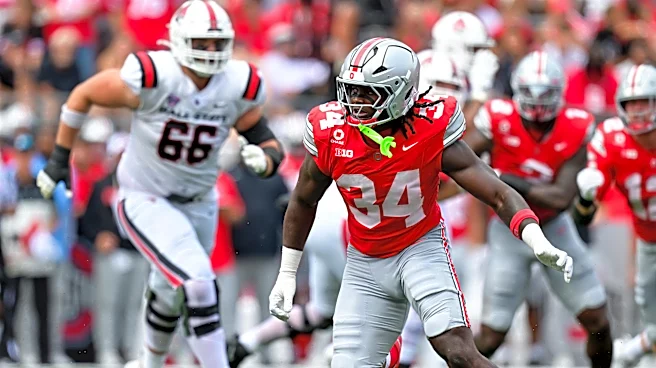


Ohio State doesn’t need to search very far for its next potential difference maker on the defensive line. He may already be wearing No. 34.
Khary Wilder arrived in Columbus with the resume of a player who was supposed to matter sooner rather than later. The 6-foot-4, 257-pound freshman from Gardena, California, finished his Junipero Serra career with 267 tackles and 29 sacks.
His production accelerated every season. 75 tackles and 14 sacks as a sophomore, 86 tackles, 11 tackles for loss and 4.5 sacks as a junior,
then 91 tackles, 20 tackles for loss, 10 sacks and five forced fumbles as a senior. He was also named to the Los Angeles Times’ All-Star team.
His reputation wasn’t built solely on high school statistics. Wilder became one of the biggest risers in the 2026 recruiting cycle, eventually earning five-star recognition from Rivals and finishing as their No. 1 defensive lineman and No. 11 overall prospect.
On3 ranked him No. 2 among defensive linemen and No. 41 nationally. At the 2025 Rivals Five-Star Challenge, Wilder was named the defensive line MVP after repeatedly winning one-on-one reps against elite offensive linemen.
Evaluators specifically highlighted his long arms, ability to combine power with quickness and his versatility to attack from different alignments.
That versatility is what makes his early Ohio State flashes so interesting. During the opener against Ball State, Wilder wasn’t simply parked at defensive end. He moved around the front and showed that Ohio State can use him both outside and inside in passing situations.
PFF charted him for 17 defensive snaps and gave him a 71.8 defensive grade, third among Ohio State’s defensive ends in the game. More importantly, his pressure helped force a bad throw that became TJ Alford’s interception.
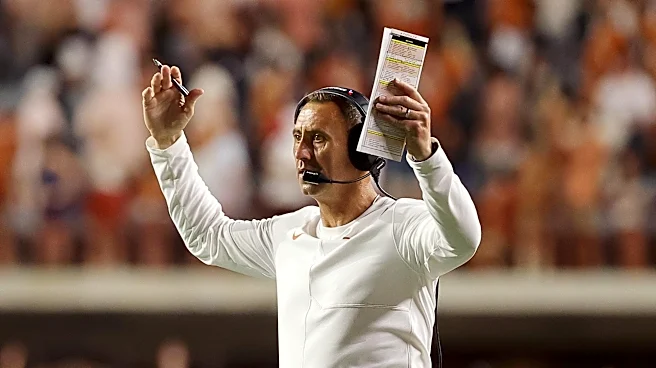
Then came Texas. Wilder’s playing time dropped dramatically. PFF charted only five defensive snaps. Yet even in that microscopic sample, PFF recorded two quarterback pressures (which led the team).
That is the part that should make Ohio State curious. Wilder had two pressures on just five charted defensive snaps against Texas, essentially creating disruption every few opportunities he received.
That doesn’t automatically mean Wilder was ready to play 50 snaps against Texas. But it does mean the sample is becoming difficult to ignore. Ohio State’s defense had trouble consistently affecting Arch Manning after the Longhorns settled in, and the Buckeyes ultimately surrendered a 20-point lead in a 24-23 loss.
The defensive line obviously wasn’t solely responsible, but when a freshman produces two pressures in five snaps, there is a legitimate football question about whether he deserved a larger opportunity.
The bigger picture: Wilder could become much more than a freshman cameo
The most intriguing thing about Wilder isn’t simply that he’s talented. It’s that his skill set gives Ohio State options. At Serra, he was productive from multiple spots along the defensive front. He could play the edge or slide inside as a 3-technique, and his high-school film showed the agility to change directions and close space despite carrying legitimate NFL defensive lineman size.
That translates naturally to the modern college pass rush. Ohio State entered 2026 looking for answers alongside Kenyatta Jackson Jr. after losing Caden Curry, who led the 2025 Buckeyes with 16.5 tackles for loss and 11 sacks. The coaching staff had several options, including Beau Atkinson, Qua Russaw, Zion Grady and Epi Sitanilei.
Wilder wasn’t initially expected to be the centerpiece of that rotation. In fact, many preseason depth-chart projections had him behind all of those more established players.
But that’s exactly why his emergence matters. Wilder has already checked several boxes. He has the size, the recruiting pedigree, the high-school production, the positional versatility and, perhaps most importantly, early evidence that his athletic ability can translate against college competition.
The next step is simple, give him enough snaps to find out what he actually is. That doesn’t necessarily mean making Wilder a starter immediately. It means putting him on the field consistently enough to establish a real role, particularly on passing downs.
Give him edge reps. Move him inside against favorable matchups. Let him attack tired offensive linemen. Give him 20-30 meaningful snaps instead of treating him like a player whose development can wait until November.
The long-term outlook is even more intriguing. Ohio State’s current defensive end room includes veterans such as Jackson, Atkinson and Russaw, but Jackson and Atkinson are seniors while Wilder is only beginning his college career.
If Wilder continues developing, the experience he gains in 2026 could position him for a substantially larger role in 2027
There is still plenty Wilder has to prove. Five or 17 snaps aren’t enough to establish consistency, and pressures aren’t sacks. He will eventually have to show that he can play with discipline, hold up against the run, understand Ohio State’s assignments and produce when offensive coordinators specifically game plan for him. But that’s precisely the experiment Ohio State should be running.
The Buckeyes already know what their veterans can provide. What they don’t yet know is how good Khary Wilder can become when he’s given a real workload.
After what he has shown in his first two games, that may be the most interesting question on Ohio State’s defensive line.