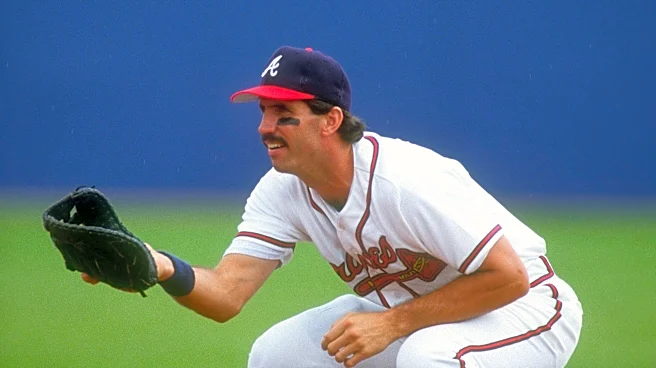

This is the latest in a series focused on the 35th Anniversary of the 1991 Atlanta Braves, the team that reversed the franchise’s fortunes with an unforgettable season. Veteran first baseman Sid Bream recalls his decision to sign with Atlanta and the events that took an unproven team to Game 7 of the World Series.
Looking back on the improbable nature of the 1991 season for the Atlanta Braves, the seeds of success were planted well in advance of their worst-to-first journey to the World Series. Drafting
and developing a new generation of talent laid the foundation, but acquiring the right veterans to put the team over the top and on the path to contention was the next step in that progression.
When John Schuerholz took over as Atlanta general manager in the winter of 1990, his mandate was to elevate the entire operation. From the front office to the field and even the stadium conditions, Schuerholz sought to upgrade how Braves baseball was experienced.
For the team itself, this meant finding the right pieces to create a well-rounded roster. A host of young talent was already assembled, but experience was in short supply for the Braves.
To complete the puzzle, Schuerholz targeted veterans from winning franchises who possessed both tangible and intangible value. That search brought former Pittsburgh Pirates Sid Bream and Rafael Belliard as well as longtime St. Louis Cardinals third baseman Terry Pendleton to Atlanta.
Bream, who reached free agency for the first time at age 30 in the winter of 1990, was coming off a trip to the National League Championship Series with Pittsburgh. Serving as the strong side of a platoon at first base for the Pirates, Bream appeared in 147 games and batted .270 with 15 home runs and 67 RBI in 389 at-bats, posting an .804 OPS in 1990.
The Braves got to work at the annual Winter Meetings, Schuerholz’s first at the helm.
On December 5, 1990, Atlanta signed Bream to a three-year, $5.5 million contract. That occurred just two days after inking Pendleton to a four-year, $10.2 million deal. Belliard was added a couple of weeks later, completing an infield revamp designed to provide a young pitching staff with proven veterans to make plays behind them.
“Our attempt in coming to these meetings was to make improvements in our club, not only ability, but makeup,” Schuerholz told the Associated Press at the time. “This certainly makes us stronger.”
Solving first base had proven quite difficult for the Braves prior to Bream’s arrival.
In the winter of 1989, they signed slugger Nick Esasky to a three-year, $5.7 million deal. Fresh off a 30-homer season with the Boston Red Sox, Esasky was limited to just nine games with Atlanta in 1990 and was eventually diagnosed with vertigo. That pressed rookie outfielder David Justice into action at first base, a position he would play for several months before the trade of long-time fan favorite Dale Murphy to the Philadelphia Phillies in August. That bittersweet move opened up right field and paved the way for Justice to earn Rookie of the Year honors.
The Bream signing brought some left-handed power, a steady glove, and leadership to Atlanta. But truth be told, he never intended to leave Pittsburgh. Bream grew up in Carlisle, Pennsylvania, and enjoyed being back in his home state after starting his professional career with the Los Angeles Dodgers before coming over in a 1985 trade.
“I was a free agent, but the Pirates had told me at that point in time, after we lost to the Cincinnati Reds, ‘Sid Bream is our first priority to sign for the 1991 year,’” Bream said. “So, we weren’t even thinking about going anyplace else, truthfully. Then throughout negotiations, they didn’t even get close to the market price on me, let alone anything more for being their priority.”
The Pirates’ inaction opened the door for the Braves to add a player who quickly became a respected team leader. All that was left was for Bream to walk through that door.
“The market opened up and we opened ourselves up, not even thinking anything about it, truthfully,” Bream recalled of his family’s decision to explore new opportunities. “The Braves gave us a great offer, but even after that, I tried to stay in Pittsburgh. If they were to give me a no-trade clause, I’d have stayed there. But it didn’t happen. They said no to the no-trade clause. And I said, ‘Man, if I’m your first priority, then I’d hate to see what your last one is.’”
Bream arrived at his new baseball home motivated and with a fresh challenge in front of him. He was part of a young Pirates club that climbed from 98 losses in 1986, his first full season, all the way up to 95 wins and a trip to the postseason in 1990. While the Pirates played in the NLCS, the Braves wrapped up a 97-loss campaign.
It was fair to wonder how long it would take for Atlanta to follow a similar trajectory to Pittsburgh’s, and Bream was about to find out.

“We came down to Atlanta, not knowing what to expect other than the fact they had a lot of great young ball players,” Bream said. “John Schuerholz was bringing in some people that knew how to play the game and knew how to win (like) Terry Pendleton and Charlie Leibrandt. Raphael Belliard shored up shortstop but (we) all had some leadership in there. I had some winning underneath me, so it was a great fit. The young guys listened well. Bobby Cox and the rest of the coaching staff did a great job, and it got us to where we needed to be.”
Cox served five years as Atlanta’s general manager from 1986-1990, orchestrating trades and drafts to fill the organizational pipeline with young talent. With many of those players arriving in the major leagues, Cox stepped out of the front office and back into the dugout to resume a managerial career he’d put on hold after 1985.
With Schuerholz taking over Atlanta’s executive responsibilities after nearly two decades as the GM for the Kansas City Royals, Cox could now focus on getting the most out of the roster. In order to accomplish that, the need for proven veteran voices to help guide a youthful team was critical.
“One of the nice things about Bobby Cox – and you don’t find a lot of managers that allow this to happen – but Bobby Cox allowed Terry, myself, and Charlie to have team meetings without the coaching staff to be able to hash things out and talk things through,” Bream said. “We started to do that on a regular basis. Sometimes we got into some pretty good little spats, but we were trying to get the young players to understand what it was and what it meant to be a winner. But you could start to feel things starting to come together.”
Those meetings enhanced the accountability, but the shared experience of a pennant race brought the Braves closer together and closer to relevance than they’d been in nearly a decade.
A rivalry with the Dodgers would decide how the National League West was won. Atlanta rolled into the All-Star break at 39-40, their best record at the halfway point since 1984. The Braves even spent a week in first place from May 10-17, but they weren’t content to allow that to be the high-water mark for their season.
The second half was a magical ride for an Atlanta team that had finished in last place for three consecutive seasons and lost 90-plus games five times in the previous six years. The Braves came out of the break by winning 9 of 11 and trimming their division deficit from 9-1/2 games down to 2-1/2 games in just two weeks.
“It wasn’t until after the All-Star break that we put that winning streak together and it got us back into contention,” Bream said. “At that point in time, you started to feel things happening. Atlanta-Fulton County Stadium started to buzz and I think that’s when everything started to get to the place of, ‘Wow, we can do this.’”
As the momentum grew that summer, so did the crowds in Atlanta. With the rivalry reaching its crescendo down the stretch, there were 45,000 fans per game packing the stands to see the Braves and Dodgers square off. Trailing by a half game in the standings, Atlanta took 2-of-3 from Los Angeles in the first of two September series and moved into first place.
Bream delivered a grand slam in the first inning on September 15 as the Braves guaranteed their first winning season since 1983 with a 9-1 victory. They would trade first place with the Dodgers five times in the final 32 games before Atlanta finally clinched the division title on October 5, 1991, in Game No. 161.
“Seeing that they were in front of us but being able to go up against them and win ballgames to take the lead away from them was always a special time,” Bream said. “After the All-Star break we started to do that. Then you started to hear that tomahawk chop get going in the whole stadium. It was a very, very, very special time. I tell people the ‘91 season, for me, was probably the most special. Watching a team go from last place to first place and having a city adopt us the way that they adopted us, it was a very, very special time for us.”
The Braves headed to the NLCS against the Pittsburgh Pirates. It was a first for Atlanta, but Bream’s old team was once again attempting to reach the World Series. A classic seven-game series would follow, with the Braves winning the final two games on the road to clinch the NL pennant.
Waiting for Atlanta were the Minnesota Twins, another club that had gone from last place in 1990 to play for a championship just one year later. The Braves were a team just learning how to win together en route to their first World Series appearance since 1958. Meanwhile, the Twins won the World Series in 1987 but slipped in the standings before getting back on track in 1991 with future Hall of Famers Kirby Puckett and Jack Morris leading the way.
The two teams squared off in a classic World Series battle, a seven-game epic in which each team won every game played in its home ballpark. The Twins went up 2-0 before the Braves brought the series home and won all three at Atlanta-Fulton County Stadium.
Back in Minnesota with two chances to close it out, Atlanta was walked off twice in extra innings. First it was Puckett with a game-winning homer off Liebrandt in the 11th inning of Game 6, then it was Morris with a 10-inning shutout performance in the Game 7 clincher.
Just like that, the incredible season was over and the Braves came up just one game short. Even though they weren’t able to win the World Series, Bream recalls the exhilaration of playing on baseball’s biggest stage – a place no one expected the Braves to reach just six months earlier.
“I tell everybody that all of us want that opportunity, to be in those situations,” Bream said. “I go back and I look on the internet and see how many games were one-run or won in that last at-bat. They could’ve gone either way. It really, truly could have.”
The series was an instant classic, perhaps the greatest ever played. Five games were decided by one run with three going to extra innings.
Atlanta’s scoring chances in Game 7 remain a point of contention. The best opportunity came in the eighth. After Lonnie Smith’s lead-off single, Pendleton doubled to the gap in left center. On the play, Twins rookie Chuck Knoblauch faked a throw to second base, causing Smith to second-guess where the ball was. Rather than picking up third base coach Jimmy Williams for direction, Smith stalled rounding second and had to stop at third.
Knoblauch’s decoy proved to be a game-saving play for Minnesota. After Ron Gant grounded to first and the runners stayed put at second and third, Morris intentionally walked Justice before getting Bream to hit into an inning-ending double play.
Even after 35 years, those missed opportunities are still fresh on the minds of those who lived it.
“Terry had a guy on third base with less than two outs and he didn’t score (in the fifth inning),” Bream recalled. “And obviously, we know about the double with Lonnie (stopping) at second base. I know I had an opportunity with the bases loaded and one out in order to score runs in that last game. We had a lot of opportunities, but Jack Morris that night was just a little bit better. He got the job done. You’ve just got to tip your hat to him. We fought hard, but we just weren’t able to come home with it.”
Bream and the Braves were up to an encore in 1992.
After another magical season, they had an NLCS rematch against the Pirates. Bream’s Game 7 dash from second base to home plate sent Atlanta back to the World Series and still stands as one of the greatest moments in postseason history.
Atlanta ultimately fell to the Toronto Blue Jays in six games in the 1992 World Series. Bream split time with Brian Hunter in 1991 and 1992, but Fred McGriff’s arrival in late 1993 changed things at first base for the Braves.
Bream departed as a free agent and spent his final season as a reserve for the Houston Astros in 1994. He retired after a 12-year career during which he batted .264 with 90 home runs. 455 RBIs, and 50 stolen bases in 1,088 games for the Dodgers, Pirates, Braves and Astros.
If you’d like to dive deeper into first-hand accounts from the ‘91 squad, check out Steve Avery’s retrospective on that fateful season.