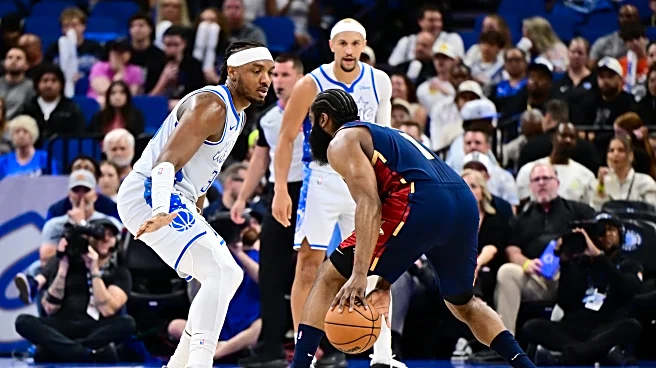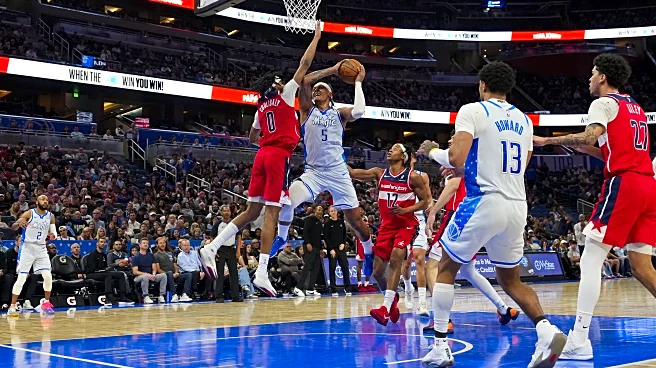


Now that’s more like. The Wizards fell behind the Orlando Magic by as much as 19 points in the second, roared back with a +15 fourth quarter to send the game to overtime, briefly took a one-point lead in the extra period, and still brought home the loss they needed. Now that’s a quality tank loss.
For my money, the best part of this game was 21-year-old Bilal Coulibaly taking over Washington’s offense late. In just 6:41 of playing time in the fourth, he shot 5-9 from the floor (including a banked-in
three from the wing) to score 13 points. He finished the game with 29 — a new career high.

Now, the offensive takeover was creaky at times. That banked in three was lucky, and Orlando defenders made him convert some very difficult shots.
And yet, the takeover was something I’ve wanted to see since they traded up a spot to draft him. In a close game the players wanted to win, Coulibaly tried to dominate and mostly succeeded. Orlando couldn’t keep him out of the paint when he committed to driving.
Maybe the creaky, clunky experience last night will lead to a smooth and confident takeover in the future.
Maybe.
At least we got a taste of hope last night.
Back to reality, it’s still in Washington’s best interest to keep on losing. They’ve lost 10 in a row to move into third worst behind the Indiana Pacers and Sacramento Kings. The Pacers are currently on an 11-game skid. The Kings — a franchise as committed to getting things wrong as the Wizards — have won four of their last six. The race to the bottom is real.
Thoughts & Observations
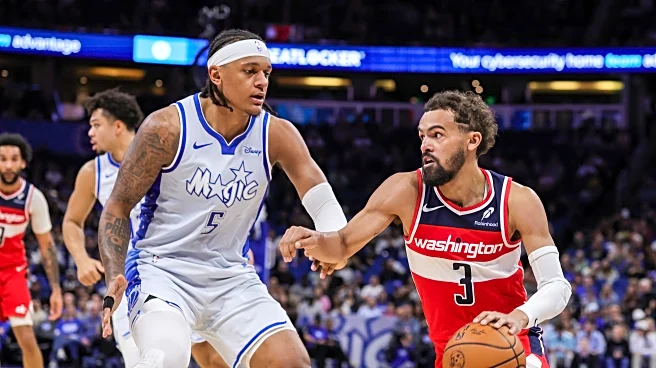
- Trae Young is a truly abysmal defender. I’ve known this, as has everyone else who’s watched him play over the course of his career. Seeing it up close again has been…well…a tough reminder. I mean, I’m used to seeing terrible perimeter defense from guys wearing Wizards uniforms. Young is a whole new thing — I haven’t seen defense this ineffective since Isaiah Thomas was starting.
- When the Magic saw Young between them and the basket, they drove right at him and mostly got layup line opportunities. He seemed to try to take a charge once, though I suspect he just couldn’t get out of the way fast enough.
- We’ve probably all seen highlights of Draymond Green having wrecking ball defensive possessions where he moves around the floor blowing up the opponent attempts to run offense. In the first quarter (possession ending around 6:57), Young had the opposite of that. He matadored dribble penetration that produced a paint touch, peel switched onto a cutter, who he fouled.
- Sure sign that I’m a curmudgeon — watching Tre Johnson turn down a semi-open three-point attempt to drive in and toss up a floater annoys me. For all but a few — and Johnson is not among the few — floaters are crummy shots. Necessary at times, but only as a last resort. Just. Drive. To. The. Basket.
- The Wizards coaching staff has done a great job all season designing halfcourt set plays. They ran a beautiful one to start the second quarter — Tristan Vukcevic set a back screen at the three-point line for Justin Champagnie, who came wide open on his cut to the rim. Unfortunately, it was Bub Carrington making the lob pass, and he’s terrible at throwing lobs. Champagnie could barely tip the ball, and the Wizards failed to score.
- Too many injuries in this one. Sharife Cooper took a hard fall for the Wizards and didn’t return. Jonathan Isaac sprained his left knee after leaping for an alley-00p. Jalen Suggs banged knees, took a hard fall on that knee, and then took another hard fall going for a block. Orlando needs him healthy.
- I had many notes last night about Suggs and his teammates picking on Young. Suggs especially.
- Orlando’s broadcast team made a big deal of saying Vukcevic’s name correctly. Only problem? They got it wrong. Every time. For the record, it’s pronounced Vook-sevitch. Not Vook…chevitch.
- Leaky Black has been a problematic defender in his (brief) stint with the Wizards, and he had some rough possessions last night. He also had some good possessions — the first one I’ve seen from him since he arrived in Washington.
- I continue to think Paolo Banchero is mightily overrated. Black, Coulibaly, and Anthony Gill repeatedly forced him to take fading midrange twos — exactly the shots NBA defenses want to give up. And he’s not good at shooting them.
- Speaking of Wizards coaches designing good set pieces, the sideline out of bounds play with 18 seconds left was great. They slalomed Coulibaly through a couple screens, which forced Orlando to switch Banchero onto Coulibaly and put Tristan da Silva in weakside help position. Banchero was out of position on the catch, and Coulibaly attacked fast. da Silva came to help, and Coulibaly dropped a pass to Black for a dunk. Great design and execution.
- If the goal was to win, the Wizards coaches blundered when they didn’t foul on what turned out to be Orlando’s final possession of overtime. They let the Magic run the clock to about six seconds, and then failed to even get a shot up when they got the ball back. If.
Four Factors
Below are the four factors that decide wins and losses in basketball — shooting (efg), rebounding (offensive rebounds), ball handling (turnovers), fouling (free throws made).
The four factors are measured by:
- eFG% (effective field goal percentage, which accounts for the three-point shot)
- OREB% (offensive rebound percentage)
- TOV% (turnover percentage — turnovers divided by possessions)
- FTM/FGA (free throws made divided by field goal attempts)
Stats & Metrics
PPA is my overall production metric, which credits players for things they do that help a team win (scoring, rebounding, playmaking, defending) and dings them for things that hurt (missed shots, turnovers, bad defense, fouls).
PPA is a per possession metric designed for larger data sets. In small sample sizes, the numbers can get weird. In PPA, 100 is average, higher is better and replacement level is 45. For a single game, replacement level isn’t much use, and I reiterate the caution about small samples sometimes producing weird results.
POSS is the number of possessions each player was on the floor in this game.
ORTG = offensive rating, which is points produced per individual possessions x 100. League average so far this season is listed in the Four Factors table above. Points produced is not the same as points scored. It includes the value of assists and offensive rebounds, as well as sharing credit when receiving an assist.
USG = offensive usage rate. Average is 20%. Median so far this season is 17.7%.
ORTG and USG are versions of stats created by former Wizards assistant coach Dean Oliver and modified by me. ORTG is an efficiency measure that accounts for the value of shooting, offensive rebounds, assists and turnovers. USG includes shooting from the floor and free throw line, offensive rebounds, assists and turnovers.
+PTS = “Plus Points” is a measure of the points gained or lost by each player based on their efficiency in this game compared to league average efficiency on the same number of possessions. A player with an offensive rating (points produced per possession x 100) of 100 who uses 20 possessions would produce 20 points. If the league average efficiency is 115, the league — on average — would produced 23.0 points in the same 20 possessions. So, the player in this hypothetical would have a +PTS score of -3.0.
Players are sorted by total production in the game.