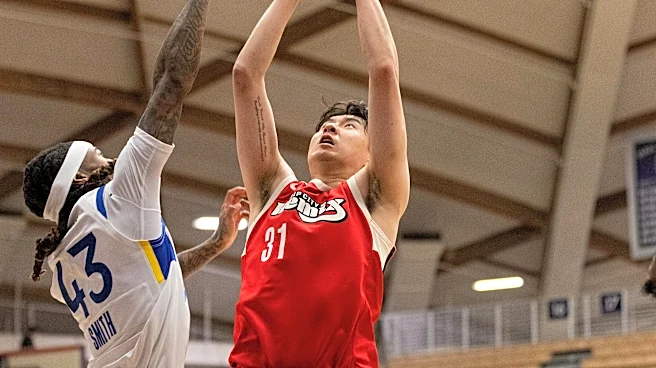


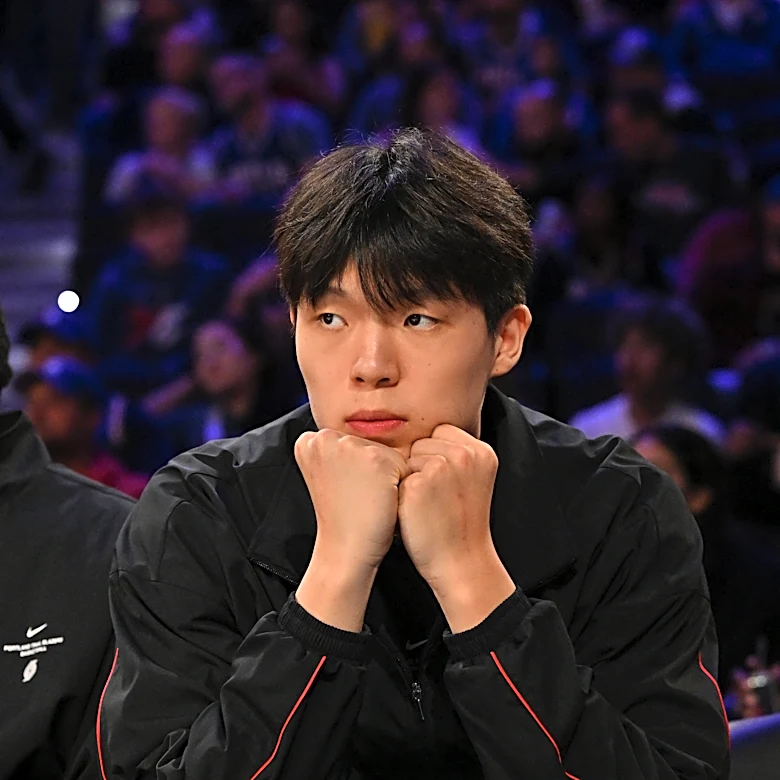
Lee Hyun-jung’s pilgrimage to become only the second South Korean player in NBA history has been an ongoing, eight-year transcontinental journey with only one constant: Lee’s willingness to accept any challenge, whatever it takes. The latest leg of his winding path to basketball’s largest stage lands him here in Portland, starting for the Rip City Remix.
Since 2025, Lee Hyun-jung has won an NBL championship with the Illawarra Hawks in Australia, a B. League Championship and postseason MVP with Nagasaki
Velca in Japan, and a gold medal at the Asian Games, where he was the top statistical performer in the tournament and named Asia-Basket’s unofficial MVP.
When you watch Lee compete, it’s easy to see why the 6’7” wing’s success has translated to such a wide variety of basketball environments. He’s a polished player. He makes quick decisions on both sides of the floor, the ball rarely sticks in his hands, he knows where he’s supposed to be on the court, and he always seems to stay active. There’s a lot to like, especially as a teammate.
Lee’s calling card is his outside shooting, primarily catch-and-shoot. He can come off curls, enter his motion, and finish with a quick release. When he gets a clean look, he’s really accurate. Heck, sometimes he’s accurate when he gets bad looks, too. As a sophomore at Davidson, he finished the COVID-shortened 2020–21 season shooting 50.8% from the field, 44.2% from three, and 90% from the free-throw line—becoming one of roughly a dozen players to post a 50/40/90 season in modern NCAA Division I history.
The primary question surrounding the Korean sharpshooter’s transition to the NBA is whether his physical tools will hold up at the highest level. I would never describe him as an explosive athlete—his lateral quickness is limited, and he’s not the strongest player I’ve ever seen—but he is self-aware enough to acknowledge his weaknesses and put in the work to improve them.
During his initial 2023 G League stint with the Santa Cruz Warriors—when he joined mid-season after recovering from a foot injury—Lee struggled to keep up with the competition defensively. Rather than accept his fate as a low-minute background player here in the US, the next season Lee opted to take a larger role in Australia’s NBL, a notoriously physical league, with an eye toward improving his shortcomings that the G League exposed.
Lee Hyun-jung explained the thought process behind the decision in a 2024 interview with Japan Forward.
“In order to overcome the issue of my weak defense, I went to Australia and made a lot of efforts to improve my defensive skills, playing a lot of one-on-one with players at the same position. I did yoga to improve my physical flexibility and made a lot of efforts to improve my muscle strength.”
He then said, “I think I also gained the intelligence to be able to play defense without losing my physical strength.”
The work hasn’t transformed his liabilities into assets, but it has mitigated them. He can take bumps and navigate screens much better, his footwork guarding on the perimeter one-on-one is smoother, his off-ball rotations are crisp, and he anticipates passing lanes to disrupt them… but the real improvement has been in his rebounding. Lee has a real nose for caroms and he’s not afraid of mixing it up in the paint to dig them out.
Playing for the Remix, there are times when Lee seems destined to get an NBA promotion. He’s shooting a blistering 49% from three on 6.8 attempts through six games, which forgives a lot of defensive sins, and his averages of 14.2 points, 7.2 rebounds, and 2.7 assists in 32.4 minutes a game look real nice on paper. His on/off numbers are also team-best.
When you take a closer look, though, you see a four-game stretch where he averaged 19.5 points bookended by two performances where he averaged 3.5. In those low-scoring games, he simply didn’t attempt many shots—taking a passive role rather than looking to score—suggesting that consistency may be another barrier to his entry into the big league. Deferring to teammates has its place, and Lee is unselfish on the court, but you can’t just disappear when you’re one of the better players, not if you want to make it to the next level.
Whether he reaches his ultimate goal of playing in the NBA won’t determine if Lee Hyun-jung’s quest has been a success, at least not to me. I believe he is defined by both the obstacles he’s already overcome and his unwavering determination to keep his eyes on the prize. The fact that he has this opportunity at all is such an unlikely event that it stands as a testament to his achievement.
The Crown Prince
Every origin story has a beginning, and Lee Hyun-jung’s first chapter is deeply rooted in family. He is the second generation of Korean basketball royalty, next in a lineage of on-court winners.
His mother, Sung Jung-a, was a tenacious competitor whose high motor and athleticism earned her the nickname “Black Panther.” Sung is one of the most decorated basketball players in the country’s history, boasting two gold and two silver medals from the FIBA Asia Cup, one gold and two silvers from the Asian Games, and a silver medal from the 1984 Olympic Games in Los Angeles.
His father, Lee Yoon-hwan, isn’t as well-known for his playing career, which ended in his mid-twenties. Instead, he made his mark on the sidelines at Samil High School—a legendary 35-years-and-counting run coaching a program that has produced some of Korea’s finest basketball talent, including the only South Korean NBA player in history, former Trail Blazer Ha Seung-jin.
The father-son duo partnered for one of the most dominant two-year stretches in the Korean high school basketball record books, posting back-to-back 23–2 campaigns during Hyun-jung’s freshman and sophomore seasons in 2016 and 2017. Lee knew that if he returned to Samil for his last year of high school, he was sure to overpower the local competition, but taking the easy route just isn’t his style. He wanted to play against the best.
He first developed a taste for elite competition representing South Korea in the FIBA U17 World Championship, when he suffered a 52-point whupping at the hands of a U.S. squad featuring Jaren Jackson Jr., Collin Sexton, and Wendell Carter Jr.
The experience left Lee feeling like a “frog in a well”, a proverbial amphibian stuck at the bottom who believes the small circle of sky it sees above is all the world has to offer. He committed to expanding his horizons. In order to become the best basketball player he could possibly be, Lee Hyun-jung had to leave the comfort of Korea.
Two Steps Forward, One Setback
Lee earned an invite to the NBA Global Academy in Canberra, Australia, where he spent his last year of high school training daily, boning up on his English, and preparing himself to play in the U.S. The hard work paid off with a scholarship to Davidson College, the alma mater of one of his favorite players, Steph Curry.
His three-year college career was a success, though how much of one is up for debate. His first two seasons of NCAA Division I play were interrupted by a global pandemic, which made things challenging, to say the least. The 50/40/90 achievement in his sophomore season comes with an asterisk, as he didn’t meet the minimum number of games to officially qualify, despite playing the entire season.
In his junior year, his only season uninterrupted by COVID, Lee averaged 15.8 points, 6.0 rebounds, and 1.9 assists on 47/38/77 shooting splits. He earned first-team All-Atlantic 10 honors and was named a finalist for the Julius Erving Award, which recognizes the top collegiate small forward in the country. Davidson made it to the NCAA tournament, where they lost to higher-seeded Michigan State in a one-point squeaker during the first round. Lee had a pedestrian 11 points on 11 field goal attempts in his final college game.
The following offseason, Lee declared for the NBA Draft. There was no guarantee he would be selected, but any chance he had was completely obliterated during a pre-draft workout in Charlotte when he suffered a foot injury that kept him sidelined for eight months. Undrafted, he soldiered through an unimpressive, injury-shortened G League run as soon as he was cleared to play.
It proved to be fruitless, but Lee remained undeterred.
Globetrotter and Local Legend
In the three-plus year interim between G League appearances with Santa Cruz in 2023 and here in Rip City today, Lee Hyun-jung has played professionally in Australia and Japan, while staying connected to the U.S. by participating in a few Summer Leagues throughout that time. His first brush with the Trail Blazers roster was a ten-day, July 2024 run in Las Vegas, where he only played 30 minutes over two games.
The championships and trophies Lee has won along the way might not even be his crowning achievements. His highest-profile triumph came this past September, when he led South Korea to a Gold Medal in the Asian Games. That success capped a grueling summer of travel—crossing the Pacific Ocean six times and the Atlantic once—all to simultaneously represent his home country and keep his NBA dream alive.
That whirlwind stretch began with a trip to San Antonio for Spurs Summer League training camp, followed immediately by a flight back home to join South Korea’s FIBA national team training. Before long, he was back in the U.S. attending mini-camps with the Celtics and Pelicans, only to cross the Atlantic shortly after for high-stakes international competition in Lebanon during the second round of the World Cup Asian Qualifiers.
During that two-game stretch of FIBA play, Lee’s mixed individual results reflected those of the team—South Korea lost the road game in which he struggled and won the home game where he excelled. Still, it was good enough for the Blazers to offer him an Exhibit 10 deal and a training camp invite.
Even with an agreement in hand, and his NBA goal closer than ever, Lee Hyun-jung still faced unfinished business with Team South Korea. It wasn’t until the Asian Games, held ten days later in Japan, that both player and team truly hit their stride.
The Asian Games tournament added another incentive motivating Lee Hyun-jung to win the ultimate prize: if he won the gold medal, the government would offer an exemption from fulfilling his mandatory military service, which was threatening to further interrupt his NBA dream. For South Korean men aged 25 and older who haven’t completed conscription, international travel is strictly limited—requiring government permission and capped at two years total for non-academic stays—before they must enlist for 18 to 21 months.
Lee’s permitted overseas travel time was down to only 110 days left. Just as his NBA dream was regaining its footing, it was about to be tripped up by another snag.
Recognizing the challenge and opportunity, Lee rose up to meet it with the greatest basketball of his career. He averaged 24.0 points, 9.7 rebounds, and 2.3 steals on 52/47/84 shooting splits over six games that South Korea won by an average of 26.2 points, cruising to a gold medal finish and winning military exemption. Lee was the best player in the tournament, bar none.
Home and Back Again and Again
Long-term, the military exemption was a game-changer for Lee’s NBA aspirations; short-term, it was a logistical nightmare. It seems like every time a path opens up for him, it reveals a bump in the road. Finalizing his legal status required weeks of in-person paperwork in South Korea—a bureaucratic delay that cost him his training camp invitation with the Blazers. Before he could even begin wading through government red tape at home, urgent NBA business called him back to the U.S.
To make it work, Lee embarked on a frantic trans-Pacific marathon: flying to Portland to pass his physical and sign his Exhibit 10 contract, rushing back to South Korea for three weeks to secure his visa, and turning right back around to land in Oregon just in time for the Rip City Remix training camp.
The Last Rung
So that’s the story of how Lee Hyun-jung ended up here in Portland, rostered on a Remix team full of players who have NBA aspirations of their own. He’s gone one more step up the career ladder with only one more left to reach the top. Lee has one last challenge to accept.
He could easily have taken the path of least resistance. More lucrative offers awaited him in Japan’s B. League, where he was fresh off a Championship MVP season and guaranteed stardom. Instead, Lee traded comfort and celebrity for the smaller check and anonymity of the G League. It seems like once the frog escapes the confines of the well, it becomes reluctant to hop back in. Lee’s appetite for competition at the highest level remains as insatiable as ever.
Lee Hyun-jung’s season with the Rip City Remix is off to a solid start, but whether or not he plays his way into a job as a Trail Blazer, his journey has already cemented his legacy as a trailblazer.