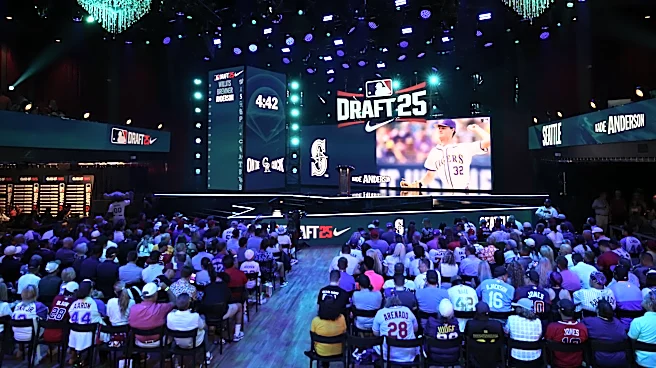




With the draft just a few days away, most of the attention has rightly gone to the Nationals first pick at 11th overall. However, I wanted to discuss a few names that could fit for the Nats with their second round pick at 42nd overall, or maybe even their third rounder at 78. With pitching being the Nats biggest organizational need, I am breaking down three college arms.
Despite the Nats badly needing pitching, most of the rumors about the Nats 11th pick have been about hitters. Infielders Ace Reese
and Chris Hacopian have been linked, as has high school two-way player Jared Grindlinger, who they seem to prefer as a hitter. I do not have a problem with the Nats taking a bat in the first round, but if they do, Paul Toboni and co. will need to focus on pitching down the board.
The Nats biggest need in the system is pitching, but more specifically close to big league ready pitching. That is why I think the Nats need to explore college arms with their second and/or third round picks. While Paul Toboni was with the Red Sox, they had success developing post-first round college arms. Payton Tolle, Connelly Early, and now Anthony Eyanson are three good examples of that. Without further ado, let’s dive into the pitchers.
The first name I want to talk about is Jack Radel from Notre Dame. Radel is a physically imposing 6’5 250 pound right hander who is expected to go in the 35 to 45 range. He has been a work horse for the Fighting Irish, and has gotten better in each of his last three seasons. Radel pounds the zone with a five pitch mix that is headlined by a mid-90’s fastball that plays up due to elite extension.
Radel just seems like a great fit for the Nats who need high floor pitching that can get to the big leagues quickly. The burly right hander just feels like he can be at least a back of the rotation starter who can eat 170 innings for breakfast. None of Radel’s secondary pitches are elite, but he throws a variety of different offerings. As we are seeing with Foster Griffin, a deep arsenal can go a very long way.
The other two pitchers I will discuss probably have higher ceilings and are more exciting developmental projects, but neither have the floor of Radel. I really think Radel could be one of those guys who flies through the minors and could get to the big leagues by 2028. Radel is built to eat innings, and could be a near plug and play number 4 starter.
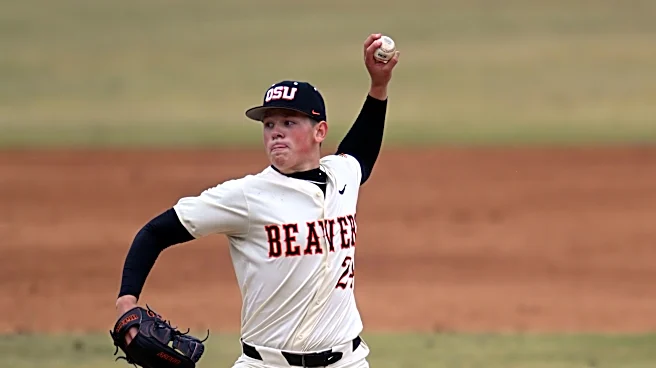
Ethan Kleinschmit from Oregon State is the next pitcher I want to discuss, and he is a very different profile. Of the three names we will talk about, Kleinschmit is the lowest ranked, and could be available in the third round. He is ranked 69th by MLB Pipeline and 78th by Baseball America. However, there are sharp people in the industry like Lance Brozdowski who really like Kleinschmit, especially if his velocity could tick up.
Right now velocity is the missing piece for the southpaw. His heater averages 92 MPH, which is light these days. However, Brozdowski wrote in his college pitcher ranking list that there are those in the industry that believe Kleinschmit could have the ability to sit 94ish with a year of professional development.
If the southpaw can actually do that, it would be a gamechanger for him. The rest of Kleinschmit’s game is already very advanced. He has a sweeper, slider and changeup that can all be at least above average. Kleinschmit also has a good fastball shape, and could probably add a sinker in pro ball. His command is also at least average, and he has a multi-year track record of success at Oregon State.
The Nats could grab the lefty in the second round if they feel convicted about him. However, the dream would be to get Radel in the second and Kleinschmit in the third. That duo would give the Nats a really high floor arm, as well as a super exciting development project. Mason Edwards of USC is expected to go in the first round, and I don’t really think his profile is all that different from Kleinschmit, so getting him in the third would be outstanding.
Ben Blair out of Liberty is the last pitcher I want to discuss. Unlike Kleinschmit, Blair is firmly a second rounder. Funk is the name of the game for the 6’3 righty. His delivery is wild to watch, but he has found a way to pound the zone despite those unorthodox mechanics.
Blair has a super low release which creates a ton of deception. He has solid velocity, averaging 94 on his heater, but the unique look helps the pitch play up. Blair also has a cutter, a sweeper and a lightly used changeup. Between his deception, and his ability to pound the zone, this is a very intriguing package.
I have mentioned it a couple times, but it is hard to overstate Blair’s control. He only walked 1.6 batters per 9 innings. The low release, sweeping breaking balls and elite control give me shades of guys like Joe Ryan and Bryan Woo. That is what you are dreaming of here.
However, there is some real relief risk here. All you need to do is watch Blair’s delivery to have questions of whether he could hold up as a starter. He has a track record of durability in college, but those mechanics sure look like reliever mechanics.
I think Blair could be a good, or even very good reliever. However, I am not sure if he quite has the stuff to be a lights out closer type. If you are taking a guy who will be a reliever in the second round, you want that guy to be a lights out reliever.
If the Nats have faith that Blair can hold up as a starter with those mechanics, it would be a pick that makes a lot of sense. He has a nice combination of ceiling and floor. However, those mechanics are just so weird, which is both a blessing and a potential curse.
Even if the Nats don’t take an arm in the first round, there are still plenty of good choices that will be available down the board. If you want a high floor, innings eating righty, Jack Radel is the guy. If the new regime wants to bet on their ability to improve velocity, Ethan Kleinschmit is the man. Lastly, if they want a funky arm who has good stuff and pounds the zone, Ben Blair is the option for them.