

The Jets moved up one spot after a Cleveland Browns victory last week and now sit third overall. With a top-3 pick and the 18th overall selection, the Jets are stacked in what’s considered a weaker draft class. With eyes on April, here’s a look at how things may turn out.
All selections are made using the PFF Mock Draft simulator and the players taken off the board during that simulation will not be available for selection to keep things fair.
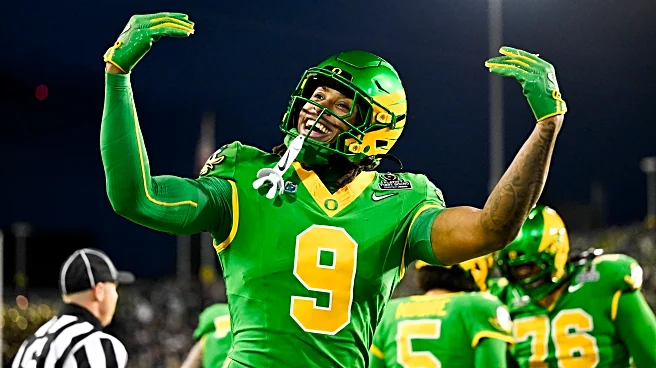
Round 1, 3rd Overall: Dante Moore, QB, Oregon
The odds are incredibly high the Jets will head into the 2026
season with a rookie QB. It’s just a question of which one. As things stand, the most likely selection is probably Dante Moore. The Oregon quarterback is not guaranteed to enter the draft, but the buzz has been getting bigger as Oregon’s season has progressed.
Moore is a very athletic quarterback who prefers to stay in the pocket thanks to the coaching of Oregon’s Will Stein, who like with Bo Nix, has coached Moore to get the ball out quickly and efficiently.
Moore has an excellent Time to Attempt of 2.33 seconds. Of Power 4 quarterbacks, only Carson Beck got the ball out faster. Fernando Mendoza, who is a quick processor himself, is 11th among Power 4 quarterbacks at 2.46 seconds.
The bigger issue for Moore is that he often tries to write checks that his arm can’t cash. Moore trusts his arm strength to make throws over the middle in traffic that he simply can’t make. That’s why seven of his eight interceptions have come over the middle of the field, and four of those seven are 10+ yards down the field.
He’s not a perfect prospect. Moore is an athletic passer who’s accurate and quick to get the ball out. That’s great and can get him very far, but only if an NFL coach can get him to play within himself.
Round 1, 18th Overall: Keldric Faulk, DT, Auburn
There’s a wide variety of thought on Keldric Faulk. From those who believe his athletic profile will turn him into a significantly better pro than college player to those who think he’s a major bust waiting to happen based more on his numbers than his athletic traits. I personally believe that Faulk is simply playing the wrong position.
Auburn has had the 285 pound athletic freak playing off the EDGE. As a result, Faulk’s skills as a pass rusher are often neutralized against quicker tackles who can handle his athleticism at his size. That’s why he’s seen a down-tick in production in 2025 where he’s had just two sacks and a pressure rate of 9.2%. This after dominating in 2024 to the tune of nine sacks and a pressure rate of 14.5%. Those numbers had the draft community expecting Faulk to end up a top-5 pick coming into 2025.
My thoughts on Faulk are pretty simple. Given his athletic profile and elite run defense, you can keep Faulk at EDGE and get a good player out of him. You’re probably looking at an NFL profile similar to former Jet John Franklin-Myers. Is that worth a top-20 pick? That’s debatable. Or, you could turn Faulk and his monster athleticism loose against guards and centers as a defensive tackle and unleash him as a pass rusher.
He’s 6 foot 6 and 285 pounds. He’s a freak of nature. Let him show you what he can do when placed in a position where that athleticism can succeed most and fix a glaring hole in the Jets defense.
Round 2, 35th Overall: CJ Allen, LB, Georgia
The Jets continue to shore up the middle of their defense, landing a stud linebacker in CJ Allen. The Georgia backer is considered the second best linebacker in the class behind only Sonny Styles. Please note that Arvell Reese is considered an EDGE and not an off-ball linebacker.
CJ Allen is a downhill player, a point and strike tackling machine. He has 69 tackles on the season with a tackle on 13.3% of defensive snaps played. That’s the best mark among Power 4 linebackers in the country. Allen is also one of only six linebackers in the top-30 in tackles among Power 4 linebackers with a missed tackle rate under 8.5%.
Allen has an insane 39 run stops in just 213 run defense snaps, an 18.3% run stop rate. It doesn’t stop there. Allen is also a heat-seeking missile as a pass rusher. He has four sacks and a 16.7% pressure rate as a blitzer this season.
So why is such a talented linebacker on the board at 35? Well, Allen has his struggles in coverage. He’s allowed a 70% completion rate, 278 yards, and a touchdown in pass coverage this season. Though it should be noted he allowed just under 10 yards per reception, 9.9, and had 3 pass breakups. But it’s true that the better teams in the league targeted him. Alabama tagged him for 59 yards and a TD in the SEC title game and 62 yards in their first matchup. Texas got him for 42 yards. Ole Miss got him for 44.
To be honest, Allen’s profile is very similar to the linebacker the Jets are about to lose in free agency, Quincy Williams. The only question is whether or not a new defensive coordinator would be able to get the most out of this archetype because as Robert Saleh showed, this kind of player has All-Pro ability if used correctly.
Round 2, 46th Overall: Chris Brazzell II, WR, Tennessee
It’s unlikely the Jets wait this long before taking a wide receiver, but the board happened to fall this way in this mock draft. So, the Jets take the premier deep threat in the 2026 NFL Draft.
Chris Brazzell has all the athletic tools any QB could ever want. He’s got monster size at 6 foot 5, he’s got blazing speed (expected to run a low 4.4 40 time), and he can jump out of the gym. You top that off with elite college production with 1,006 yards and nine touchdowns this season on 16.5 yards per reception.
That’s all great, but Brazzell is still on the board at this point for a reason. The star wide receiver plays in an offense perfectly suited to take advantage of his unique talents. He’s not the first and he won’t be the last Tennessee receiver to put up big numbers in his final college season. It’s worth noting at this point that Brazzell only had 1,044 yards and seven touchdowns in his two previous seasons combined.
There’s also the fact that despite his size and athleticism, Brazzell isn’t good in contested situations with only eight receptions on 17 contested targets, a 47.1% rate. He was four for 12 in 2024.
Brazzell dominated Georgia to the tune of 177 yards and three touchdowns, excellent numbers against the best defense he saw all year. But his numbers did taper off as the season went along. From Week 7 on, Brazzell averaged 67.9 yards per game, and he only had two touchdowns. So teams adjusted.
The question is whether or not this breakout is real, and if it is, how would that translate to the NFL? Here the Jets take a shot on Brazzell because his size and speed combination is a perfect fit next to Garrett Wilson. The idea of allowing him to face CB2s instead of being the primary focus of a defense is key.
The hope is that his big body and elite speed give Dante Moore an immediate big play threat and safety blanket all in one.
Round 4, 103rd Overall: Cayden Green, OL, Missouri
In the fourth round the Jets take an offensive lineman, Cayden Green. The Mizzou offensive lineman has experience at both tackle and guard making him an intriguing developmental option.
In 2024, Green played left guard and was solid, not spectacular. He allowed 11 pressures and one sack – good numbers but not elite. In 2025, he moved over to left tackle where he’s posted an 89.1 PFF pass blocking grade. That’s third best in the country among offensive tackles who’ve played at least 50% of snaps. He was a fine run blocker at both guard and tackle, grading out nearly identically, 75.0 at guard and 75.7 at tackle.
Green allowed zero pressures against both Alabama and Oklahoma this year. His worst game of the year was against Texas A&M’s elite defensive line, which hit him for a sack and another pressure.
At just 21 years old, Green is a great developmental prospect given his positional versatility and strong play. If Green develops into a starting caliber guard that’s a win. If he’s a swing tackle who can help on the interior that’s also a win on Day 3.
Round 4, 139th Overall: Bryce Lance, WR, North Dakota State
Yes, this is Trey Lance’s younger brother. Bryce Lance has developed into a star himself at North Dakota State as a wide receiver. He’s put up back-to-back 1,000-yard seasons and with a 6 foot 3 and 209 pound frame, he is an interesting prospect.
Lance, like Brazzell earlier in the draft, is best known for his deep threat ability. He averaged a crazy 21.9 yards per reception this past season playing in the FCS. Unlike Brazzell, Lance also dominated on contested targets, catching 66.7% of his contested targets a year after catching 61.5% of them.
Bryce isn’t as athletic as his brother, but his production speaks for itself. Now, the only reason he’d be available this late and not taken on Day 2 is the level of competition. It’s simply not that high in the FCS, especially considering he plays for one of the premier FCS programs.
Round 6, 201st Overall: Damon Wilson II, EDGE, Missouri
Back to the well in Missouri, the Jets look to add a developmental rotational pass rusher.
Damon Wilson is good at one thing, rushing the passer. He’s a very poor run defender and he doesn’t drop into coverage. He just wants to pin his ears back and rush the passer. Which is good because the Jets were among the worst pass rushes in the NFL this season.
Wilson had eight sacks and a 16.9% pressure rate for Mizzou this season after transferring from Georgia to get playing time. The star EDGE had two sacks against both Alabama and Oklahoma. In those two games, the best teams he played all season, Wilson had four sacks, 11 pressures, and a ridiculous 27.5% pressure rate.
There’s a professional pass rusher in there. It’s just going to be on a coaching staff to find ways to get him on the field given his lack of other skills.
Round 6, 209th Overall: Adam Randall, RB, Clemson
The Jets would probably like to replace Kene Nwangwu with a returner who isn’t injured all the time. Here’s Adam Randall, a kick returner and running back who could fight to make the roster or end up on the practice squad.
Randall is a tough physical runner. He averaged 3.13 yards after contact for Clemson this season, which helped him turn 23 runs up the field for 10+ yards. He also scored 10 touchdowns for the struggling Clemson offense. Receiving wasn’t his strength. He did catch 36 balls for 250 yards and three more touchdowns, but he also had six drops. Over the last two seasons Randall has a 14.3% and 15.8% drop rate.
Randall also returned kicks averaging 23.6 yards per kick return. Not great, but good enough to try and fight for a roster spot on a team that would probably like to save money on Kene Nwangwu’s roster spot.
Round 7, 217th Overall: Taylen Green, QB, Arkansas
Jets take a second shot at a quarterback here. Hopefully Green ends up a long-term backup or even a position change candidate. But this late in the game taking a chance on an extremely athletic quarterback feels warranted.
Green is the most athletic quarterback in this class. Monster arm strength, great running ability, and elite size. Green has all the physical tools to make a great quarterback. However, he struggled massively against pressure, and his turnover rates are way too high. As a backup quarterback and gadget guy perhaps he finds a role. Or maybe he tries to make the move to wide receiver or tight end. Either way, the athletic profile is enough to take a shot in the 7th round.
Round 7, 251st Overall: Drew Stevens, K, Iowa
Nick Folk’s contract is up and there’s no guarantee he doesn’t retire. So the Jets look to move on in the form of Drew Stevens.
The kicker from Iowa hasn’t been perfect this year, but he’s been good. He’s made 76.9% of field goal attempts. He was 4-6 from 50+ with a long of 58 yards. This after 2024 where he didn’t miss a kick under 50 yards.
Round 7, 253rd Overall: Treydan Stukes, CB, Arizona
Treydan Stukes is a sixth-year senior from Arizona. Finally having his breakout season after starting his college football career as a walk-on, Stukes has proven he deserves a shot at the NFL.
His 90.4 coverage grade is 4th best in the country, minimum 50% of coverage snaps. Teams avoided him like the plague, only targeting him 40 times, and he only allowed 24 receptions for a small 9.4 yards per reception. He didn’t allow a touchdown, and he had four interceptions.
Of course, Stukes has been in college football forever and likely has that as an advantage on any given week. But when you’re among the top-5 CBs in the nation you deserve a shot in the NFL.