



The Red Sox pitching staff is going to look a lot different in 2026. It’s the beginning of December, and the roster currently includes 13 pitchers with experience starting games in the major leagues. That number includes Garrett Whitlock and Jordan Hicks, both of whom will almost certainly work out of the bullpen, but it’s well above the standard five or six-man rotation that most teams deploy regardless of their inclusion.
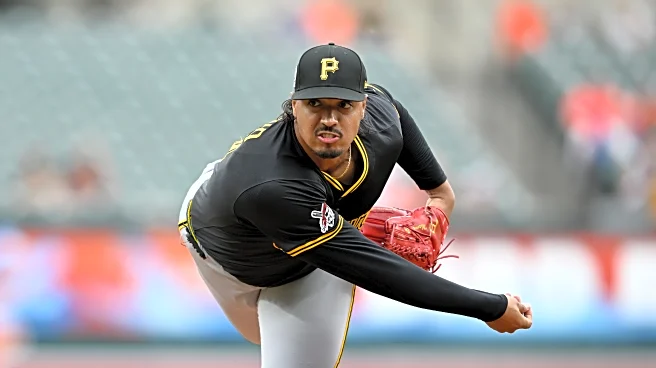
The latest acquisition is Johan Oviedo, a mountain of a man entering his sixth
major league season. Craig Breslow said that any additions to the pitching staff needed to move the needle at the front of the rotation, and Oviedo is hardly a household name. Is Craig Breslow a liar? Is Johan Oviedo an all-star primed to break out? In all likelihood, the trade likely had as much to do with adding depth to the system as it did the headliner, but that doesn’t mean there isn’t a lot to like about the new acquisition.
Oviedo only threw 40 1/3 innings in 2025, posting a very solid 3.57 ERA. While 40 innings isn’t a large sample, Oviedo displayed promising weapons over his nine starts. The first of which is his four-seam fastball. As I mentioned, Oviedo is huge, and he uses all of his 6’6” frame. He strides down the mound well, averaging 7.4 feet of extension. At about 95 mph, his fastball gets on hitters in a hurry. In addition to releasing from far down the mound, he releases from a low slot, creating an incredibly flat approach angle. The pitch returned a 12.2% swinging strike rate and a .149 batting average against. With outlier characteristics, it’s the foundation for a great arsenal.
The righty also features two breaking balls — a curveball and a slider. The slider is hard at about 87 mph, while the curveball comes in closer to 78 mph and has more depth. The swinging strike rate on either pitch isn’t through the roof, but the numbers are solid, and he throws each pitch in the strike zone frequently. Each pitch holds a strike rate of just above 65%, which is important for Oviedo for reasons I’ll get into later.
Ok it’s later. Oviedo struck out almost 25% of the hitters he faced in 2025. He also walked 13.5% of them. While he was able to get strikes with each of his breaking balls, his fastball command was nonexistent. The zone rate was low at 45%, while the strike rate was just below 55%. Fortunately, this hasn’t always been the case for Oviedo, and 40 innings is hardly a large sample. He missed all of 2024 with an injury, and most of 2025 with an injury, so it could be a case of finding his feel for the pitch with more time on the mound. On top of that, the pitch’s shape helps compensate for mistakes. Flat fastballs play best at the top of the strike zone, but they’re also generally more difficult to square up over the plate.
While increasing his fastball strike rate is crucial to cut down on walks, Oviedo’s ability to succeed with his breaking balls in the strike zone shouldn’t be overlooked. When he wasn’t throwing his fastball for strikes, he turned to his slider more often, throwing it in the zone 54% of the time. Both the hard hit rate and batting average against the pitch were very low, despite being in hittable areas. His curveball wasn’t in the zone as frequently (45%), but had similar contact numbers.
While his fastball led his pitches in swinging strikes on pitches thrown in the zone, each of his offerings did the job. Among starting pitchers with at least 250 pitches thrown, his 14.7% in-zone swinging strike rate ranked 15th, higher than any other starter on the Red Sox staff. If the Red Sox can get Oviedo’s four-seam strike rate closer to even 60%, his walk rate should plummet, and he’ll be an excellent mid-rotation option, if not better.
For the sake of completeness, he throws a sinker and a changeup as well. He uses each pitch early in counts — the sinker to righties and the changeup to lefties — to steal strikes. Like his fastball, he didn’t control either pitch well enough to return high strike rates. If his command improves, they could become viable offerings, but his four-seam should be a higher priority.