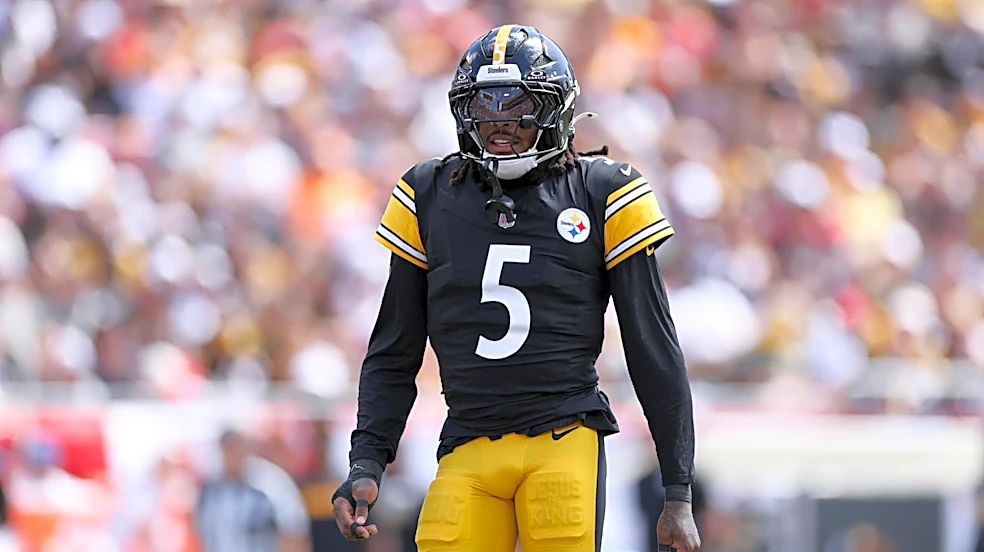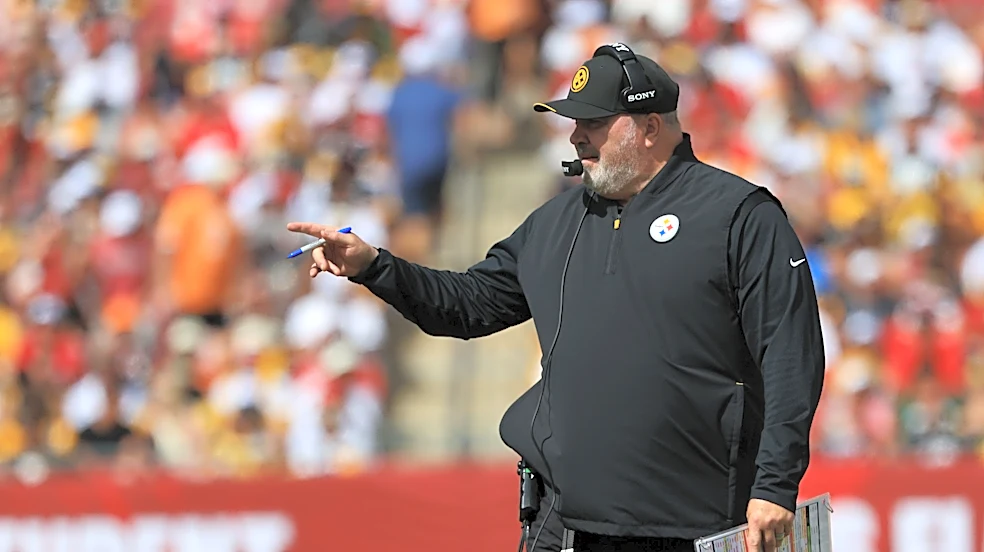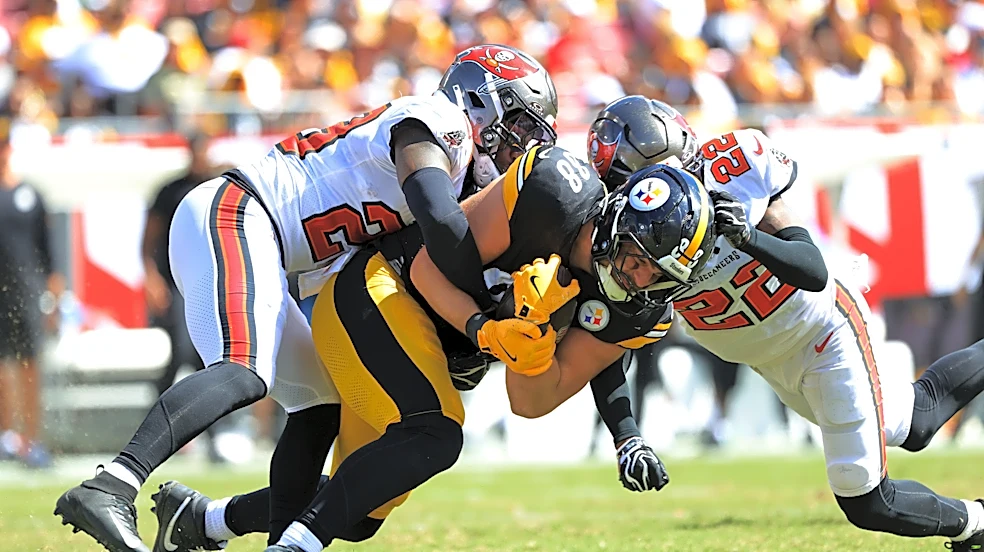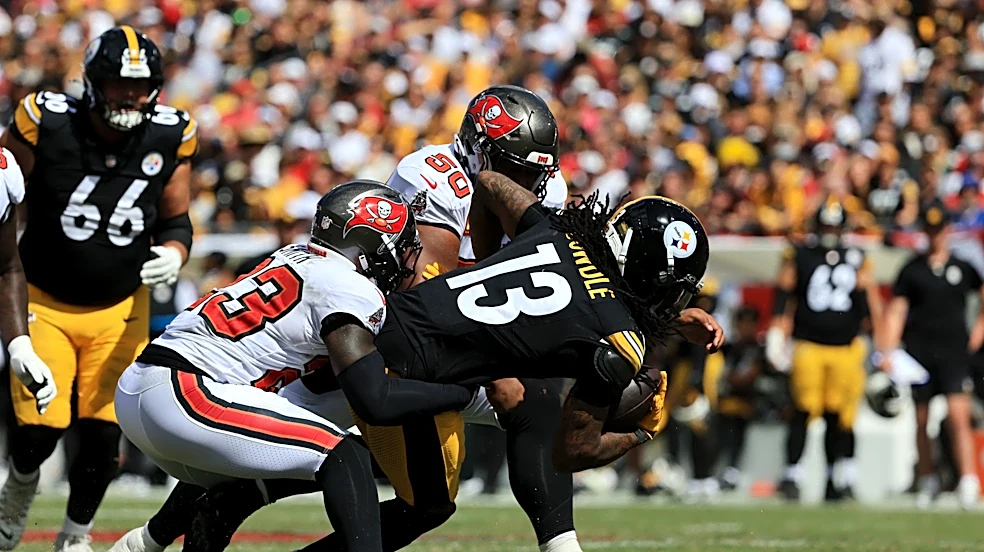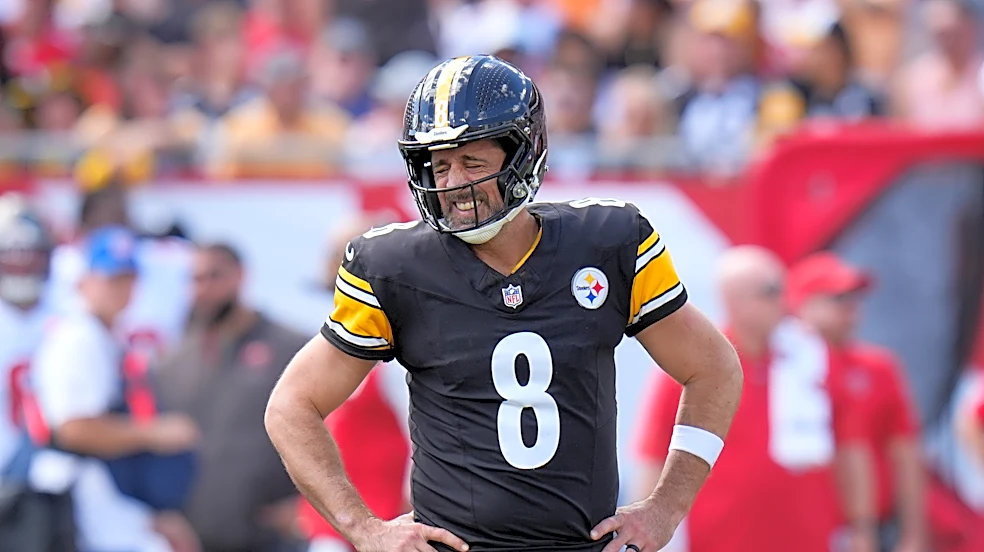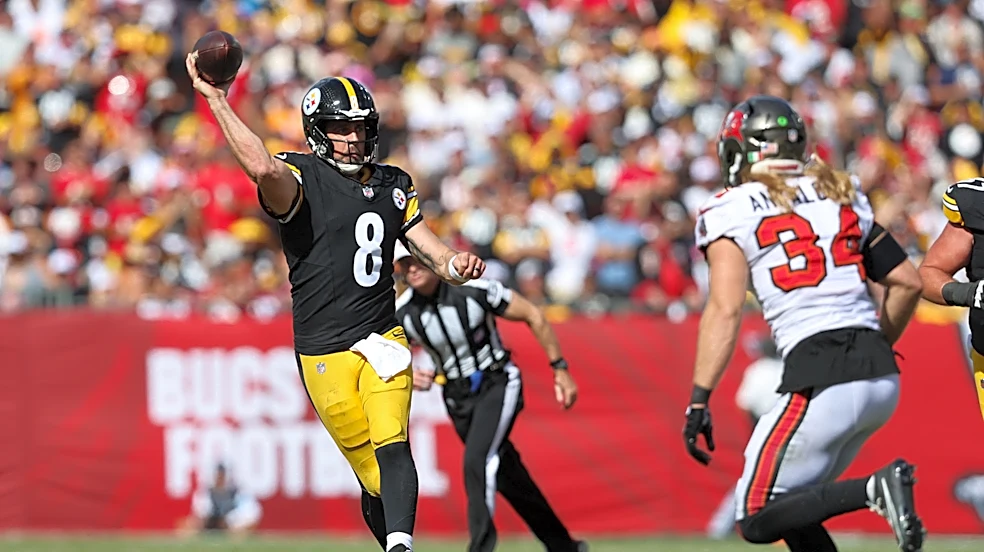


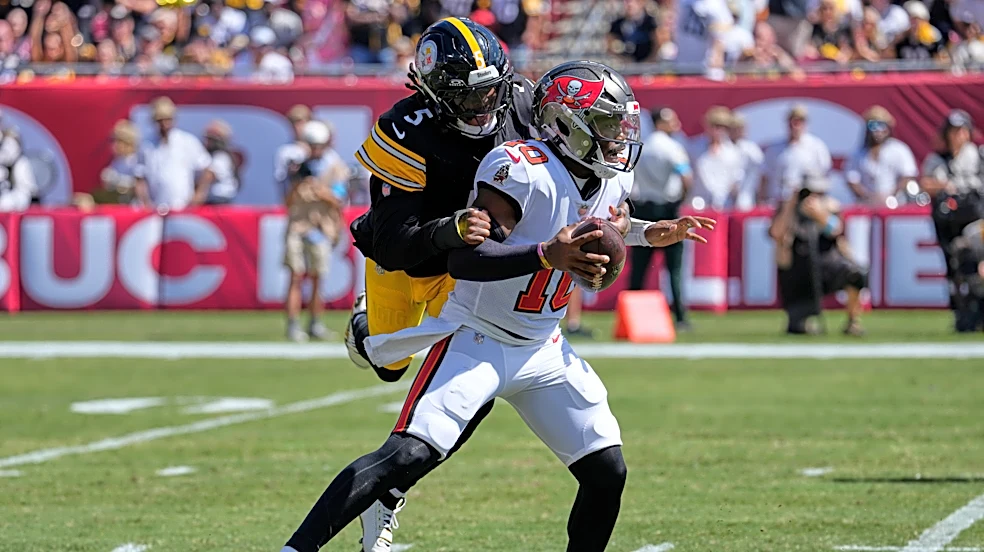


With the win last Sunday against the Buccaneers, the Steelers wrapped up the first third of the NFL season 4-2. While there is still plenty of game action left in the season, it does feel like a checkpoint where we can do our first check-in on one of the biggest storylines of the Steelers’ 2026 offseason: which young members of the 2023 draft class the organization would commit to long-term.
The 2023 draft class was the first group selected by the tandem of general manager Omar Khan and assistant
general manager Andy Weidl. While both were in place for the 2022 season, the Steelers made the unusual move of having retiring general manager Kevin Colbert stick it out through the draft process before hanging it up. That meant this offseason was the new duo’s first time attempting to decide which of their personally selected homegrown talents would remain in their plans, and which would not.
They ultimately decided that three players — outside linebacker Nick Herbig (four years, $100 million), defensive tackle Keeanu Benton (four years, $72 million), and tight end Darnell Washington (four years, $42 million) — were worthy and willing enough to accept an extension. Meanwhile, two others — cornerback Joey Porter Jr. and tackle Broderick Jones — were not able to do the same.
We don’t need to relitigate why Porter Jr. and Jones are no longer Steelers. Jones will go down as a misstep from Khan and Weidl’s first draft. How the Porter Jr. decision will be remembered is slightly more complicated. The way we’ll talk about his departure in the coming years will depend partially on how Porter performs post-Pittsburgh. It’s also hard to make any definitive claims about how this decision will affect the franchise in the long term until we see how Pittsburgh addresses the cornerback position this spring, as well as how they spend the second-round pick from his trade package when they finally get to use it in 2028. Regardless, it’s a disappointing outcome for two players who once held so much promise for the team.
In deciding to pay Herbig, Benton, and Washington, but not Porter, the Steelers have once again affirmed that they value building in the trenches. For two straight years, they have dispensed with players who play more in the boundaries of the field — last year it was wide receiver George Pickens — and looked to retool those positions in the draft and free agency. Certainly, there were indeed other factors at play in the decision to let both of those players go, but it is revealing about the team’s priorities, nonetheless.
This week, we’ll be looking at the players from the 2023 class the organization did commit to. While none of them have started to receive that new money on the books just yet, we’ll try to determine if they’re still trending in the right direction in terms of development. We’ll be taking their entire seasons thus far into account, but will be looking closely at the most recent game against Tampa Bay with this week’s film study.
Let’s dive in.
Nick Herbig

New deal total: 4 years, $100 million (10th among edge rushers)
AAV: $25 million (11th)
Guaranteed money at signing: $21 million (29th)
RB: After failing to record a sack in the first five games of 2026, Herbig logged two against Tampa Bay last week – in arguably the toughest assignment of his season thus far with most of his snaps coming against All-Pro tackle Tristain Wirfs.
While I certainly wasn’t shocked to see Herbig get the big contract he did this offseason, it felt like one that was paying for future usage more than past output. But don’t get me wrong: Herbig has been ridiculously efficient during his past seasons as a Steeler, logging a 7.5 sack season in 2025, good for second-best on the team.
The impressive part was that Herbig put up those numbers playing just 59.6% of the Steelers’ defensive snaps in 2025 – a number that was only as high as it was due to both TJ Watt and Alex Highsmith missing some games. While Herbig was undoubtedly worth $25 million per year as a pass rusher, could the Steelers justify paying him that with both Watt and Highsmith still under contract, and with Herbig still losing snaps to both?
Of course, that’s not an entirely fair way to frame things: As Ryan mentioned in the intro, Herbig’s new-contract cap hit won’t kick in until 2027 (it jumps from $5.4 million to $25.2 million), meaning that the Steelers won’t really have a dilemma about paying too many good edge rushers until next year.
But at the same time, the Steelers made a big commitment to Herbig, and in 2026 he’s played just 54.3% of the team’s defensive snaps (and still 37% of the team’s special teams snaps) and saw his efficiency numbers drop with a 10.2% pressure rate through six games – on pace for the worst of his career by over four percentage points.
While only pass rush snaps count towards pressure rate, it is fair to point out that Herbig has had far more varied usage in Patrick Graham’s defense, with 63 of his 138 snaps so far this season coming at positions other than edge — something he’s admitted has been a challenge. Herbig has been playing off-ball linebacker more and rushing everywhere from over guards to being lined up in the slot. And in a new defense with a higher emphasis on simulated pressures and stunts, not every snap is designed for Herbig to get home to the quarterback, either.
According to NFL Pro, Herbig is only averaging 14.7 pass rush snaps per game, down from 21.9 last year.
Still, Pittsburgh paid Herbig as a pass rusher, and the team’s usage of him – and his production – hasn’t entirely reflected that yet.
But against Tampa Bay on Sunday, Herbig showed any doubters that the speed rusher Steelers fans fell in love with is still absolutely there. His burst and bend remain unbelievable.
That said, Herbig still has room to grow when it comes to finishing plays, especially if the team continues to experiment with him as an off-ball linebacker. Causing chaos alone can make a good front seven player, but making more of those tackles can take Herbig’s game to the next level.
The big question of this article has been if these contracts are aging well through six weeks. With Herbig, I’d say “yes” with some caveats. His current AAV currently ranks between Nik Bonitto ($26.5 million) and the Jonathan Greenards, Andrew Van Ginkels, George Karlaftises of the league ($24.5 to $23 million) – right in the sweet spot between the “star” and “very good player” tiers of the position. And of course, that ranking will only move more in the Steelers’ favor as the market inflates in the years Herbig is under contract. It’s also worth noting his guarantees are far from crippling.
Herbig fits in that area of the market well right now, and his “it” factor as a pass rusher gives him the potential to move closer into star territory. Of course, the Steelers will have to give him more opportunities to get there first.
Final verdict: Living up to the new money, but still some questions about role on team.
Darnell Washington

New deal total: 4 years, $42 million (9th among tight ends)
AAV: $10.5 million (15th)
Guaranteed money at signing: $11.25 million (28th)
RP: Washington got the smallest of the three contract extensions that we’re examining today, and he also plays the position traditionally considered the least valuable between them. And yet, if you asked which of these three players would most noticeably have their absence felt, I would choose Washington.
Tight ends have become en vogue. Look no further than the league’s plummeting rates of 11-personnel (three wide receiver sets) usage. As recently as 2022, there were only 13 teams using 11-personnel at a rate below 60%, according to Sūmer Sports. In 2026, 21 teams have dipped below that threshold. The Steelers aren’t quite there yet — they sit at 61.2 % thanks to Aaron Rodgers and Mike McCarthy’s affinity for that grouping — but they have been trending down in recent weeks as they’ve lost receivers to injury and have leaned more into their running game.
But the Steelers aren’t exactly missing out on the tight end fad either. They use two tight end sets (12-personnel) 28.1% of the time, eighth most in the NFL. Only one receiver, DK Metcalf (391), has more snaps than Pat Freiermuth (284) and Washington (272).
You might be asking why tight ends are suddenly all the rage. To put it simply, it’s about creating matchup advantages. Not every tight end possesses the same skill set, but an ideal tight end is able to create plays as a pass catcher, as well as help provide better blocking than your typical wide receiver could thanks to their bigger size. What modern offenses have started figuring out is that by trotting out two or more tight ends, they can put opposing offenses in a bind. If defenses stay with lighter personnel — like nickel and dime packages with more defensive backs on the field — the offense can use the extra size tight ends provide to try to out-physical the defense in the run game by having bigger players. If defenses instead go heavier, with more linebackers or extra defensive linemen on the field, the offense can hunt matchups in the passing game by picking on the linebackers in coverage, or tricking them with play action.
That brings us back to Washington and the Steelers. While Freiermuth is the more prolific pass catcher, Washington has proven he can create explosive plays when targeted, and he has quickly been regarded as one of the better blocking tight ends in the league.
PFF grades aren’t perfect, but to give you an idea of Washington’s effectiveness, he’s got their fifth-highest run-blocking grade among tight ends with at least 80 run-blocking snaps this season. Increase that threshold to 100 snaps, and he has the second-highest grade among 20 tight ends with that kind of workload.
While I personally feel like there is still room for the Steelers to do more with Washington as a blocker —especially getting him on the move pre-snap — they have started to find more creative ways to deploy him as a blocker.
But it’s not just limited to the traditional running game; the Steelers are also finding ways to utilize Washington as a designed blocker in their passing attack.
And even when he isn’t technically blocking on a play downfield, he’s a great chess piece to use to stress or obstruct defenders in coverage to open up other playmakers. I would like to see the Steelers utilize Washington more in rub concepts to set legal picks, or in tandem with more receiver routes to help open up space for players like Germie Bernard, DK Metcalf, and Roman Wilson when he returns.
And while Washington doesn’t put up huge numbers as a pass catcher — 15 receptions, 156 yards, and two touchdowns so far — it still feels like there is untapped potential the Steelers could get from him in this area.
I don’t want to pretend Washington is perfect, however. I actually think the game against the Buccaneers might have been his worst of the season, despite scoring the touchdown.
He helped contribute to an interception early in the game.
There were also a handful of plays where sloppy technique got him beat as a blocker. Here were the two worst instances:
There was also a play where he was tagged with an illegal shift penalty that wiped what would have been a 3rd-and-16 conversion from Jaylen Warren in the red zone during the fourth quarter.
So no, Washington isn’t a perfect player. None are. But when you look at his body of work, and what he means to this offense, I lean towards him more than earning his money. Factor in that he has such low guaranteed money, and it truly feels like the Steelers got a bargain for one of the NFL’s unicorns.
Final verdict: Living up to the new money.
Keeanu Benton

New deal total: 4 years, $72 million (18th among defensive linemen)
AAV: $18 million (T-25th)
Guaranteed money at signing: $14 million (48th)
RB: I’ll be honest, I didn’t expect Keeanu Benton to re-sign with the Steelers. I always thought he would be a player who would go on to play his best football with another team. Instead, he’ll be playing out his prime in the black and gold.
Despite oozing with potential from his college days, Benton has long been a player Steelers fans have been somewhat lukewarm on in terms of his long-term potential. However, some of his upside started to show in 2025 when Benton broke out with 5.5 sacks despite still largely playing nose tackle – that’s rare pass-rushing juice for the position.
Benton isn’t the tooliest of rushers, but his patented club/rip move remains deadly. In his recent seasons, he’s been good for a handful of play-breaking block sheds per game, often playing with the definition of “violent hands.”
He’s an athletic defender who’s more than capable of generating highlight-reel plays.
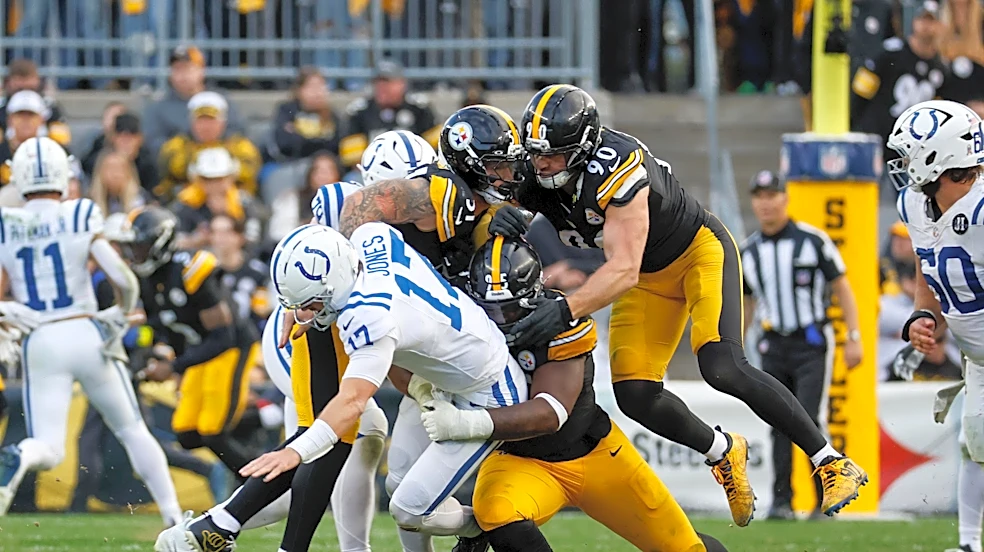
And while Benton’s pressure rate has slightly dipped so far this season (4.3% compared to 5.7% in 2025), I’d argue 2026 is shaping up to be his most impactful year yet, with performances against the Colts and Buccaneers in recent weeks that popped off the screen even if the box score stats weren’t gaudy.
Playing less nose tackle in Patrick Graham’s defense, Benton has looked more comfortable against the run, getting blown off the ball less than he used to and dropping a knee at times to anchor against double teams. He isn’t a standout bull rusher, but has continued to pick up tricks from Cam Heyward, with three batted passes in the last two weeks and a number of well-timed leaps against Tampa Bay that seemed to disrupt the play.
And despite Derrick Harmon being out for Pittsburgh as of late, Benton has played a large role in the effort that kept Bucky Irving to 2.4 yards per carry and Jonathan Taylor to just 3.0 in the last two weeks. Once the ageless Heyward finally does retire, Benton’s growth has indicated the team’s defensive line play won’t suddenly become a weakness, which is exactly why Pittsburgh kept the latter around.
It’s also worth noting that while Benton’s contract might’ve been the most surprising per fans in terms of cost, it’s an accurate picture of where he fits in an expensive NFL defensive line market. Benton may be tied in terms of AAV with Heyward (who has been an absurdly good deal for Pittsburgh contract-wise in recent years), but remains in the tier of names such as Devonte Wyatt ($18.3 million) and Ed Oliver ($17 million), just above the tier of Tershawn Wharton and Javon Kinlaw (around $15 million). Even more than Herbig, Benton’s contract is shockingly low in terms of guarantees, as well.
Benton’s big game against Tampa Bay continued to build the case that the Steelers made the right move in betting on the 25-year-old to keep growing as a long-term defensive piece. Don’t get too caught up in sack numbers for a defensive tackle – Benton has been a fun watch in 2026.
Final verdict: Living up to the new money.
Join in on Steelers R&R by sharing your takes on this week’s topics. Feel free to pitch future questions in the comment section or on Twitter/X: tag @_Ryland_B or @RyanParishMedia, or email us at steelersreadnreact@gmail.com.