



Special thanks to Jed Burks of the Big Red Junkies for joining me to discuss Nebraska’s roster on this week’s podcast:
Offense

Nebraska’s offense, more than any other Big Ten team, is entirely dependent on its quarterback, UNLV transfer #10 QB Colandrea. On every other performance metric — with the same playcaller, and against a defensive slate that, overall, has been much easier than the last couple years — the Cornhuskers’ offensive efficiency is down substantially. The most notable are 1st down rushing
efficiency -12 percentage points from 60% to 48%, early down passing efficiency -5 points from 58% to 53% (1st down alone is down to 44%), and the six skill players with at least 10 touches who played last year (five for Nebraska, one a transfer from UCLA) falling between -6 and -18 percentage points in per-carry or per-target success rate.
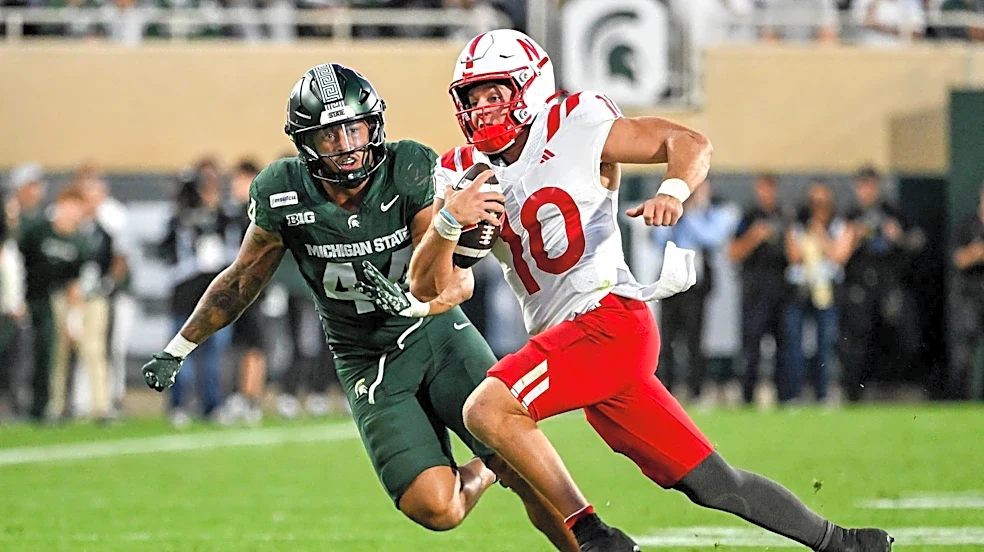
Colandrea, however, is the absolute star of the show. In the run game, while every other running back is underwater in efficiency and adjusted YPC, Colandrea’s 17 designed carries prior to garbage time on five unique types of QB run plays have a 76.5% success rate at 9.8 yards per carry. The team’s run game is far more skewed to the 8+ yard “chunk yardage” tranche than previous years’ 4-7 yard “efficiency” tranche – 28% of all of Nebraska’s designed runs go for 8+ yards, and Colandrea represents 40% of those 8+ yard runs despite only getting 15% of the the designed carries. In other words, Colandrea by himself is producing nearly a triple share of the big runs this offense depends on to advance the ball.
The quarterback’s scrambling ability is also single-handedly responsible for keeping drives alive. Colandrea’s scramble success rate raises the overall called pass play success rate by +2.2 percentage points (I count sacks and scrambles against the passing efficiency score, since I chart the games and can tell what the playcall was). Situationally, he’s even more vital: on 2nd downs, particularly 2nd & medium, Colandrea’s scrambles are responsible for a +7.5% increase in conversions, and on 3rd downs an absolutely incredible +9%.
Colandrea’s NCAA passer rating in raw stats is currently 147.3 on 186 passes, a Z-score of +.3 or about a third of a standard deviation above FBS median. However, because of how late Colandrea’s been left in games against overmatched opponents that took extra time to put away for peculiar reasons which Jed and I discussed quite a bit on the podcast (we made up some terms, including “crunky offense” and “dead points” in doing so), a larger part of that than is typical came during garbage time or against the FCS opponent. Controlling for this produces a 127.2 adjusted passer rating, a Z-score of -.5 (adjusted passer ratings have a lower median and tighter σ than raw).
I have a hard time explaining the dropoff in Colandrea’s passing performance. I charted several of his games at UNLV last year and thought he was a talented passer from the pocket, and I’ve seen each of these targets with surer hands against tougher defenses. Jed and I spent some time puzzling over it; his suggestion was Colandrea’s prior history of locking in on one particular receiver per game – he’s right that that’s happened to an extent in 2026, but I don’t find it to be a satisfying explanation, since most of the time when he’s missing passes the throw is to the correct receiver given the coverage.
But I don’t have a particularly satisfying explanation either, instead I see a lot of different things from open hips in his throwing motion to lack of effort from receivers to a passing pattern that isn’t taking advantage of intermediate routes. The negative play rate is at 13.92%, worse than the FBS median but almost identical to last year, though with the quirk that the offense is a perfect 5 for 5 at recovering their own fumbles which makes them the luckiest offense in the FBS at the moment in that regard (quite ironic to those familiar with the Huskers’ recent run of fumble history).
The upshot to all of this has been an offense that gets stuck in neutral for long stretches, even against teams that it’s much better than, only to suddenly get in gear with their highly explosive talent and go on scoring jags … often with a dynamic play with Colandrea’s legs as the spark. Jed and I agreed the key to keeping this offense in check would be focusing on taking that spark away – in the designed run game by treating his carries as the top threat, and in the passing game having a disciplined rush plan. There is a strong tell in scramble effectiveness between runs to the field and the boundary – Colandrea is lethal when allowed to juke and break tackles to the wide side, 80% efficiency and 12.8 YPP when he breas the pocket that way, but he goes down fast with only 33% efficiency and 3.8 YPP to the short side. Some examples:
Running Backs

Due to #25 RB Rule missing a game — Jed told me he’s back to 100% now — there’s something of a distortion in the data, after controlling for it then it becomes clear that Rule is the top back on the team both in terms of the staff’s preferences and producing superior numbers adjusting for opponent quality. That works out to be 55% efficiency and 4.92 adjusted YPC for the true freshman. Jed and I agreed that Rule’s talent from watching him run looks like he could produce much better than that, and something odd is going on. I think Jed’s suggestion of a downgrade at offensive line, paraticularly the two guard positions, is probably right.
#13 RB M. Nelson technically has more carries during meaningful play than Rule, but only by dint of playing an extra game. Nelson’s numbers are pretty mediocre in 2026 — 52.4% and 4.65 YPC — and considering the relatively soft slate in four of their five FBS games and his 2025 production which was +10 percentage points in efficiency and nearly two full yards per carry better, I again think he could be doing a lot better, especially if he can get to the outside.
#22 RB Mozee has the same efficiency number, 52.2%, but is at 5.0 YPC, though I think this is just because he barely played against the only tough defense Nebraska faced.
Here’s a representative sample of successful called rushing plays:
And unsuccessful called rushing plays:
The most notable thing about the running backs is that collectively they have 23 passing targets between them on short throws, with no real difference between the three in target frequency, playtype, or per-target production, although each are in the single digits so it’d be tough to evaluate if there were. These plays are all short throws, about half are screens and the rest are wheels, checkdowns, and over-the-middle Texas routes. If we treat, cumulatively, whichever tailback is in as a single player, that player would by far be the most effective outlet on the team and the only one close to Colandrea’s personal production, with 56.5% efficiency and 10.04 YPT.
Tight Ends

There is one thing that #8 TE Lindenmeyer is very good at, and as such he’s vital to the offense – downfield blocking as an escort for Colandrea’s runs and the RBs on short passing plays. Jed and I had some fun on the podcast discussing how much bigger he looks than his listing and how effective he is blocking on the move. By the middle of the third FBS game of Nebraska’s I watched, I realized my eyes were just tracking Lindenmeyer’s position in the formation – when he was split out and released into the pattern, it was highly predictive of where the ball was going to go: if he headed to the boundary he was a short pressure release target, to the field he would block the play on those two vital elements of the offense.
However, if Lindenmeyer played in-line then his blocking grades in the run game are surprisingly poor, and as with all aspects of the passing offense the dumpoffs and RPO toss plays for him got miserable yardage and conversion rates – 47.8% efficiency and 4.57 YPT.
Unfortunately, we haven’t seen much of the talented local product #29 TE C. Nelson; Jed told me he had another injury, to his knee this year, and has been in and out, though he might be available on Saturday. In Nelson’s absence the H-back we’ve seen is technically listed as a wideout but in actuality plays as a blocker on close to 40% of meaningful rushing plays, #4 HB Bonner. He is undersized for the role at 6’2” and 225 lbs and grades out poorly, I’m not sure why Nebraska hasn’t fielded a bigger body for this job.
Wide Receivers

Effectively, Nebraska has two wideouts they actually use as wideouts in 2026: UCLA transfer #3 WR Gilmer, and returner #2 WR Barney. Both are very talented and I’ve seen them be productive in previous years, but their numbers are down significantly in 2026: Gilmer is at 46.8% per-target success rate and 6.22 adjusted YPT, Barney is at 50% and 7.76 adjusted YPT. Those numbers are mediocre to poor compared to FBS medians, but Barney is clearly more productive on his routes and so the offense could be more efficient if Gilmer weren’t targeted 60% more often … though whatever the underlying problem is would likely still remain.
In raw stats, #1 WR Hunter appears to be the third receiver, and in 2025 he was, but in 2026 the majority of his touches during meaningful play have actually been sweeps with a little push pass (this is done so that if there’s a mishap in the exchange, which in fact happened this year, it goes down as an incomplete pass instead of a fumble on a technicality; your faithful film reviewer is not so easily manipulated and counts these as rushing plays). After proper splits and garbage time controls, Hunter has an atrocious 42.9% per-target success rate and 37.5% per-carry success rate, with 6.14 YPT and 3.8 YPC. Jed mentioned some comments OC Holgorsen made about effort in practice.
Two young receivers I liked watching in the non-con play during 2025, before they were sat down for a rigid three-WR group the rest of the year, #18 WR Q. Clark and #19 WR Mills, have still not really been used. Mills hasn’t been targeted at all, a real shame in my opinion, while Clark has almost entirely been used as a blocker on a specific RPO toss play to the tight end – so much so that his presence on the field is nearly a dead giveaway of that RPO being called. The official scorekeeper has Clark marked down has being targeted eight times but these include throwaways where he was merely the nearest player to the sideline and other completely uncatchable balls which I exclude, what’s left are two passes prior to garbage time — the same number as Bonner and two other blocker WRs combined — which Clark had even a remote shot at.
Here’s a representative sample of successful passing plays:
And unsuccessful passing plays:
Offensive Line

Nebraska has played six offensive linemen in 2026, three are returners and three are out of the portal. They’ve undergone some shuffling between the guys playing LG and RT, which is where two of the portal players are at. I thought Jed was candid and forthright in his diagnosis of the challenges at guard and why they were doing the shuffle, as well as being too optimistic about replacing three departures with transfer starters.
By far the best lineman is #51 C Evans, one of the few entirely homegrowns. He’s stayed put and been a solid presence. They also haven’t really moved around #57 LT Pritchett (although there was something odd going on in week 2, a package which cut his reps in half inclusive of garbage time, but that game was effectively over after five drives and it hasn’t repeated since). Jed and I have grappled a bit in our conversations about Pritchett; when he transferred in from Alabama in 2025 he was in an ongoing battle with argubly three other tackles and survived it to come out on top but I don’t really show significant improvement, while Jed contends he went from bad to the second-best lineman on the team, though he concedes that’s a low bar.
The third lineman who hasn’t moved is #54 RG Black, who transferred in from Iowa State this year. I am not certain why Black has had the rock-solid confidence of the staff commensurate with Evans’ meaningful rep share, as his grades on my tally sheet are the second lowest in run blocking, just barely better than the other guard transfer who’s evidently in hot water, and below FBS median in pass protection. The biggest 2025 to 2026 dropoff in single-position o-line grades, and likely the biggest explanation for the run game tumble, is going from high 4-star Notre Dame transfer Rocco Spindler who played nearly all reps last year to Black playing 100% of meaningful reps, whereas RT upgraded, LT stabilized, and LG at least has two different guys in the rota now.
At the beginning of the year, LSU transfer #65 LG Mubenga was the starter on at left guard and jack-of-all-trades lineman #77 OL Gottula was the starter at right tackle. Jed told me that South Carolina transfer #55 RT Babalade likely would have had the right tackle job but he was dinged up in Fall camp. It looks like what happened was that around the time that Babalade became healthy enough to start, the staff had become unsatisfied with Mubenga’s play — or at least, indecisive about it — so moved Gottula over and had him start at LG, but with Mubenga rotating a little less than half the time.
In my opinion, Gottula is better suited to play tackle but still constitutes a big upgrade over Mubenga in performance grades and because as a homegrown he reduces the transfer count from three to two. I might say they’d be better off just benching Mubenga, but Gottula’s never played a full season since he was partial reliever who got hurt as a redshirt freshman and a rotational tackle with a 40% rep share last year, so perhaps he isn’t ready to go without a backup.
Right tackle was a real mess for Nebraska for a couple of years so I consider Babalade an upgrade, he generally escorts his pass rusher out the back and leaves a big scramble lane open for Colandrea, though I don’t have great run blocking grades on the outside run plays this offense is constantly trying to hit.
Defense

Nebraska’s defensive advanced metrics from charting hold up much more than their offensive stats do, particularly their robust 3rd down stop numbers over 70% and their drive efficiency defense.
There are some more remarkable things about the defense when I dive deeply into the numbers. First, there’s very little rotation, a pattern which continues from previous seasons under Coach Rhule. Second, it’s very clear that the strength is in the defensive front, not the secondary – it’s a blitz heavy team that prioritizes pressure first and foremost with far better 3rd down pass defense than 1st down. Third, the combination of those things usually means that there’s a falloff in effectiveness late in the game as the defensive front starters get fatigued and can’t rotate out, but unlike with most teams when this is easy to detect statistically — including Nebraska not long ago — there’s no good evidence for it in 2026 so far.
Still more curiosities: Nebraska has very clear situational splits in their down & distance rush vs pass effectiveness, to wit they defend the run well on 1st down and 2nd & long, poorly in short yardage; they defend the pass well on 3rd down, poorly on 1st down and 2nd & short, and modestly (but relatively worse than they defend the run) on 2nd & long. Put together, that militates for a fairly obvious strategy: pass on early downs, take shots on the 2nd & short “money down”, run on 3rd & short as the fall back to convert. But Nebraska’s opponents have universally done the exact opposite: they’ve run a lot on 1st down then again on 2nd & long, putting themselves behind the chains and letting the Huskers escort them off on 3rd & long, meanwhile they’ve rushed 70% of the time on 2nd & short despite the fact that Nebraska has not once successfully defended a 2nd & short pass outside of garbage time.
Then there is the matter of the super-explosive plays. On average three times a game the Huskers give up a massive play, and as Jed and I discussed, these look like flukes in isolation except for the fact that they keep happening. They are also responsible for the “dead points” phenomenon – Jed is right, in my opinion, the games against overmatched opponents which didn’t go into garbage time early were not because the opponent were really in it, but because they hit a couple of these super-explosives, scored quickly, then those points just sat on the scoreboard as an obstacle for Nebraska’s “crunky” offense to slowly overcome. In examining these plays, I think they do back up the observation that the front is much stronger than the secondary, and specifically the DBs Jed mentioned on the podcast as being particularly problematic (he suggested I re-evaluate that part of the tape and I’m glad I did, he was right).
However, what’s most curious is that they don’t reinforce what I might have expected to see, which would be Nebraska paying a price for excessive 3rd down aggression or offenses taking advantage of blitzes, or shots on short-yardage money downs. Instead, virtually all of these come on long-yardage early downs, as a part of what seems to be regular play (there’s just one exception, the most recent which was a quasi-trick play on 4th & 1 by Indiana, though by definition that’s not playing with house money; I’ve excluded it from the following compilation). It looks to me like the super-explosives are simply baked into the secondary’s habits and structure – at a rate of about 8.5% of all standard downs, Nebraska just lets a player get behind them and doesn’t make the tackle. Here they are:
Defensive Tackles

The performance by the DTs has been excellent, especially considering the incomplete rotation. There really is no replacement for #1 DT Whittington at 3-tech, during the first four FBS games he’d come off and be replaced by a couple of bench guys on some minor reps but last week against Indiana he played ironman. #44 DT Van Poppel I would characterize as more of the starter at the other spot and has an edge due to his size, he had been rotating more with #34 DT Stoudmire but missed last week and was listed as Doubtful on Wednesday’s injury report. Again, Stoudmire effectively played ironman.
There were only a handful of reps for one of the second-liners, #71 DT Terry, another handful for the true freshman nose at 350 lbs #90 DT Berrymon on their heavy packages (though he’s a supplement, not really a relief), and on their light packages one of the ends comes inside.
Whittington in particular has been impressive for having cracked the play from RB alignment and jumping across the formation into the right gap. I think Van Poppel has been better getting penetration than Stoudmire, but offenses can’t push Stoudmire around at all.
Defensive Ends

The ends have followed a similar pattern of very limited rotation and a stud producer, with one guy doing his job without really generating havoc stats. The production is all coming from former 5-star #96 DE Nwaneri, while #5 DE A. Jones is the edge-setter who never leaves the field. Jones very rarely has gotten penetration — he didn’t at any of his other four Big Ten stops either — but at Nebraska he’s consistently holding the line and letting others do their jobs. (I’ve called them weakside and strongside in my notes but I don’t know that’s actually it, as far as I can tell they pick the left and right sides of the line and just stick there for a couple drives regardless of formation of hashes, then switch on later drives.)
It’s pretty clear that #93 DE Pietrzak plays behind Jones on the rare occasion Jones comes off the field, and there’s not really a drop-off in edge setting, though there hasn’t really been an uptick in havoc either. There is, however, a major falloff in havoc when #2 DE Lenhardt replaces Nwaneri on the other side. Lenhardt simply lacks Nwaneri’s length and drive. The 3rd down specialist who plays on the interior in their racecar packages is #86 DE Goldman.
Linebackers

#0 LB Chambliss came over from San Diego State with DC Aurich as the captain of the defense, he essentially never leaves the field. Chambliss missed the first game, making the rep shares look like more of a three-way rotation when actually it’s a split between #10 LB Shavers and #24 LB Foster for the same spot, and both played in the first game. In my opinion Shavers has a higher athletic ceiling, but Foster has gotten more starts, Jed thinks because of more consistent play.
The backup and SAM, when they occasionally go to the 4-3, has been #40 LB Merritt, he’s actually generated substantially more havoc stats than Foster has even with far fewer regular reps and missing last weeks again against Indiana (he’s not listed at all on the Wednesday injury report).
The linebackers are the key to the entire 4-2-5 defense – they’re the extra attackers in the pressure packages and the extra backout coverage to help the secondary, and with corners usually in man they can usually only count on the nickel and boundary safety as supplements for midfield coverage and tackling.
Here’s a representative sample of successfully defended rushing plays:
And unsuccessfully defended rushes:
Secondary

Separating out the successful pass play defenses when it was all credited to the defensive front rush or blitz vs the secondary in coverage, and also separating the failed pass play defenses between the super-explosives and the more ordinary sort, shed a lot more light on the strengths and weaknesses of this group – and that analysis lined up exactly as Jed suggested on the podcast.
Far and away the most common way that opposing offenses squandered well protected pockets — that is, on the late-down plays in which the defensive front brought pressure, the line picked it up, but the QB blew the opportunity to convert — was by challenging #7 CB Marshall. As Jed said, he’s their best defensive back in coverage and there’s a reason he never leaves the field. On the other side, FIU transfer #22 CB Evans grades out fairly well too, though he’s rotating heavily with highly rated true freshman #16 CB Odem who shows his talent but also some freshman stuff. The Evans / Odem side of the field tends to be more vulnerable than Marshall’s, but there are better places on the defense to attack.
Cross-referencing the super-explosives with the grades on regular plays, Jed was right, the most problematic are the nickel #8 DB D. Jones and the boundary safety #26 DB McDougle. Both are hitters in the run game and can get a break-up with a hard hit from behind against a short pass, but in coverage can be liabilities and don’t have the make-up speed to catch a runner in open space. Jones never rotates off, and McDougle is another San Diego State transfer Aurich brought with him and I don’t think he’d get a challenge (I also don’t think they have a free hand for one, judging by the recycling of the backups).
The starting field safety, #4 DB Conn, was available most of the year but unlike McDougle, he rotated with his backup #13 DB Guthrie (curiously, Guthrie was a starter last year while Conn was an FCS transfer who played sparingly). Guthrie was injured after a few weeks, then Conn was injured early in the Indiana game. So #28 DB Benning, a junior but who wasn’t very experienced, went from backup boundary safety and only lightly used into something like a starter role. Wednesday’s injury report lists Conn as Out but doesn’t mention Guthrie so I expect Guthrie to resume the field safety spot and Benning to go back to being the boundary backup.
All three of the guys who played field safety have the most mixed record of the DBs. Each show up extensively in the super-explosive tape … of course they do, plays can’t go super-explosive if field safeties can catch them. Their grades are fairly solid in coverage the rest of the time, however, unlike the boundary and nickel players; that is, as long as Conn, Guthrie, or Benning kept the play in front of them they did fine, but if they got into trouble they didn’t have the ability to erase the mistake.
Here’s a representative sample of successfully defended passing plays:
And unsuccessfully defended passes: