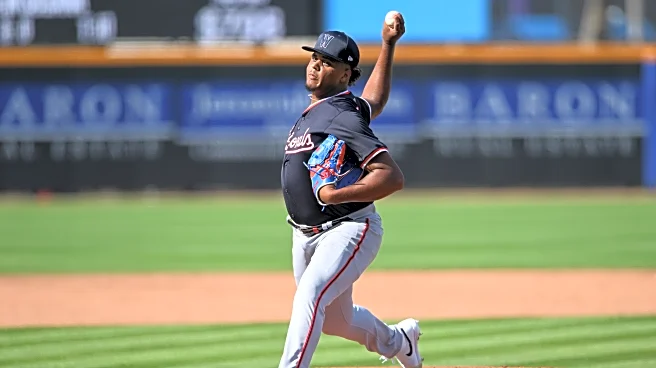


The Luis Perales trade made one thing clear, the Washington Nationals want their pitching prospects to throw absolute gas. After the deal, the Nats top pitching prospects are almost all flamethrowers. Between Perales, Jarlin Susana, Miguel Sime Jr., Travis Sykora, Alex Clemmey, Eriq Swan and Landon Harmon, there is a ton of heat in the Nats farm system.
Let’s start with the new kid on the block, Perales. The Nats targeted him because they believed in his pure stuff over the command oriented approach
of Jake Bennett. Despite not being the biggest guy, Perales’ fastball is absolutely electric. While he had some command troubles coming off of Tommy John Surgery, the stuff was still there in his brief action in 2025.
The fastball averaged 99 MPH in the Arizona Fall League and also has strong life at the top of the zone. He also has a cutter, a slider and a splitter to go with it. Perales nearly threw half of the triple digit fastballs recorded in the Arizona Fall League this year.
Sure, there is injury risk and relief risk here, but the arm talent is absolutely electric. Over the past couple of years, the Nats have really targeted velocity and Perales fits the trend. This trend started before Paul Toboni arrived, but looks like it will continue.
The 2025 draft is a good example of the Nats prioritizing velocity. In the 3rd and 4th rounds of the draft, the Nats selected two of the hardest throwing high school pitchers in the class and signed both to overslot deals. Landon Harmon was taken in the third round. He has an electric fastball that already sits in the mid 90’s and touches 99. With a projectable frame, there should be even more in the tank as well.
Miguel Sime Jr., the Nats fourth round pick throws even harder. At 6’4 235 pounds at just 18 years old, he is a massive guy with an even bigger arm. His fastball sits in the upper 90’s and routinely hits triple digits. Sime was one of the hardest throwers in the entire class. He is still a bit raw, but the Nats wanted a chance to develop him.
Sime is similar to another massive pitcher the Nats have developed in Jarlin Susana. Back in 2022, a teenaged Susana was the final piece of the Juan Soto deal, but he has developed well. Susana has become one of the best pitching prospects in the sport and is a consensus top 100 prospect. Even with injury and command issues, his stuff is just undeniable.
Susana is the hardest thrower of the bunch, with his heater sitting in the triple digits as a starter. The 6’6 right hander also has a filthy slider to go with the heater. When he is on his game, Susana can be unhittable. He underwent lat surgery to end his season early, but he is still so promising.
He has the rare ability to hold his triple digit velocity deep into games. When you watch him throw, it is insane how effortless his velocity looks. There are questions here, but the stuff is undeniable.
These are probably the most notable flame throwers, but they are not the only ones. Travis Sykora is arguably the Nats top pitching prospect. While he may not throw as hard as Perales or Susana, his heater still sits in the 94-97 MPH range. In high school, he could reach back for triple digits at times. Sykora will miss most, if not all of this season due to Tommy John Surgery.
Alex Clemmey is a nasty lefty who is one of the Nats better pitching prospects. He came over in the Lane Thomas trade, and was one of the Nats best performers in the Minor Leagues in 2025. In high school, he flirted with triple digits, but his fastball mostly lives in the 93-96 MPH range these days.
However, it plays up due to his deceptive delivery. With a lanky 6’6 frame, Clemmey’s arms and legs are just flying at the hitter. That hurts his command sometimes, but it does create a ton of deception.
At this past trade deadline, the Nats picked up yet another flame thrower in a trade with the Dodgers. That would be Eriq Swan. Like a lot of these guys, Swan has some command issues, but his fastball can hit the triple digits. A converted position player, Swan has serious athleticism and arm talent.
His fastball/sweeper combination probably works best out of the bullpen. However, this is another electric arm the Nats have in their system. These days, velocity is king and the Nats are living by that philosophy.
There are drawbacks to this approach, like command problems and injury concerns. However, heat plays in the big leagues. If you watched this past year’s playoffs, it felt like everyone was throwing in the upper 90’s. The Nats are trying to accumulate these kinds of power arms. Hopefully this approach can pay off with long term success.