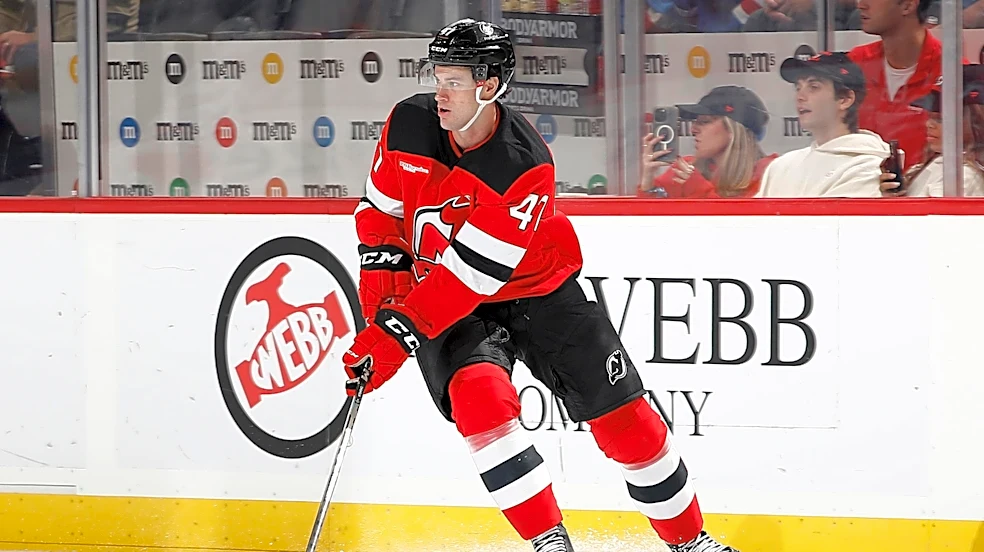

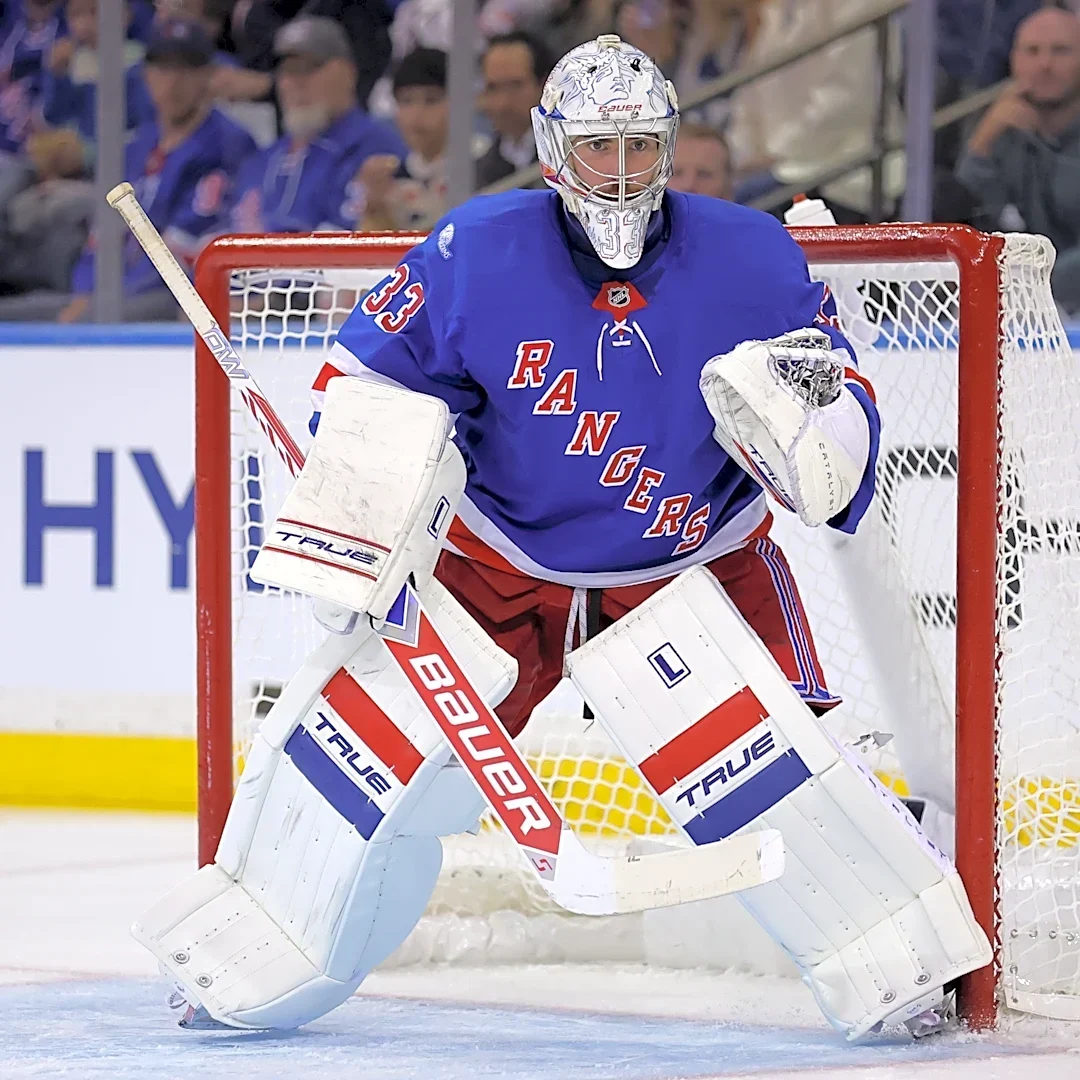





Generating offense from the blueline has been one of the New Jersey Devils’ biggest issues over the last couple of years. 2023-24 was the start of the downturn, but the true collapse came in 2024-25, when former general manager Tom Fitzgerald made a concerted effort to fill his defense corps with zero-offense crease-clearers such as Brenden Dillon and Johnny Kovacevic. The decline in Jonas Siegenthaler’s offensive game has played a big role in this as well. Siegenthaler was never an offensive dynamo,
but there was a time when we could count on him to make a good first pass or even flash some scoring skill every once in a while. His goal in Game Four of the 2023 first round series against the New York Rangers is the most prominent example that comes to mind for me:
In fact, that whole play was a thing of beauty, from Siegenthaler whipping it over to his partner Dougie Hamilton, to Hamilton wasting no time feeding Nico Hischier cutting up the wing, to Hischier finding an activating Siegenthaler across the ice, to Siegenthaler wiring one past one of the best goalies of this generation.
There have obviously been some moments that resemble this here and there since the highs of 2022-23, but not nearly as many, and certainly not enough to keep New Jersey’s offense afloat in general. The forwards can and should take on most of the offensive burden, but it’s also on the defense to, at the very least, keep the puck moving in the right direction with good outlet passes, timely keeps at the offensive blueline, and so on. This baseline level of offense cannot be maintained with an aging Hamilton and a young defenseman in Luke Hughes who has not quite fully blossomed yet.
And that’s where Declan Chisholm comes in.
First-year general manager Sunny Mehta acquired Chisholm in the offseason in the hopes of unearthing a hidden gem. Although hearing Mehta talk about Chisholm, you certainly wouldn’t think he was all that hidden. Mehta heaped praise on Chisholm all offseason long, going so far as to call him “kind of dynamic offensively”. Prior to being named GM of the Devils, Mehta put together a sparkling track record as an NHL executive, most notably as the Florida Panthers’ AGM. So when Mehta speaks, it’s worth listening as he almost certainly knows what he’s talking about.
So today, I thought it would be a good idea to check out the early returns on the Declan Chisholm experience. Has he been “kind of dynamic offensively” with New Jersey? Has he at least been pushing play in the right direction? What has his role been since he got here? We’ll take a look at all of that today.
(Note: Numbers and league-wide ranks come from prior to Sunday’s games)
Deployment And Usage
We’ll start with how head coach Sheldon Keefe has been using Chisholm. To the surprise of no one, Chisholm has been used exclusively on the third pair this season. Aside from maybe out of necessity due to injuries, Chisholm has never really been used in a top-four role in his career. So it makes sense that Keefe wouldn’t push him up the lineup right away.
Here are the time on ice numbers for all Devils defensemen this season:
A few things stand out here.
First, there are some pretty solidified tiers among Devils defenders thus far. Hughes is in his own tier at the top. Hamilton and Pesce are next, both averaging the exact same amount of time per game. Next, Siegenthaler is in tier three, rounding out the top four. The newly-returned Kovacevic is next, and then there are Chisholm and Dillon in the bottom tier together.
This all makes sense to me, although I’m a little surprised Siegenthaler and Dillon haven’t been getting more ice time. Still, we clearly see here that Chisholm is getting bottom pair minutes as far as the ATOI goes.
Next, we’ll turn to Hockey Stat Cards as a second opinion. According to their numbers, Chisholm’s quality of offensive competition is in the 17th percentile league-wide, while his quality of defensive competition is in the 25th percentile. In other words, he’s been getting extremely cushy deployment, which is what you’d expect from a third-pair defenseman.
Not that we didn’t know this, but it’s nice to have some numbers to confirm it. Chisholm has been used in a depth role against soft competition.
Surprising Strengths And Weaknesses
Ok, so how exactly is he faring in that depth role against soft competition?
By the traditional production, he hasn’t exactly been lighting it up. He only has one assist through the first eight games of the season. He also has a measly two shots on goal as well, although he has taken 15 total shot attempts this year. I think that’s a reasonable number of shot attempts for a third-pairing defenseman who gets no power play time, so I guess one of my big takeaways from diving into Chisholm’s numbers is that he needs to work on hitting the net with his shots.
Next, we’ll take a look at his advanced numbers. According to Natural Stat Trick, his 5-on-5 numbers are actually pretty spectacular:
When Chisholm is on the ice, the Devils are usually pushing play forward. Even with score effects in play, which has been a big topic of conversation around New Jersey’s pristine advanced metrics this season, Chisholm would still look great. However, there is a problem that Chisholm faces that it seems like the entire team is facing at the moment: Despite those impressive metrics, he’s getting outscored 2-3 at 5-on-5. Granted this is not the end of the world at all. It’s very early in the season, and a single goal in his favor boosts his GF% all the way from 40% to 50%. But still, Chisholm is struggling to turn his great process into great results, a problem that, as mentioned, the entire team is suffering from at the moment.
But what about offense specifically? After all, overall value is great, but offensive value in particular is what the blueline desperately needs. Here are Chisholm’s offensive rate stats, again per Natural Stat Trick. I’ll also include his rank among all 242 NHL defensemen who have played at least one game thus far to provide context for these numbers:
These are all pretty strong numbers, especially those CF/60 and SCF/60 rates. When he’s on the ice, the Devils do seem to generate more quantity than quality based on these figures. But even his worst rank, HDCF, has him in roughly the 68th percentile league-wide.
But elsewhere, Hockey Stat Cards has some conflicting numbers when compared to NST. Based on his style of play, the numbers we just went over, and what Mehta has said about him, you would think that he’s generating most of his value on the offensive side. Well not according to HSC, who has Chisholm tabbed at an Offensive Net Rating of -1.0. That places him in the 14th percentile in the NHL, which is obviously pretty terrible.
However, Chisholm is also clocking in at a +0.7 Defensive Net Rating, which is good for the 84th percentile league-wide.
This came as a surprise to me. Just going based off of my eye test, I didn’t think Chisholm was getting caved in defensively, but I certainly didn’t think he was a secret shutdown star. Do any other metrics agree with this? Let’s go back to Natural Stat Trick, this time checking out some defensive rate stats and ranks among all NHL defensemen:
Lo and behold, NST also has Chisholm ranked as a pretty terrific defensive driver. That xGA/60 mark in particular really stands out.
Finally, for the first time, let’s check out former All About The Jersey contributor CJ Turtoro’s new hockey analytics website, PostHockey. According to his model, Chisholm is 108/242 in 5-on-5 xGF/60 at 2.46. On the defensive side, Chisholm’s 1.89 xGA/60 has him tied for 31/242 with noted defensive ace Jaccob Slavin. Overall, Chisholm is rocking a 56.5 xG% per Turturo’s model, which places him 51st out of 242 defensemen. So here’s another metric that is telling us that Chisholm is generating a good amount of value, just not in the way any of us might have expected. And by the way, Turtoro’s site also uses a Net Rating model. According to his numbers, Chisholm’s Defensive Net Rating currently stands at +0.6, good for 45th in the league. His Offensive Net Rating sits at -1.0, near the bottom at 226/242.
My best guess as to why Chisholm actually looks pretty solid offensively based on the rate stats at NST and PostHockey, yet looks pretty awful in the eyes of Hockey Stat Cards and Turtoro’s Net Rating, is because HSC and Turtoro’s models take into account usage and difficulty. So because Chisholm is enjoying extremely cushy deployment thus far, the models are not impressed with his raw rate stats and ding him heavily for him only going up against soft competition.
These sources are obviously not gospel. But in my opinion, Natural Stat Trick and Hockey Stat Cards are two of the absolute best publicly-available metrics in the game, and Turtoro’s new model deserves respect as well. And they are all telling us the same thing: Chisholm has been a slight disappointment offensively (mostly due to usage and lack of traditional production like points and shots), but has been a very pleasant surprise defensively.
Off-Hand versus Strong Side
When it comes to Chisholm, a big talking point amongst a lot of Devils fans recently has been how different he looks now that he’s playing on his strong side. In the first five games of the season, Chisholm was paired with Dillon, and we saw Dillon on the left with Chisholm on the right. Over the last three contests, Dillon has been a healthy scratch with Kovacevic slotting back into the lineup. Kovacevic being a righty has allowed Chisholm to shift back to his strong side on the left. Based on my own eye test, it does look to me like Chisholm has been performing better since going back to the left side.
That being said, the numbers don’t quite back this up. Here are Chisholm’s 5-on-5 numbers with both Dillon and Kovacevic according to Natural Stat Trick:
It’s odd to me that the Chisholm-Kovacevic pairing can be underwater in every category, but still comes out with a really good xG%. I suppose the logic there would be that, while they’re losing the quantity battle, the average quality of all their chances are better (not all HDCF are created equal, after all).
Moneypuck tells a similar story. According to their model, the Chisholm-Dillon pairing is rocking an xG% of 61.5% in 53 minutes together, while the Chisholm-Kovacevic pairing is at 54.5% in 36 minutes.
As much as I am a big believer in analytics, this might be a spot where I have to overrule our computer overlords. I think we’re dealing with microscopic sample sizes here, and so the numbers aren’t able to fully capture true impact yet. Especially for the Chisholm-Kovacevic pairing, which has spent a whole three games together. At this sample size, each game has an outsized impact, and their last game against Washington really tanked that pairing’s numbers. Compared to where they were after a stellar game against the Rangers together, it’s night and day.
So in the end, I believe that the Chisholm-Kovacevic pairing is going to be more effective long-term than Chisholm-Dillon. Partly because Kovacevic allows Chisholm to play on his natural side, and partly because, even though I think Kovacevic is seriously limited as a player, I do think he’s better than Dillon at this stage of Dillon’s career. Dillon has had an excellent career that he should be very proud of, and by all accounts, he’s an upstanding guy and a great leader. But he might finally be reaching the end here. With Kovacevic as his partner, I think Chisholm will be put in a better position to succeed.
The Damon Severson Comparison
Damon Severson was a divisive player during his time here. I think there were two major reasons for this: First, his mistakes tended to be MASSIVE mistakes. So even though all the metrics might tell you he was doing a great job, those positives were very quiet and subtle compared to how loud and noticeable his missteps were. Second, I believe he was always a solid defenseman who mostly played too high up the lineup. During most of his time in New Jersey, the Devils had a pretty terrible defense corps. That thrust Severson into tougher assignments and minutes than he could handle, which made him look worse than he actually was.
But in 2022-23, the Devils finally cobbled together a strong enough blueline that Severson was bumped all the way down to the bottom pair. And do you know what happened as a result? Severson absolutely obliterated his competition.
Playing much softer minutes than before, Severson posted the following 5-on-5 numbers per Natural Stat Trick:
Those aren’t just good numbers, those are jump-off-the-page numbers. And those remarkable process stats turned into actual results as well, with the Devils outscoring opponents 60-50 with Severson on the ice. And individually, he posted a solid seven goals and 33 points in 81 games that season.
Moneypuck backs this up. Severson sometimes got some top-four deployment due to injuries and such, but if you look at his third-pair minutes with the likes of Brenden Smith and Kevin Bahl, Severson consumed everything in his path. The Smith-Severson pairing produced an xG% of 61.1% in about 427 minutes together. Severson-Bahl was even better, coming in at 64.1% in 302 minutes.
So what does all this have to do with Chisholm? Well for a few years now, I’ve been of the belief that if the Devils want to go places, they’ll need a Severson-esque weapon on their third pair.
A part of what made that 2022-23 squad so great is that every defensive pairing had a strong puck-mover. Hamilton had a Norris-caliber season on the top pair. John Marino was shockingly effective as a two-way force and puck-mover on the second pair. And Severson led the way on the third pair. For the 2026-27 Devils, Luke Hughes might be developing into a top-pair force before our very eyes. Meanwhile, Hamilton isn’t what he once was, but he still has enough left in the tank to move the puck and take on second-pair minutes effectively.
That leaves the third pair, and potentially where Chisholm can make a big difference. I don’t view players like Dillon or Kovacevic as guys who can move the needle in a depth role. Chisholm does have that potential though, especially as the source of offense the bottom of the lineup has needed for a while now. Severson’s 2022-23 is the gold standard to me when it comes to third-pairing defensemen. Or, if Severson is not your cup of tea, how about the defending champion Carolina Hurricanes? They’ve employed Shayne Gostisbehere as a sheltered, third-pairing offensive specialist for a few years now. And every year, he crushes his soft minutes, and despite him being used in third-pair deployment at 5-on-5, he is a massive reason why Carolina has been so good and finally won a Cup last season. If Chisholm can match or even come close to what Severson did in 2022-23 or what Gostisbehere does now, then we’re going to be talking about one of the best acquisitions that any team in the NHL made over the summer. I don’t know if Chisholm can get there, but that is the bar to strive for.
Final Thoughts And Your Take
Back when we did our season predictions, I named Declan Chisholm as my X-Factor. I did so for all the reasons we’ve discussed today, including the Damon Severson comparison, which I also brought up in that season prediction post.
Doing this deep dive into his numbers was illuminating to me, as it showed that a lot of the metrics do not agree with my eye test. When I’ve watch Chisholm play this season, I’ve seen a player who was slow out of the gate offensively but has really started to look more confident and effective at moving the puck lately. Meanwhile I did not see a guy who was struggling defensively, but I did not see a high-end stopper either. But all the models we’ve looked at today paint a picture of a player who is struggling a bit to generate quality offense, but who is absolutely smothering opposing teams defensively. I actually don’t expect this to continue, and I expect Chisholm will improve offensively and come back down to earth defensively. But even if that doesn’t happen, Chisholm is finding a way to provide genuine value in a third-pairing role for the Devils.
That being said, I do think it would be better for New Jersey is Chisholm started contributing more offensively, even if that means sacrificing some defense to do it. I understand that value is value in the end, and it shouldn’t matter how a player produces so long as they produce. But I feel as though Chisholm improving offensively will help everyone around him more than his current state. Chisholm driving play offensively will help the forwards produce more offensive value themselves, which would hopefully lead to more actual goals being scored.
In the end, I am surprised at Chisholm’s relative struggles on offense (again, mostly due to usage and traditional stats, as some of the raw rate stats are good) and his terrific defensive metrics. As mentioned, I don’t expect that to continue, but whether he’s contributing offensively or defensively, I have been encouraged by the early returns from Chisholm. I think Sunny Mehta has thus far been proven wrong about what makes Chisholm worth a chance, but he has been proven right that this player can help the Devils.
What do you think of Chisholm’s first few weeks with the Devils? Have these numbers matched your eye test, or do they come as a surprise? What has been the most surprising thing about Chisholm to you? How confident are you that he can continue to provide value in a third-pairing role? As always, thanks for reading!