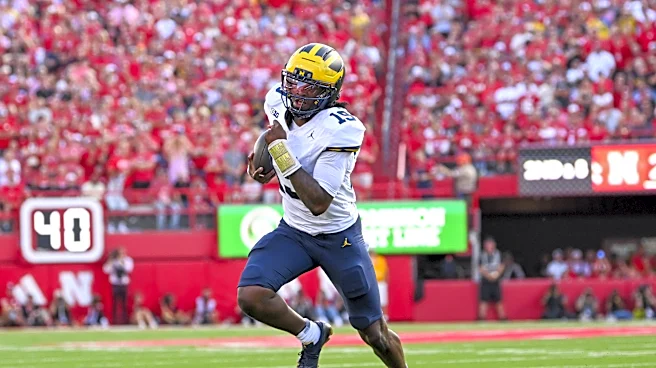




Last season proved to be a disappointing one for the Michigan offense, but we were at least able to see the team experiment with some things that can ultimately help improve the outlook for 2026. One of those experiments demonstrated that when Bryce Underwood runs the ball more, the offense’s upside is much greater.
For three games in 2025, Michigan was without head coach Sherrone Moore – against Central Michigan and Nebraska due to the school’s self-imposed suspension stemming from the Connor Stalions
Saga, and against Texas in the Citrus Bowl after he was fired for cause.
During those games, Michigan was under the leadership of Biff Poggi as the interim head coach. The team’s energy was different when Poggi was in charge, but the way it operated on the field was different too – particularly with the handling of Underwood and the offense.
With Poggi running the show, Underwood was trusted more, particularly on the ground. Against Central Michigan, Nebraska, and Texas, Underwood ran the ball for 114, 61, and 69 yards, respectively – his three highest rushing totals of the season. And in those games, Michigan scored 63, 27, and 27 points – three of the team’s highest scoring totals of the season
All year, Moore was hesitant to let Underwood use his rushing ability in-game, often citing the lack of reliable backup options Michigan had at quarterback and not wanting to put Underwood in harm’s way. There’s surely some validity in that, but by not allowing a dual-threat quarterback to actually be a dual-threat, it severely limited the offense’s upside and made life easier for opposing defenses.
By the end of 2025, Underwood’s ability as a thrower wasn’t up to the standard that many fans had hoped. But when that’s the only lens he’s viewed through, it puts a cap on what makes him a great all-around player. When he was given the freedom to run the ball, we saw some of the traits that had been talked about when he was a highly-regarded high school player – great speed, shiftiness, and good contact balance that make him tough to bring down.
Moore, Chip Lindsey, and the powers that ran the 2025 Michigan offense viewed him purely as a drop-back passer too often. Jason Beck and his offensive staff shouldn’t and likely won’t view him in the same light.
When you look through Beck’s resume as both a quarterbacks coach and as an offensive coordinator, the first thing that jumps out is the players that he’s worked with. The most notable of these is Taysom Hill, a quarterback from BYU who has made his name in the NFL doing pretty much everything other than throwing the ball. Hill had two full seasons as a starter in college, and in those seasons ran for a combined 1,947 yards while not being a great passer. Still, BYU’s offenses were highly productive with him as the starter.
Similarly, Beck oversaw Bryce Perkins at Virginia, another dual-threat quarterback who ran for 1,692 yards over the course of two years. And most recently, Beck has worked with Devon Dampier, who’s run for 2,001 yards over the last two seasons in Beck’s offenses at New Mexico and Utah.
Between the six seasons where Hill, Perkins, and Dampier were the starters for their respective teams, the team with the lowest scoring output was Virginia with Perkins in 2018 at 28.5 points per game – already better than the 27.5 points per game that Michigan posted last year. As you can see, Beck hasn’t just worked with running quarterbacks in the past – he’s been successful with them.
With Underwood, Beck now has another quarterback who fits the dual-threat mold. We just haven’t seen that yet because the previous coaching staff was too cautious with him. If this coaching staff chooses to lean into Underwood’s ability as a runner, it would undoubtedly add another element to the offense. And it wouldn’t merely be something that defenses would need to think about; it’s something that could truly stress them.
Based on Underwood’s limited sample size as a runner last season, he showed that his athleticism alone is helpful for picking up the occasional first down or for ripping off big chunk plays, but how that athleticism is incorporated into the offense matters as well.
For this, we can look at how Dampier was used last season as a case study. Of course, Dampier did plenty of his damage on scrambles when passing plays broke down, but Utah also used him in plenty of designed runs, including zone reads and midline options – plays that are particularly useful in the spread system Michigan will employ this year. Some more traditional draws and power runs were mixed in as well. Michigan shouldn’t be afraid to use Underwood similarly to how Dampier was used with Utah last year.
With Dampier running Beck’s system in 2025, Utah put up 41.3 points per game, all without him being exactly the most polished passer (2,450 passing yards, 63.5 completion percentage in 2025). That’s not to say Michigan can’t still expect growth from Underwood with his arm, but the coaching staff can still find a way to make the offense productive even without a quarterback that’s registering video game-like numbers through the air. Michigan’s staff was hoping for those big gains in the passing game in 2025, and when it didn’t get them, it chose not to try other options.
If Michigan wants its offense to take a big step forward in 2026, it needs to ensure that it’s using its players in ways that maximize their skills. Sure, it would be nice if Underwood were an elite thrower of the football, and that’s still not out of the realm of possibility for him, but his five-star pedigree from high school wasn’t only based on arm talent.
Beck and Koy Detmer Jr. will try to squeeze all the juice they can out of him over the next eight months, but they already have a great tool to work with that the previous staff never fully took advantage of.