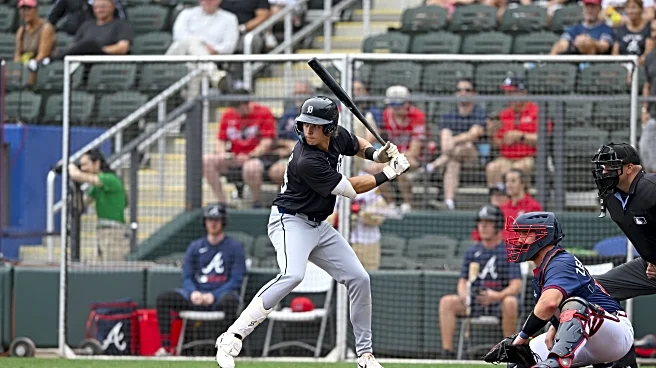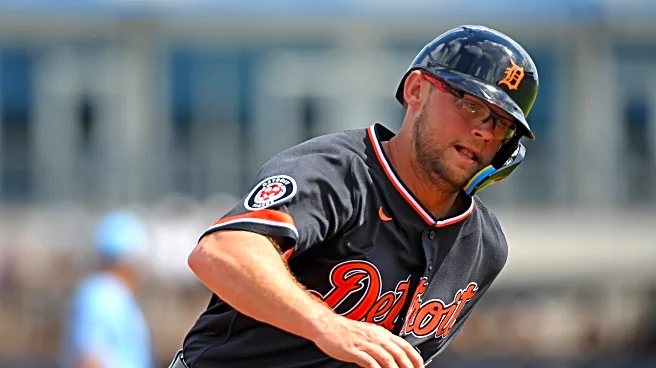



One element that makes the Detroit Tigers a lot more formidable than they were last year is the presence of near major league ready positional prospects. Last season they didn’t really have a prospect push to buoy them throughout the season, particularly in terms of hitters. One of their top hopes for depth in the infield this season is Max Anderson. After a breakout 2025 season at the Double-A level, he’s had a nice spring camp and looks the part of a quality hitting prospect who isn’t too far from
contributing to the Tigers’ efforts this season.
The 24-year-old right-handed hitter was the Tigers’ second rounder in the 2023 draft, selected right after they picked Max Clark and Kevin McGonigle with their first selections. The Tigers paid Anderson a hair less than $1.5 million to sign out of Nebraska, which saved them around $470K in signing bonus. Even better, it appears they got that pick correct.
Anderson doesn’t offer much in the way of athleticism, and is best suited to second base, but he can really hit. He raked in college, and he’s continued to be a high average, low strikeout hitter in the minor leagues. A second baseman by trade, Anderson has continued to improve his glove, footwork, and throwing during his time with the Tigers. The element that continues to hold him back is his lack of footspeed and range. Still, that’s not too dissimilar from Gleyber Torres’ defensive profile. So as long as Anderson hits, the Tigers will find a way to use him, whether at third base, first base, or at second in case of a Torres injury.
The knock on this profile is that while Anderson has plenty of juice and has popped numerous balls with plus exit velocities in his time in the minor leagues, he didn’t really hit for that much game power in his 2024 full season debut in A-ball. A free-swinger, hitting from a pretty deep crouch and without the flexibility to create good bat angles on pitches to all parts of the zone, Anderson has a tendency to let his hands do most of the work at the plate. To unlock his power potential, he needed to work on pulling more balls in the air, but he also needed to be a lot more selective in terms of what he’s swinging at as well, trying to get more pitches he can drive rather than just chasing off the plate on pitches he can slap the other way. In 2025, he made some strides in that direction.
In 405 plate appearances for the Double-A Erie SeaWolves, Anderson launched 14 home runs and hit .306/.358/.499. He struck out just 14.6 percent of the time, with a decent 6.9 percent walk rate as well. He moved up to Triple-A Toledo late in the season, and while his strikeouts spiked somewhat, he held his own, and added another five homers in 32 games to reach 19 long balls on the year. You couldn’t ask for too much more overall, though his numbers against left-handers were far better than his solid but modest .767 OPS against right-handed pitching. It also didn’t hurt that as predicted, Anderson and Kevin McGonigle faced much weaker pitching in the Arizona Fall League than they were used to seeing, and absolutely tore the place apart.
Anderson still hits the ball on the ground too much, but he improved in that regard compared to his 2024 debut and he also started pulling more balls to left field. He continues to show his plus hand-eye coordination in routinely getting the barrel on the ball, even on pitches where he was initially fooled. He didn’t abandon his crouch as some thought he might, but he did moderate it a bit, helping him to be more mobile in the box to catch balls out front, as opposed to letting everything travel deep with a heavy bias to the opposite field the way he did in his first pro season. Even better he did it without striking out any more, and even his late season run in Toledo showed a better than league average strikeout rate complete with sustained home run power.
It’s only 32 plate appearances of spring training work, but so far Anderson has held his own in spring camp. The stocky infielder is not going to get faster, but he’s otherwise continued to refine his defensive game and looks playable at both second and third base. We haven’t seen him cut down on the chase yet, but by hunting more pitches he can pull and drive early in counts, and then trusting his strong pure hitting ability deeper into an at-bat, he looks more and more like he’ll be a solid major league hitter who hits left-handers well in particular.
The final step for Max Anderson this season is to consolidate his gains and keep working on his zone discipline. Currently he isn’t on the 40-man roster, though he’ll be Rule 5 eligible next fall, and the Tigers don’t have an opening for him at second or third base. However, if this were a lower tier MLB roster Anderson would probably be going north with the team or looking at a debut in the spring. His more refined defensive game this spring has been a nice upgrade for him as well, and it’s worth mentioning that he also looks like a fairly attractive trade piece this season if required.
There’s a lot of pressure on Anderson to hit and to hit for solid power. He isn’t going to provide much value defensively or on the bases. However, he has cleaned up his all around game even more this offseason, and he shows a lot of signs that the bat will play enough to find at least a part-time role in the years ahead.
The Tigers have kept him in major league camp much of the spring, and it’s notable that he’s not on the Spring Breakout roster and seems likely to travel to Colorado for the club’s final two exhibition games of the spring calendar. He’ll head to Toledo beyond that, but on a team with a heavily left-handed infield group beyond 2026, there will be opportunities for a regular role as a lefty mashing infielder with a little positional versatility. A significant injury around the infield could open up a spot for him to make his debut this year. If not, one would expect that the Tigers will get him at least a look at the show sometime this summer when an opportunity comes along.