

In December of 2024, I wrote a Hogs Haven fanpost investigating Ben Sinnott’s lack of production during his rookie season. In the article, I referenced the classic edutainment game Where in the World is Carmen Sandiego? and analyzed the statistics and circumstances surrounding the second-round tight end’s exclusion from the offense. At the conclusion of the investigation, the mystery remained unsolved. Fast forward to the present, where an even greater conundrum now presents itself for the ACE detective
company. The entire tight end group is missing from Washington’s offense.
There’s a lot to investigate, so let’s dust off the magnifying glass and try to find the culprit.
Offensive Coordinator
Is David Blough not utilizing his tight ends enough? There were several articles written during the offseason hypothesizing that Blough would mirror Ben Johnson’s offense and use heavier personnel; with 12 and 13 looks, in fact, like I wrote one of them. Most thought we would see a mix in the neighborhood of 60% 12-personnel, 30% 11-personnel and right around 10% use of 13-personnel groupings. Were we all wrong?
Not completely. Below is Washington’s personnel usage through the first four weeks of the season, provided by SumerSports.
11 Personnel – 63.46%
12 Personnel – 21.92%
13 Personnel – 10%
As you can see, the amount of 12 personnel utilization so far was vastly overestimated and is flip-flopped with the rate of 11 personnel, but there seems to be multiple reasons for this distribution.
The first is Chigoziem Okonkwo’s hamstring injury, which sidelined him for much of the last three weeks. His absence did clear the way for Colson Yankoff — who shined in training camp this summer — to play more, and the undrafted free agent has played 23% of the total snaps so far this season. While developing, Yankoff just isn’t on the same level as Chig. He has only drawn four targets on 37 routes. Ben Sinnott currently leads the team in routes run by Washington’s tight ends with 49 but he’s last in targets with two and is already followed closely by Chig, who has 46 routes run with seven targets so far. We can expect those numbers to increase for Okonkwo when the Commanders host the Giants on Sunday.
Antonio Williams
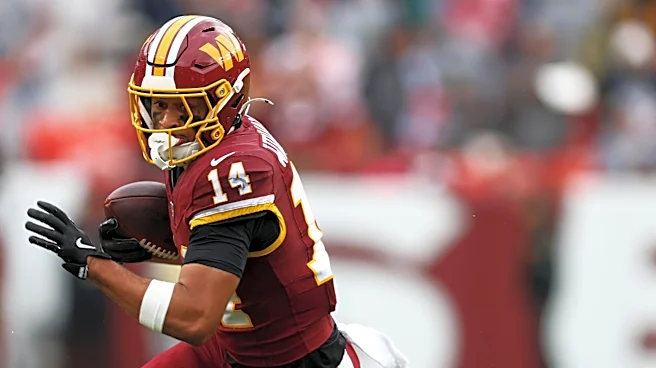
Another reason is the emergence of rookie wide receiver Antonio Williams. Considered pro-ready coming out of the college, Williams was incredibly effective right away and won the NFL Rookie of the Week in his debut. Williams has been close to hitting on several big plays, but untimely drops and penalties have negated them. It is hard to take a player like that off the field for the receiving talents of John Bates and Ben Sinnott. It will be interesting to see what their personnel usage looks like on Sunday versus the Giants, as Stefon Diggs has been ruled out and Chig will be a full go. However, in order to use more heavy personnel, Washington’s offense must become more effective at it.
Inefficient run game
As you can see from the graphic above, Washington’s offense hasn’t been particularly productive in either heavy (two or fewer WRs) or light groupings. They have an approximate 42% success rate out of both, with similar rates of explosive plays and EPA ratings. A big reason for that has been the ineffectiveness of the run game.
Looking at the table from SumerSports again, we can see additional heavy personnel is not making the run game more effective, as the EPA per rush is actually lower when using heavy personnel. Therein lies a big part of the problem.
The current group of tight ends, while talented, lacks players that can create separation the way Zach Ertz did during his time in Washington. The effectiveness of both Okonkwo and Sinnott depends on creating mismatches. One way of doing so is using heavy looks by forcing the team to honor the run with slower, bigger-bodied defenders that the more athletic tight ends can exploit in coverage. Since Washington does not have an effective running game, defensive coordinators aren’t being forced to deploy more linebackers and bigger hybrid players to stop it. You can see how effective teams with impressive rushers like Derrick Henry, Bijan Robinson and James Cook have been out of heavy sets this season. To be multiple out of the same look, you must have a balanced attack and use the run game to set up play-action.
Play-action is critical to the success of tight ends like Sinnott. As the second-round tight end said during the offseason, he is better in an offense that uses outside zone play-action or other misdirection in order to create plays.
Without the running game play-action is not very effective. Washington has gone away from it early as they struggle to generate a rushing attack with their running backs. Per ESPN’s John Keim, Washington ranks 19th in play-action pass attempts, a number that many thought would be higher this season. While Okonkwo has the ability to get open in the short underneath, more play-action would allow him to use his speed to stretch the field vertically. But, in order to sell it, the team needs to be able to rush the ball effectively. Perhaps the return of Austin Ekeler running behind guard Sam Cosmi and newly appointed starting center Lucas Patrick will ignite the running game and allow Blough to utilize more play-action to create plays like this one.
Injuries
Finally, Washington just hasn’t had all their talent on the field at the same time. When Chig did return against the Colts, the majority of his snaps were played with seventh-round selection Athan Kaliakmanis behind center. The rookie quarterback was under siege and didn’t have time to find Okonkwo on several open looks in Week 4.
To close our case, the real culprit behind the disappearance of the Washington Commanders’ tight ends has been the personnel, but not entirely those in the tight end room. Either due to injuries or performance, Blough hasn’t had the players to run the offense the way he prefers on game days. Starting on Sunday, with the return of several key players including quarterback Jayden Daniels and Cosmi, the rookie offensive coordinator could get his first chance to change that since Week 1. We will see if that means the return of the tight end to Washington’s offense.